Leadership Presentation Skills: Turning Ideas into Influence and Action

Leadership Presentation Skills: Turning Ideas into Influence and Action

Table of Content

Read summarized version with

TLDR | 3 Executive Actions for Leaders

Structure ideas to reduce cognitive load and improve decision clarity
Signal composure to strengthen credibility under pressure
Design communication to guide interpretation, not just deliver information

Before a presentation earns approval, alignment, or action, it passes a silent test not of confidence or effort, but of clarity.

In most professional environments, ideas do not fail because they lack intelligence. They fail because they arrive unstructured, overloaded, or poorly framed. The slides may be detailed, the speaker may be prepared, and the data may be accurate, yet the outcome remains unchanged. Decisions stall, questions multiply, and momentum fades.

This happens because audiences are not evaluating how much you know. They are evaluating how easily they can understand, trust, and act on what you are saying.

At senior levels, this distinction becomes critical. A presentation is not simply a delivery of information. It is a moment where thinking is tested in real time. If the message increases cognitive effort, it reduces decision confidence. If it simplifies understanding, it accelerates alignment.

This is where presentation skills move beyond technique and become a leadership capability. They determine whether your ideas translate into influence and action or remain intellectually sound but practically ignored.

Why Presentation Skills Shape Decisions at Senior Levels

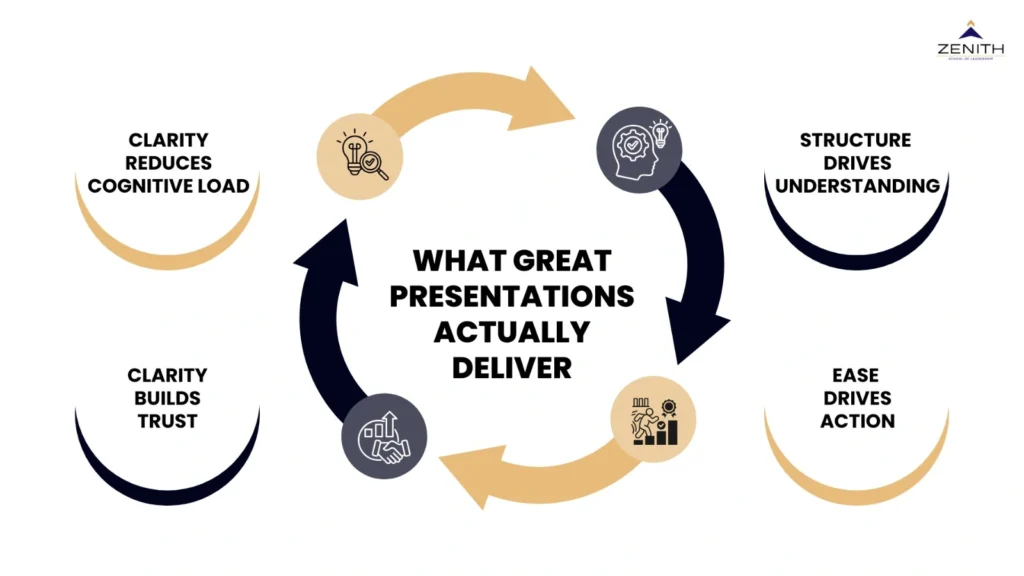
What great presentations actually deliver framework for senior professionals by Zenith School of Leadership

At senior levels, presentations are not information sharing events. They are decision-shaping moments that influence how strategy is understood, how confidently decisions are made, and how quickly alignment is achieved.

Research in cognitive psychology shows a consistent pattern: when information is poorly structured, cognitive load increases. As cognitive load rises, comprehension drops and decision-making slows. Even strong ideas begin to feel complex, uncertain, or difficult to act upon.

The implication is direct. The quality of your thinking alone is not enough. The structure of your communication determines whether that thinking creates impact.

Two professionals may present the same idea. One creates clarity, alignment, and forward movement. The other creates discussion, ambiguity, and delay. The difference is rarely intelligence. It is structure and delivery discipline.

The Real Risk: When Presentations Create Cognitive Overload

Presentation skills that accelerate results framework for senior professionals by Zenith School of Leadership

Most presentations fail in a predictable way. They attempt to communicate too much, too quickly, without sufficient structure.

This creates cognitive overload.

Cognitive overload begins when the audience receives more information than it can process in real time. Attention fragments, interpretation becomes inconsistent, and key messages are lost. The presenter may continue speaking, but the audience has already disengaged mentally.

Leaders often respond by adding more slides, more data, or more explanation. However, more content does not resolve overload. It intensifies it.

What restores clarity is not more information. It is a better structure. Strong presentation skills reduce cognitive load before it begins to affect decision quality.

A high-stakes scenario to understand Cognitive Overload

During the Apollo 11 Moon Landing, communication between astronauts and mission control had to be precise, structured, and immediately actionable. As the spacecraft approached the lunar surface, fuel levels were critically low and the margin for error was minimal.

There was no room for long explanations or ambiguity. Instructions were delivered in short, structured sequences clear enough to be understood instantly and acted upon without hesitation.

This discipline ensured that actions were executed correctly, decisions were made quickly, and errors were minimized under extreme pressure.

The context may be different, but the principle remains the same inside organizations. When stakes are high, clarity is not optional. It directly determines how effectively people can think, decide, and act.

Why Structure Determines Influence and Strengthens Presentation Skills

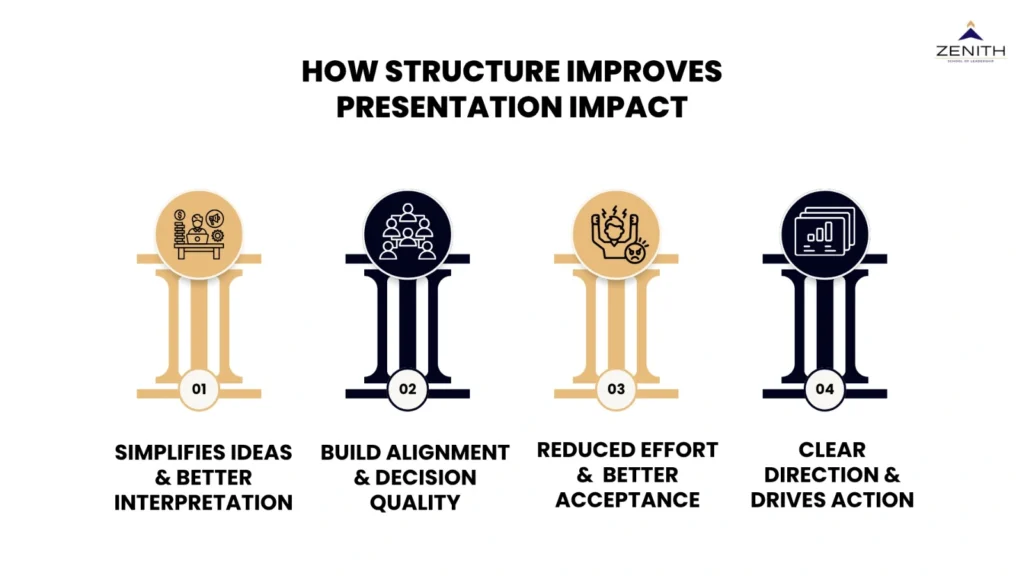
How structure improves presentation impact framework for senior professionals by Zenith School of Leadership

Many professionals believe influence comes from strong ideas, confident delivery, or compelling visuals. These factors matter, but they are not sufficient.

Influence is ultimately driven by how easily an audience can process and act on a message.

When structure is clear, ideas feel sharper, decisions feel easier, and confidence increases. When structure is weak, ideas feel complex, decisions feel risky, and hesitation increases. This is why strong presenters do not rely on volume or detail. They rely on structured clarity.

Clarity reduces effort. Reduced effort increases acceptance. Acceptance drives action.

In practice, this means presentation skills are built through a few disciplined shifts. It begins with structuring thinking before building slides. Instead of starting with content, the focus shifts to clarifying what the audience needs to understand, what decision needs to be made, and what matters most.

From there, reducing cognitive load becomes critical. Simplifying without losing meaning using fewer ideas, clearer sequencing, and shorter explanations creates stronger impact than dense information.

Equally important is signaling composure. Authority is communicated through steadiness, controlled pacing, intentional pauses, and clear language. These cues shape how the message is received as much as what is being said.

Finally, every presentation must drive decision clarity. It should answer one critical question: what should happen next? Without this, even well-structured presentations lose their impact.

A Simple Framework and Habit That Strengthens Presentation Clarity

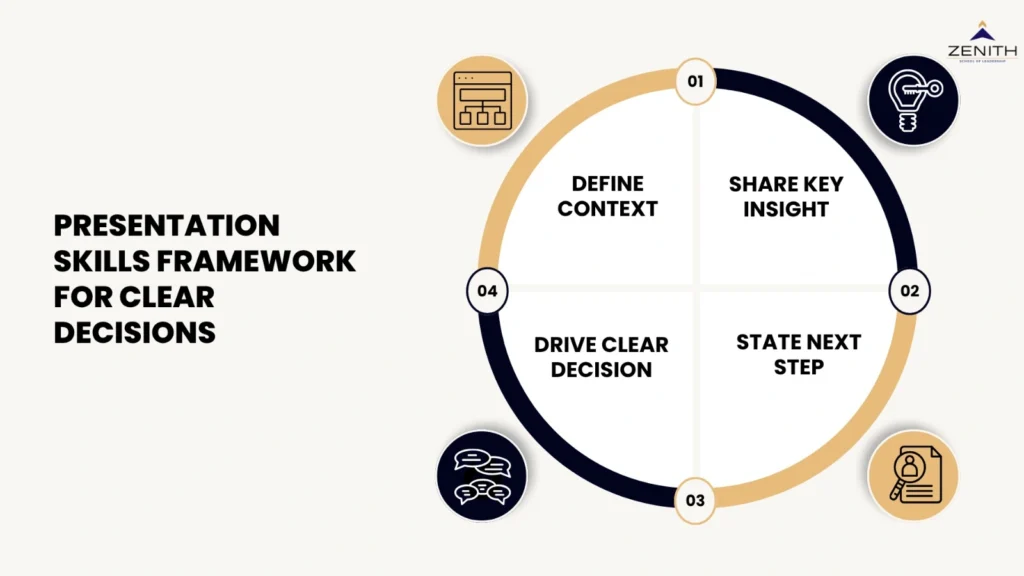
Presentation skills framework for clear decisions for senior professionals by Zenith School of Leadership

One of the most effective ways to improve presentation clarity is to structure thinking through four elements:

Context — What is happening
Insight — What this means
Decision — What needs to happen
Next Step — What action follows

This structure makes ideas easier to follow, aligns interpretation across stakeholders, and accelerates decision-making. It is especially useful in leadership presentations, business reviews, and strategic discussions where clarity directly impacts outcomes.

To reinforce this structure in practice, a simple habit can make a significant difference.

Before any presentation, define one sentence clearly:
“After this presentation, the audience should decide ______.”

This shifts how content is structured, how key points are delivered, and how outcomes are guided.

For the next seven days, take it one step further by beginning every presentation with:
“The key decision from this discussion is ______.”

This small discipline anchors attention early, reduces ambiguity, and creates immediate alignment. Over time, it leads to fewer clarification questions, faster decisions, and stronger follow-through.

Clarity at the start reduces confusion at the end.

Final Thought

In professional environments, ideas do not compete on intelligence alone. They compete on clarity.

The most effective leaders are not those who speak the most. They are those who make understanding easier, decisions clearer, and action faster.

That is what strong presentation skills enable.

And in moments where decisions matter, clarity becomes an influence.

Unlock your first coaching session →

Book Your 1-on-1 Session

Table of Content

Read summarized version with

TLDR | 3 Executive Actions for Leaders

Structure ideas to reduce cognitive load and improve decision clarity
Signal composure to strengthen credibility under pressure
Design communication to guide interpretation, not just deliver information

Before a presentation earns approval, alignment, or action, it passes a silent test not of confidence or effort, but of clarity.

In most professional environments, ideas do not fail because they lack intelligence. They fail because they arrive unstructured, overloaded, or poorly framed. The slides may be detailed, the speaker may be prepared, and the data may be accurate, yet the outcome remains unchanged. Decisions stall, questions multiply, and momentum fades.

This happens because audiences are not evaluating how much you know. They are evaluating how easily they can understand, trust, and act on what you are saying.

At senior levels, this distinction becomes critical. A presentation is not simply a delivery of information. It is a moment where thinking is tested in real time. If the message increases cognitive effort, it reduces decision confidence. If it simplifies understanding, it accelerates alignment.

This is where presentation skills move beyond technique and become a leadership capability. They determine whether your ideas translate into influence and action or remain intellectually sound but practically ignored.

Why Presentation Skills Shape Decisions at Senior Levels

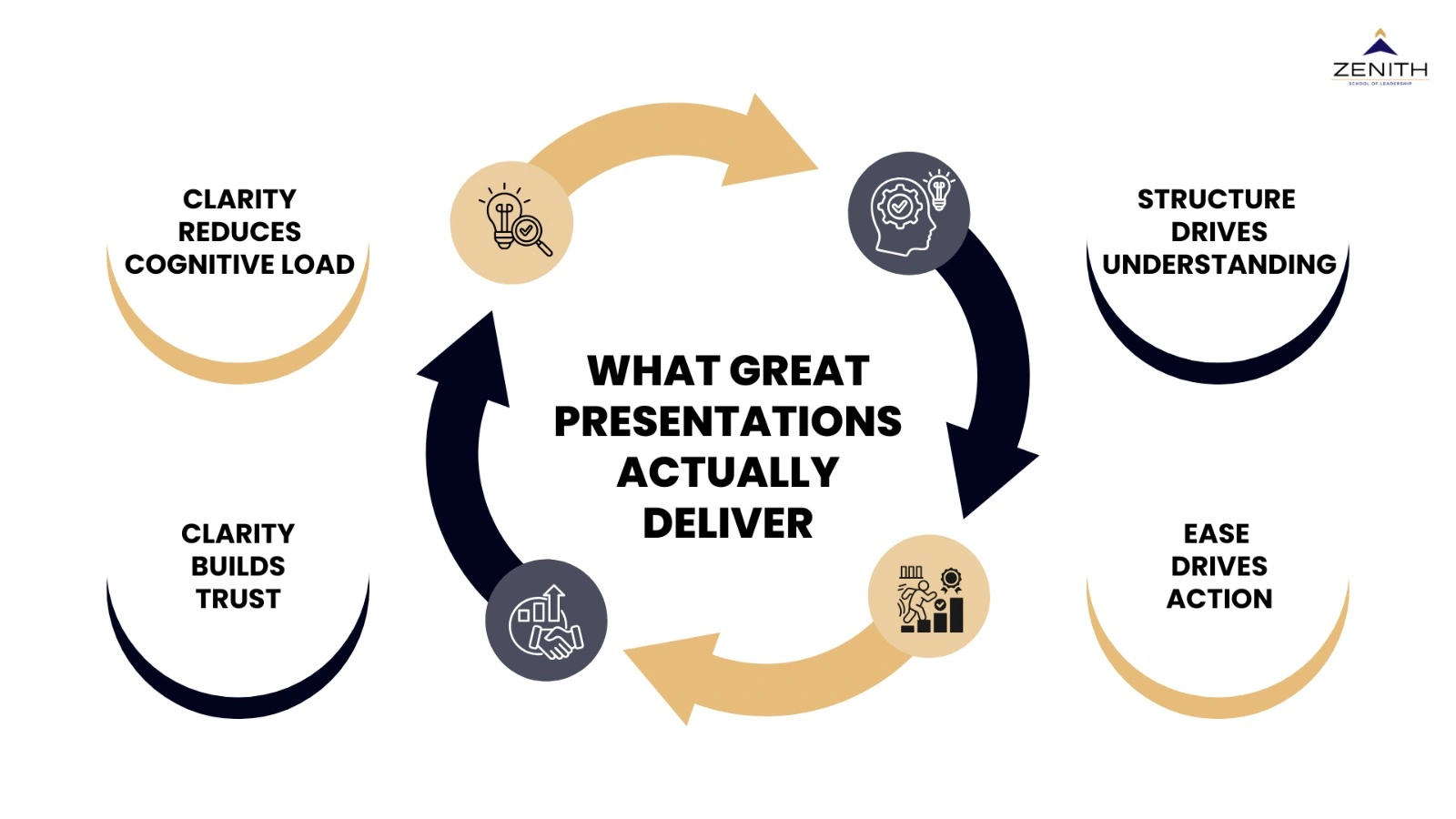
What great presentations actually deliver framework for senior professionals by Zenith School of Leadership

At senior levels, presentations are not information sharing events. They are decision-shaping moments that influence how strategy is understood, how confidently decisions are made, and how quickly alignment is achieved.

Research in cognitive psychology shows a consistent pattern: when information is poorly structured, cognitive load increases. As cognitive load rises, comprehension drops and decision-making slows. Even strong ideas begin to feel complex, uncertain, or difficult to act upon.

The implication is direct. The quality of your thinking alone is not enough. The structure of your communication determines whether that thinking creates impact.

Two professionals may present the same idea. One creates clarity, alignment, and forward movement. The other creates discussion, ambiguity, and delay. The difference is rarely intelligence. It is structure and delivery discipline.

The Real Risk: When Presentations Create Cognitive Overload

Presentation skills that accelerate results framework for senior professionals by Zenith School of Leadership

Most presentations fail in a predictable way. They attempt to communicate too much, too quickly, without sufficient structure.

This creates cognitive overload.

Cognitive overload begins when the audience receives more information than it can process in real time. Attention fragments, interpretation becomes inconsistent, and key messages are lost. The presenter may continue speaking, but the audience has already disengaged mentally.

Leaders often respond by adding more slides, more data, or more explanation. However, more content does not resolve overload. It intensifies it.

What restores clarity is not more information. It is a better structure. Strong presentation skills reduce cognitive load before it begins to affect decision quality.

A high-stakes scenario to understand Cognitive Overload

During the Apollo 11 Moon Landing, communication between astronauts and mission control had to be precise, structured, and immediately actionable. As the spacecraft approached the lunar surface, fuel levels were critically low and the margin for error was minimal.

There was no room for long explanations or ambiguity. Instructions were delivered in short, structured sequences clear enough to be understood instantly and acted upon without hesitation.

This discipline ensured that actions were executed correctly, decisions were made quickly, and errors were minimized under extreme pressure.

The context may be different, but the principle remains the same inside organizations. When stakes are high, clarity is not optional. It directly determines how effectively people can think, decide, and act.

Why Structure Determines Influence and Strengthens Presentation Skills

How structure improves presentation impact framework for senior professionals by Zenith School of Leadership

Many professionals believe influence comes from strong ideas, confident delivery, or compelling visuals. These factors matter, but they are not sufficient.

Influence is ultimately driven by how easily an audience can process and act on a message.

When structure is clear, ideas feel sharper, decisions feel easier, and confidence increases. When structure is weak, ideas feel complex, decisions feel risky, and hesitation increases. This is why strong presenters do not rely on volume or detail. They rely on structured clarity.

Clarity reduces effort. Reduced effort increases acceptance. Acceptance drives action.

In practice, this means presentation skills are built through a few disciplined shifts. It begins with structuring thinking before building slides. Instead of starting with content, the focus shifts to clarifying what the audience needs to understand, what decision needs to be made, and what matters most.

From there, reducing cognitive load becomes critical. Simplifying without losing meaning using fewer ideas, clearer sequencing, and shorter explanations creates stronger impact than dense information.

Equally important is signaling composure. Authority is communicated through steadiness, controlled pacing, intentional pauses, and clear language. These cues shape how the message is received as much as what is being said.

Finally, every presentation must drive decision clarity. It should answer one critical question: what should happen next? Without this, even well-structured presentations lose their impact.

A Simple Framework and Habit That Strengthens Presentation Clarity

Presentation skills framework for clear decisions for senior professionals by Zenith School of Leadership

One of the most effective ways to improve presentation clarity is to structure thinking through four elements:

Context — What is happening
Insight — What this means
Decision — What needs to happen
Next Step — What action follows

This structure makes ideas easier to follow, aligns interpretation across stakeholders, and accelerates decision-making. It is especially useful in leadership presentations, business reviews, and strategic discussions where clarity directly impacts outcomes.

To reinforce this structure in practice, a simple habit can make a significant difference.

Before any presentation, define one sentence clearly:
“After this presentation, the audience should decide ______.”

This shifts how content is structured, how key points are delivered, and how outcomes are guided.

For the next seven days, take it one step further by beginning every presentation with:
“The key decision from this discussion is ______.”

This small discipline anchors attention early, reduces ambiguity, and creates immediate alignment. Over time, it leads to fewer clarification questions, faster decisions, and stronger follow-through.

Clarity at the start reduces confusion at the end.

Final Thought

In professional environments, ideas do not compete on intelligence alone. They compete on clarity.

The most effective leaders are not those who speak the most. They are those who make understanding easier, decisions clearer, and action faster.

That is what strong presentation skills enable.

And in moments where decisions matter, clarity becomes an influence.
Unlock your first coaching session →

Book Your 1-on-1 Session