
Leadership Communication Strategies That Motivate Employees: Turning Direction into Ownership
- April 17, 2026
- Gurleen Kaur
Leadership Communication Strategies That Motivate Employees: Turning Direction into Ownership
- April 17, 2026
- Gurleen Kaur
Table of Content
Read summarized version with
TL;DR
- Connect tasks to meaningful contribution outcomes
People don’t commit to tasks they commit to impact. When work is tied to visible outcomes, effort becomes ownership. - Stabilize priority signals to maintain motivation consistency
When priorities shift, motivation fragments. Consistent signals create focus, trust, and sustained performance. - Provide behaviourally clear direction when urgency increases
In high pressure moments, clarity beats explanation. Precise, actionable communication drives immediate alignment and execution.
Most leaders do not lose motivation in their teams because of weak incentives, poor talent, or lack of clarity in tasks. The decline begins in a far less visible way.
The work continues. Deadlines are met. Meetings happen on time. On the surface, nothing appears broken. Yet underneath, something important starts to shift. Initiative becomes selective, ownership becomes conditional, and energy becomes uneven.
This is the point where many leaders misdiagnose the problem. They increase monitoring, repeat instructions, and reinforce urgency. Activity increases, but the pattern does not correct itself.
Because the issue is not execution. It is an interpretation.
Employees are not only asking what needs to be done. They are continuously evaluating something deeper whether their effort actually matters.
This is where leadership communication strategies become decisive. Motivation does not decline when work becomes harder. It declines when work loses visible meaning. And meaning is not assumed. It is communicated.
Why Meaning, Not Instructions, Drives Motivation
At senior levels, motivation is rarely driven by incentives alone. Research across organizational psychology consistently shows that perceived task significance is one of the strongest drivers of sustained effort. Frameworks such as the Job Characteristics Model reinforce that meaning and impact directly influence engagement and performance consistency.
The implication is practical.
Employees do not respond to tasks in isolation. They respond to what those tasks represent. Two identical assignments can produce very different levels of effort depending on how they are communicated. One feels like routine execution, while the other feels like contribution to something that matters.
The difference is not the task. It is the interpretive frame created by communication.
When leaders clarify why the work matters, what outcome it enables, and how it connects to a larger direction, effort becomes internally reinforced. When that connection is missing, effort becomes mechanical, short-term, and inconsistent.
This is why leadership communication clarity is not a soft capability. It is a performance driver.
When Meaning Starts Drifting, Motivation Becomes Unstable
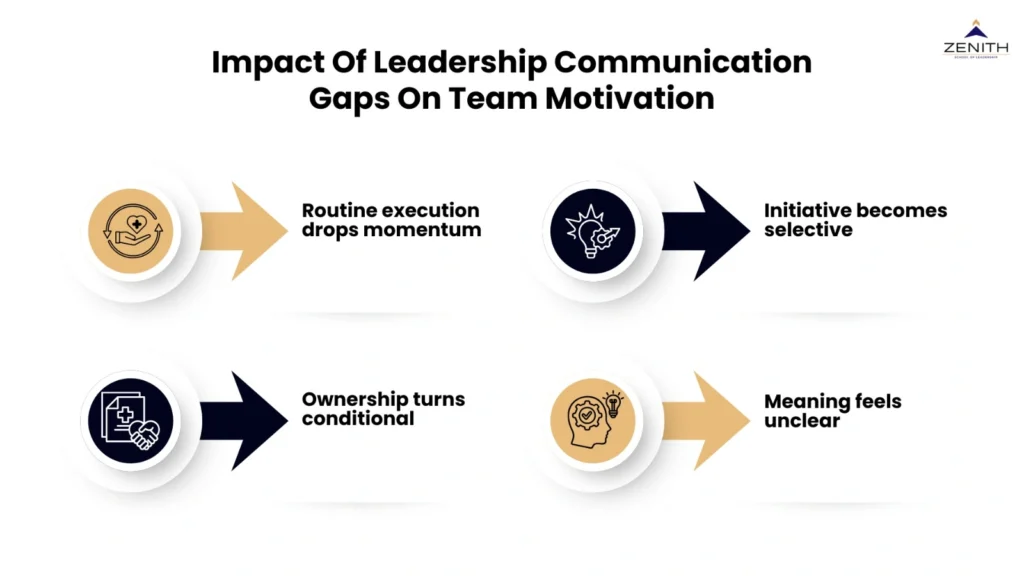
In most organizations, motivation does not collapse suddenly. It gradually becomes unstable. This happens through what can be described as meaning drift.
Meaning drift begins when the perceived importance of work starts shifting across individuals and teams. The message is shared and the task is assigned, but interpretation varies. One employee sees urgency, another sees routine work. One invests extra effort, another does the minimum required.
Over time, this creates inconsistent ownership, uneven performance quality, and reduced initiative across the system.
Leaders often respond by increasing communication volume. The instinct is understandable, but it rarely solves the problem. When meaning is unstable, more communication often amplifies confusion rather than reducing it.
What restores motivation is not more messaging. It has a clearer meaning. Strong communication skills reduce meaning drift before it spreads.
A High-Pressure situation where communication had to work instantly.
During the US Airways Flight 1549 emergency landing, the aircraft lost both engines shortly after takeoff. The situation was unfolding rapidly, leaving no time for long explanations or detailed instructions.
Inside the cabin, passengers were uncertain and under extreme stress. In that moment, communication became the primary tool for survival.
Flight attendants did not attempt to explain the situation. They did not describe what had happened or what might happen next. Instead, they focused entirely on behaviour.
Their instructions were short, direct, and repeated with urgency:
“Brace. Brace. Heads down. Stay down.”
There was no excess language, no softening of the message, and no informational overload. Only clarity that could be acted upon immediately.
This worked because it reduced cognitive delay, eliminated interpretation ambiguity, and converted instruction into immediate action. It stabilized behaviour in a moment where hesitation could have been costly.
The pattern applies inside organizations as well. The stakes may be different, but the principle remains the same. When communication is clear, behaviour aligns faster. When it is not, hesitation increases even among capable people.
Why Meaning Converts Effort into Ownership
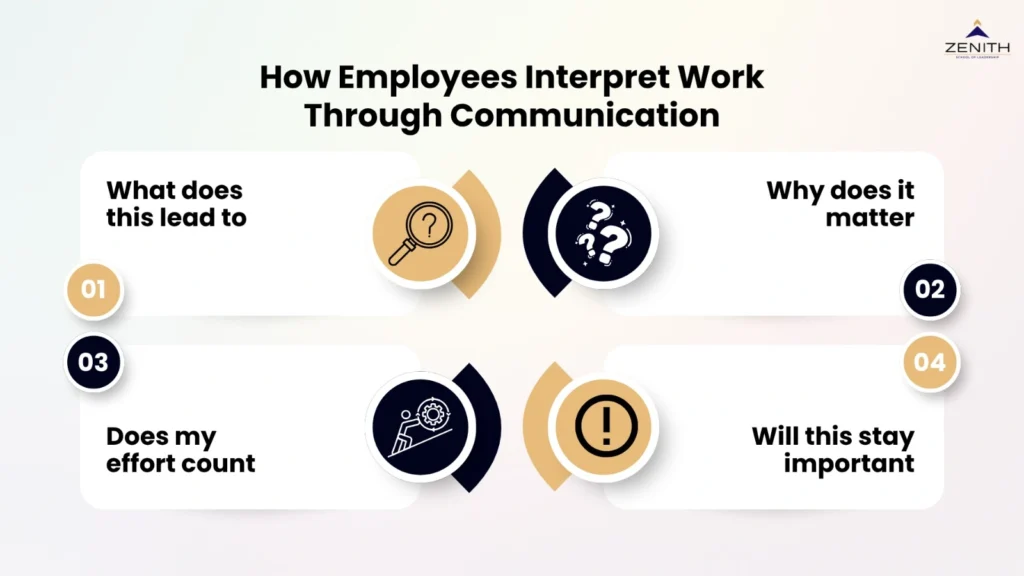
Employees do not evaluate effort in isolation. They evaluate it through perceived significance.
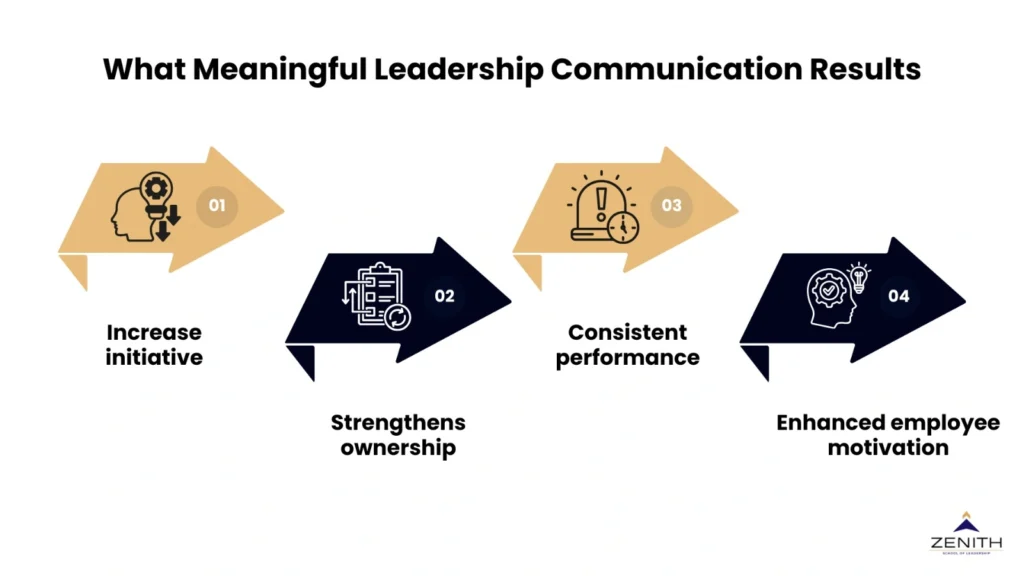
When meaning is stable, initiative increases, ownership strengthens, and performance becomes consistent. When meaning is unclear, effort becomes minimal, initiative reduces, and motivation fluctuates.
This is why high-performing leaders communicate differently. They do not only define what needs to be done. They define why the effort matters.
Because meaning converts compliance into commitment, and commitment sustains motivation.
The Communication Signals That Shape Ownership
Communication Intelligence explains why motivation depends on meaning visibility.
Employees interpret leadership communication through three underlying signals: relevance clarity, importance stability, and contribution visibility. They are continuously assessing whether the work matters, whether it will continue to matter, and whether their effort makes a difference.
When these signals are consistently clear, ownership increases, discretionary effort rises, and engagement becomes self-driven. When these signals are inconsistent, effort becomes cautious, initiative becomes selective, and motivation becomes situational.
This is why motivation is not created through pressure alone. It stabilizes when meaning remains clear and consistent.
Motivation weakens when communication leaves too much room for interpretation.
When tasks are assigned without explaining their relevance, initiative drops and engagement becomes inconsistent. When priorities shift frequently, confidence in direction weakens and ownership becomes cautious. When urgency is overused, fatigue increases and intrinsic motivation declines. When leaders assume people already understand importance, effort becomes misaligned and commitment reduces.
These patterns are subtle, but their impact compounds over time. Strong communication restores clarity by making meaning visible and stable.
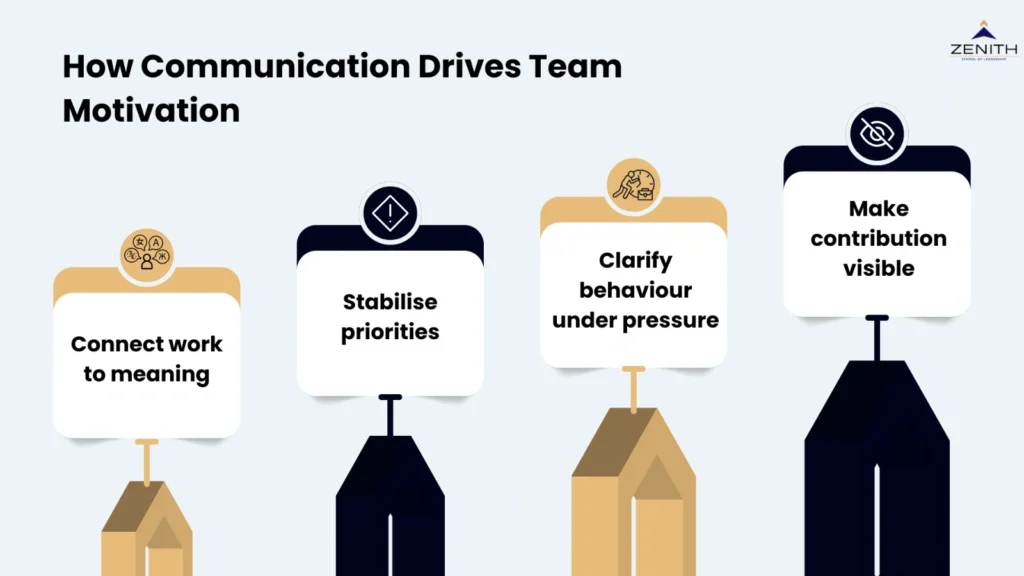
Leaders strengthen motivation when they explicitly connect effort with relevance. Instead of assuming people understand why work matters, they make it clear what outcome the effort enables and how it supports the broader direction.
They also maintain stable importance signals. When priorities are reinforced consistently, people gain confidence in where to invest their effort.
And when pressure increases, they shift to behavioural clarity. Language becomes shorter, direction becomes sharper, and abstraction is reduced. This improves response speed and reduces hesitation.

A Simple Structure That Strengthens Motivation Consistency
High-performing leaders consistently anchor meaning through four elements: task, meaning, contribution, and ownership.
They clarify what must be done, why it matters now, what success enables, and who influences the outcome. This structure reduces interpretive effort and strengthens alignment, ownership, and execution consistency.
It is especially effective in team discussions, performance conversations, change communication, and strategic initiatives.
A Simple Leadership Habit That Strengthens Clarity and Alignment
Before assigning any important task or starting a key interaction, define one simple line:
“This task matters because it directly improves ______.”
“The impact of completing this successfully is ______.”
Used consistently, this small shift changes how people interpret their work. It makes relevance visible, aligns attention early, and reduces ambiguity before execution begins.
Over time, leaders begin to notice stronger initiative, better follow-through, fewer clarification loops, and reduced need for reminders. Teams align faster because they are not just working, they are working with the same understanding.
Clarity at the start reduces confusion at the end.
Why keep proving yourself silently? Step into influence that gets recognized.
- 1:1 Strategy Session for precision diagnosis of communication gaps
- Defined Success Signals to align perception with performance
- Interpretation Clarity to eliminate misunderstanding at leadership level
- Executive Presence Framing to strengthen how your value is perceived
- Leverage Mapping to unlock high-impact visibility and influence
- Invitation-Only Access for professionals ready for next-level growth
Final Thought
Leadership influence is not determined by how clearly instructions are given. It is determined by how clearly people understand why their effort matters.
The most effective leaders do not rely on pressure, repetition, or incentives alone. They use leadership communication strategies that connect effort to meaning, stabilize interpretation, and convert direction into ownership.
In environments where sustained performance matters, that clarity becomes a decisive advantage.
Composure is a choice you keep making while you speak.
Hold your pace. Shorten your sentences. Place one deliberate pause after your outcome line. That pause is where gravitas becomes felt.
A useful self test while speakin. Can I hear control in my own voice?
3. Name the Risk
Do not let the audience guess what is at stake. Don’t avoid naming the issue. Name the tradeoff so clearly that the unsurfaced tension also becomes manageable.
Examples:
- The tradeoff here is speed versus certainty.
- The risk is not the cost. The risk is delay.
- This decision protects customer trust while we accelerate delivery.
4. Close with Commitment
End with a commitment the group can agree to. A commitment is stronger than a conclusion because it creates action.
Examples:
- If we are aligned, the commitment for this week is X.
- The next step we can commit to today is Y.
- If we agree on the outcome, this is the decision we lock now.
FAQs
They are structured ways of communicating that connect tasks with meaning, improving ownership, engagement, and performance consistency.
Because instructions without relevance clarity reduce perceived importance, making effort feel mechanical rather than meaningful.
They make contributions visible, stabilize priorities, and reduce interpretation gaps, increasing initiative and ownership behaviour.
Assigning tasks without explaining why they matter, leading to reduced engagement and inconsistent effort.
Yes. When meaning remains visible and stable, employees sustain higher levels of ownership and discretionary effort over time.
Through Gurleen Ma’am’s guidance, I learned to lead with empathy and clarity.Today, I’m heard, respected, and deeply connected with my team.

Sireesha Manyam
Technical Lead | Microsoft
Table of Content
Read summarized version with
TLDR | 3 Executive Actions for Leaders
- Connect tasks to meaningful contribution outcomes
- Stabilize priority signals to maintain motivation consistency
- Provide behaviourally clear direction when urgency increases
Most leaders do not lose motivation in their teams because of weak incentives, poor talent, or lack of clarity in tasks. The decline begins in a far less visible way.
The work continues. Deadlines are met. Meetings happen on time. On the surface, nothing appears broken. Yet underneath, something important starts to shift. Initiative becomes selective, ownership becomes conditional, and energy becomes uneven.
This is the point where many leaders misdiagnose the problem. They increase monitoring, repeat instructions, and reinforce urgency. Activity increases, but the pattern does not correct itself.
Because the issue is not execution. It is an interpretation.
Employees are not only asking what needs to be done. They are continuously evaluating something deeper whether their effort actually matters.
This is where leadership communication strategies become decisive. Motivation does not decline when work becomes harder. It declines when work loses visible meaning. And meaning is not assumed. It is communicated.
Why Meaning, Not Instructions, Drives Motivation
At senior levels, motivation is rarely driven by incentives alone. Research across organizational psychology consistently shows that perceived task significance is one of the strongest drivers of sustained effort. Frameworks such as the Job Characteristics Model reinforce that meaning and impact directly influence engagement and performance consistency.
The implication is practical.
Employees do not respond to tasks in isolation. They respond to what those tasks represent. Two identical assignments can produce very different levels of effort depending on how they are communicated. One feels like routine execution, while the other feels like contribution to something that matters.
The difference is not the task. It is the interpretive frame created by communication.
When leaders clarify why the work matters, what outcome it enables, and how it connects to a larger direction, effort becomes internally reinforced. When that connection is missing, effort becomes mechanical, short-term, and inconsistent.
This is why leadership communication clarity is not a soft capability. It is a performance driver.
When Meaning Starts Drifting, Motivation Becomes Unstable
In most organizations, motivation does not collapse suddenly. It gradually becomes unstable.
This happens through what can be described as meaning drift.
Meaning drift begins when the perceived importance of work starts shifting across individuals and teams. The message is shared and the task is assigned, but interpretation varies. One employee sees urgency, another sees routine work. One invests extra effort, another does the minimum required.
Over time, this creates inconsistent ownership, uneven performance quality, and reduced initiative across the system.
Leaders often respond by increasing communication volume. The instinct is understandable, but it rarely solves the problem. When meaning is unstable, more communication often amplifies confusion rather than reducing it.
What restores motivation is not more messaging. It has a clearer meaning.
Strong communication skills reduce meaning drift before it spreads.
A high-pressure situation where communication had to work instantly.
During the US Airways Flight 1549 emergency landing, the aircraft lost both engines shortly after takeoff. The situation was unfolding rapidly, leaving no time for long explanations or detailed instructions.
Inside the cabin, passengers were uncertain and under extreme stress. In that moment, communication became the primary tool for survival.
Flight attendants did not attempt to explain the situation. They did not describe what had happened or what might happen next. Instead, they focused entirely on behaviour.
Their instructions were short, direct, and repeated with urgency:
“Brace. Brace. Heads down. Stay down.”
There was no excess language, no softening of the message, and no informational overload. Only clarity that could be acted upon immediately.
This worked because it reduced cognitive delay, eliminated interpretation ambiguity, and converted instruction into immediate action. It stabilized behaviour in a moment where hesitation could have been costly.
The pattern applies inside organizations as well. The stakes may be different, but the principle remains the same. When communication is clear, behaviour aligns faster. When it is not, hesitation increases even among capable people.
Why Meaning Converts Effort into Ownership
Employees do not evaluate effort in isolation. They evaluate it through perceived significance.
When meaning is stable, initiative increases, ownership strengthens, and performance becomes consistent. When meaning is unclear, effort becomes minimal, initiative reduces, and motivation fluctuates.
This is why high-performing leaders communicate differently. They do not only define what needs to be done. They define why the effort matters.
Because meaning converts compliance into commitment, and commitment sustains motivation.
The Communication Signals That Shape Ownership
Communication Intelligence explains why motivation depends on meaning visibility.
Employees interpret leadership communication through three underlying signals: relevance clarity, importance stability, and contribution visibility. They are continuously assessing whether the work matters, whether it will continue to matter, and whether their effort makes a difference.
When these signals are consistently clear, ownership increases, discretionary effort rises, and engagement becomes self-driven. When these signals are inconsistent, effort becomes cautious, initiative becomes selective, and motivation becomes situational.
This is why motivation is not created through pressure alone. It stabilizes when meaning remains clear and consistent.
Motivation weakens when communication leaves too much room for interpretation.
When tasks are assigned without explaining their relevance, initiative drops and engagement becomes inconsistent. When priorities shift frequently, confidence in direction weakens and ownership becomes cautious. When urgency is overused, fatigue increases and intrinsic motivation declines. When leaders assume people already understand importance, effort becomes misaligned and commitment reduces.
These patterns are subtle, but their impact compounds over time.
Strong communication restores clarity by making meaning visible and stable.
Leaders strengthen motivation when they explicitly connect effort with relevance. Instead of assuming people understand why work matters, they make it clear what outcome the effort enables and how it supports the broader direction.
They also maintain stable importance signals. When priorities are reinforced consistently, people gain confidence in where to invest their effort.
And when pressure increases, they shift to behavioural clarity. Language becomes shorter, direction becomes sharper, and abstraction is reduced. This improves response speed and reduces hesitation.
A Simple Structure That Strengthens Motivation Consistency
High-performing leaders consistently anchor meaning through four elements: task, meaning, contribution, and ownership.
They clarify what must be done, why it matters now, what success enables, and who influences the outcome. This structure reduces interpretive effort and strengthens alignment, ownership, and execution consistency.
It is especially effective in team discussions, performance conversations, change communication, and strategic initiatives.
A Simple Leadership Habit That Strengthens Clarity and Alignment
Before assigning any important task or starting a key interaction, define one simple line:
“This task matters because it directly improves ______.”
“The impact of completing this successfully is ______.”
Used consistently, this small shift changes how people interpret their work. It makes relevance visible, aligns attention early, and reduces ambiguity before execution begins.
Over time, leaders begin to notice stronger initiative, better follow-through, fewer clarification loops, and reduced need for reminders. Teams align faster because they are not just working—they are working with the same understanding.
Clarity at the start reduces confusion at the end.
Final Thought
Leadership influence is not determined by how clearly instructions are given. It is determined by how clearly people understand why their effort matters.
The most effective leaders do not rely on pressure, repetition, or incentives alone. They use leadership communication strategies that connect effort to meaning, stabilize interpretation, and convert direction into ownership.
In environments where sustained performance matters, that clarity becomes a decisive advantage.
Composure is a choice you keep making while you speak.
Hold your pace. Shorten your sentences. Place one deliberate pause after your outcome line. That pause is where gravitas becomes felt.
A useful self test while speaking
Can I hear control in my own voice?
3. Name the Risk
Do not let the audience guess what is at stake. Don’t avoid naming the issue. Name the tradeoff so clearly that the unsurfaced tension also becomes manageable.
Examples
The tradeoff here is speed versus certainty.
The risk is not the cost. The risk is delay.
This decision protects customer trust while we accelerate delivery.
4. Close with Commitment
End with a commitment the group can agree to. A commitment is stronger than a conclusion because it creates action.
Examples
If we are aligned, the commitment for this week is X.
The next step we can commit to today is Y.
If we agree on the outcome, this is the decision we lock now.
FAQs
They are structured ways of communicating that connect tasks with meaning, improving ownership, engagement, and performance consistency.
Because instructions without relevance clarity reduce perceived importance, making effort feel mechanical rather than meaningful.
They make contributions visible, stabilize priorities, and reduce interpretation gaps, increasing initiative and ownership behaviour.
Assigning tasks without explaining why they matter, leading to reduced engagement and inconsistent effort.
Yes. When meaning remains visible and stable, employees sustain higher levels of ownership and discretionary effort over time.