Communication Skills That Improve Team Collaboration: Turning Cooperation into Coordinated Execution
- April 25, 2026
- Gurleen Kaur
Communication Skills That Improve Team Collaboration: Turning Cooperation into Coordinated Execution
- April 25, 2026
- Gurleen Kaur
Table of Content
Read summarized version with
TL;DR
- Align on what success actually means
When everyone defines success differently, effort gets scattered. Clear, shared outcomes bring focus, speed, and direction. - Fix interpretation, not people
Most breakdowns aren’t personal, they’re perceptual. Shift feedback to clarify understanding, and watch trust and collaboration improve. - Make roles unmistakably clear
When ownership is defined, execution becomes seamless. Clarity removes friction and helps teams move with confidence.
As teams collaborate, agreement often creates the illusion of alignment. But without shared meaning, execution begins to drift across individuals and functions. When communication does not define success, roles, and expectations clearly, coordination slows even when effort remains high. Team performance improves not when communication increases, but when interpretation becomes consistent across people.
Why Collaboration Weakens Despite Good Intent
At a senior level, collaboration is not simply about participation. It is about coordinated performance across multiple perspectives, functions, and decision points.
Teams often assume alignment exists because no one openly disagrees. Agreement creates comfort, but comfort should not be mistaken for clarity. Shared understanding is what enables coordination.
Research in organizational behavior consistently shows that misalignment in interpretation, not lack of capability, is one of the primary causes of execution delays. When individuals operate with different mental models of the same objective, coordination effort increases, decision speed decreases, and performance consistency declines.
Two teams can have equal talent and equal intent. One executes with precision, while the other struggles with repeated alignment loops. The difference is not effort. It is communication clarity.
The Real Risk: Interpretive Misalignment
In most organizations, collaboration does not collapse suddenly. It becomes progressively inefficient.
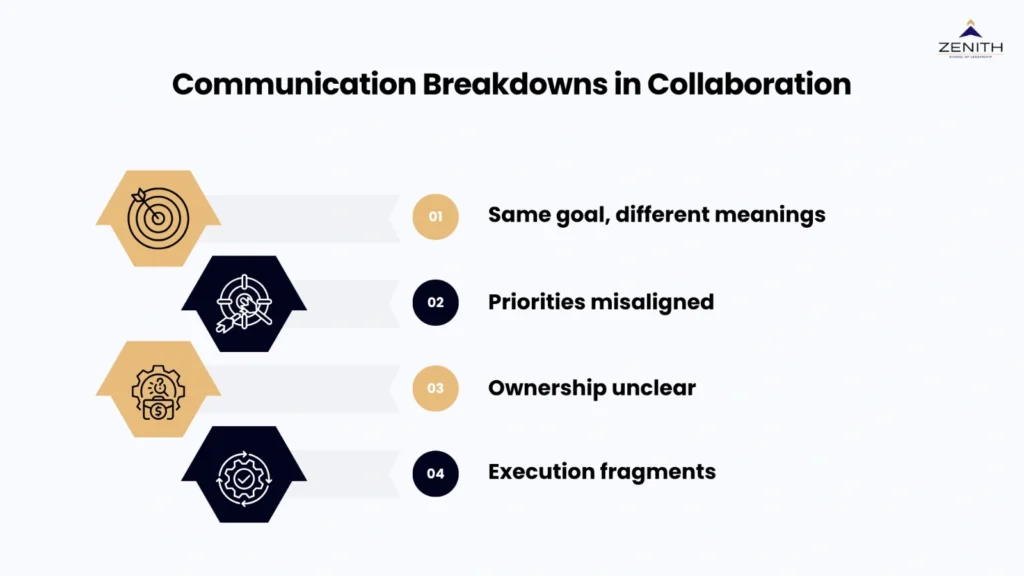
The objective is shared. The plan is discussed. Responsibilities are outlined. Yet interpretation varies across individuals. One person prioritizes speed, another prioritizes accuracy. One assumes ownership, another assumes support.
These small differences may seem minor in isolation, but over time they create visible friction. Teams find themselves revisiting the same discussions, clarifying decisions repeatedly, and correcting misaligned efforts.
Leaders often respond by increasing communication frequency. However, more communication does not resolve misalignment if meaning remains unstable. It often adds more layers of interpretation.
What restores collaboration is not more messaging. It is clearer shared meaning.
How Pixar Turned Feedback into Collaboration
Inside Pixar Animation Studios, collaboration is shaped through a practice known as the “Braintrust.”
During the development of films like Toy Story, Finding Nemo, and Inside Out, teams regularly review unfinished work together. These sessions are not about approval. They are about improving clarity.
What makes this process powerful is not just feedback, but how feedback is framed.
Instead of saying, “This scene doesn’t work,” feedback is expressed through personal interpretation:
“I found this part confusing.”
“The emotional stakes felt unclear here.”
“I didn’t understand why this character made that decision.”
This shift changes everything.
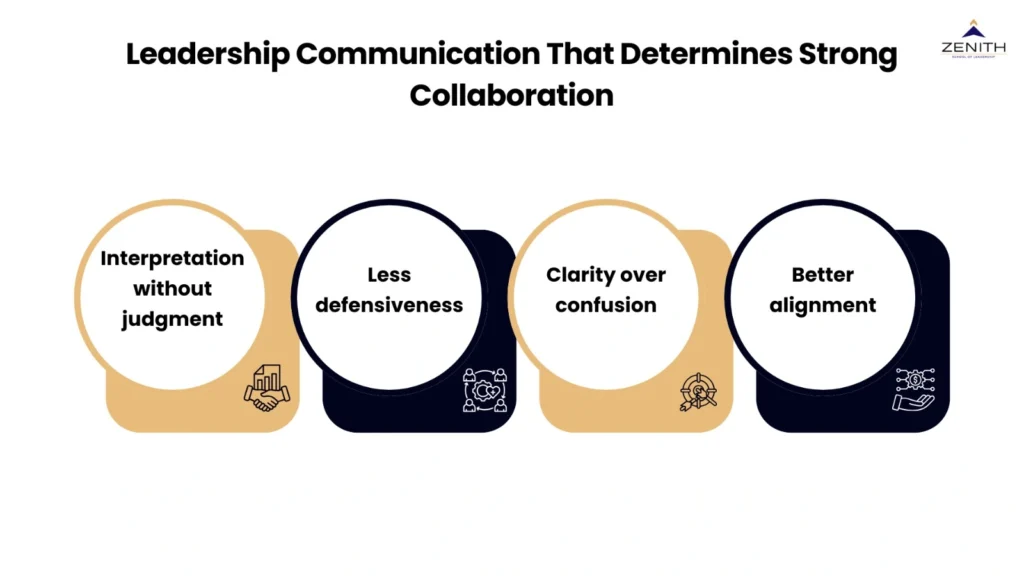
By focusing on interpretation rather than judgment, feedback stops feeling personal and starts becoming useful. It reduces defensiveness, highlights where meaning is unclear, and allows creators to improve without feeling attacked.
Over time, this approach has helped Pixar maintain consistently high storytelling quality.
The leadership insight is simple but powerful:
The way feedback is communicated determines whether collaboration strengthens or stalls.
The Pattern Behind Strong Collaboration
Teams do not collaborate effectively simply because individuals are capable. They collaborate effectively when interpretation remains consistent.
When meaning is shared, priorities become clear, responsibilities stabilize, and decisions move faster. Execution feels coordinated.
When meaning varies, goals feel ambiguous, ownership becomes unclear, and decisions slow down. Execution becomes fragmented.
This is why high-performing teams invest more in aligning interpretation than in increasing communication volume.
Shared meaning reduces friction. Reduced friction improves coordination. Coordinated execution improves performance reliability.
What Weakens Collaboration
Collaboration often breaks not because of effort, but because of how communication is structured.
When teams assume agreement means alignment, individuals move forward with different interpretations. When feedback evaluates people instead of clarifying gaps, defensiveness increases and improvement slows. When responsibility boundaries are unclear, hesitation and duplication appear. When context is fragmented, decisions become locally optimized but globally misaligned.

What Strengthens Collaboration in Practice
Strong communication skills correct collaboration breakdowns by making meaning visible and consistent across the team.
Leaders who improve collaboration do not just increase communication. They clarify what success looks like, how it will be measured, and which assumptions remain constant. They frame feedback around clarity instead of judgment, which reduces defensiveness and makes alignment easier.
They also stabilize role clarity early. When it is clear who decides, who contributes, and who executes, coordination becomes faster and more reliable.
One practical way to reinforce this is by structuring communication around four elements:
Objective – What success means
Definition – How success is measured
Interpretation – What assumptions remain consistent
Coordinated Action – How efforts integrate
This simple structure reduces ambiguity and ensures that teams are not just working together, but working with the same understanding.
A Small Habit That Creates Clarity
At the start of any collaborative discussion, ask one simple question: “Before we begin, does everyone share the same definition of success for this objective?”
This takes less than two minutes, but it prevents hours of misalignment later. Shared meaning drives alignment, making it easier for teams to move in the same direction from the beginning. When expectations are clearly defined, it also brings clear success and roles into focus.
At the end of discussions, another question helps surface hidden gaps:
“What part of this objective could be interpreted differently?”
This simple check strengthens understanding because feedback improves clarity and helps uncover assumptions early. Over time, these small interventions create a rhythm where structure ensures coordination, reducing confusion and improving execution.
These small interventions make invisible misalignment visible before it affects execution.
Why keep proving yourself silently? Step into influence that gets recognized.
- 1:1 Strategy Session for precision diagnosis of communication gaps
- Defined Success Signals to align perception with performance
- Interpretation Clarity to eliminate misunderstanding at leadership level
- Executive Presence Framing to strengthen how your value is perceived
- Leverage Mapping to unlock high-impact visibility and influence
- Invitation-Only Access for professionals ready for next-level growth
Final Thought
Teams do not collaborate effectively because they communicate more. They collaborate effectively because they understand the same meaning.
When leaders stabilize interpretation, clarify expectations, and align context, collaboration moves from effort to precision. And in environments where coordination determines performance, that clarity becomes a decisive advantage.
FAQs
They create shared understanding, reduce interpretation gaps, and improve coordination across team members.
Because individuals interpret goals, roles, and priorities differently, even when they agree on the objective.
Assuming agreement equals alignment without clarifying shared meaning.
By defining success clearly, stabilizing roles, and framing feedback around interpretation gaps.
Yes. Clear communication improves coordination efficiency, decision speed, and execution consistency.
Yes. When meaning is shared and expectations are clear, misunderstandings and friction reduce significantly.

Prabhakaran
Sr. Talent Acquisition Manager | PWC
Table of Content
Read summarized version with
TLDR | 3 Executive Actions for Leaders
Clarify shared definitions of success to improve coordination
Frame feedback around interpretation gaps rather than personal judgment
Stabilize role clarity to reduce collaboration friction
As teams collaborate, agreement often creates the illusion of alignment. But without shared meaning, execution begins to drift across individuals and functions. When communication does not define success, roles, and expectations clearly, coordination slows even when effort remains high. Team performance improves not when communication increases, but when interpretation becomes consistent across people.
Collaboration rarely breaks down in obvious ways. It does not fail because people stop contributing or because intent disappears. It begins to weaken when the same objective starts meaning different things to different people.
At first, everything appears normal. Meetings continue, discussions feel productive, and progress seems steady. Yet underneath that activity, small differences in interpretation begin to form. One team prioritizes speed, another prioritizes accuracy. One individual assumes ownership, while another waits for confirmation.
Over time, these differences compound. Decisions take longer, coordination requires more effort, and execution becomes uneven. The issue is not capability or commitment. The issue is that shared meaning was never fully established.
This is where communication skills become critical. Collaboration is not sustained by effort alone. It is sustained by clarity that allows multiple people to move in the same direction with the same understanding.
Why Collaboration Weakens Despite Good Intent
At a senior level, collaboration is not simply about participation. It is about coordinated performance across multiple perspectives, functions, and decision points.
Teams often assume alignment exists because no one openly disagrees. Agreement creates comfort, but comfort should not be mistaken for clarity. Shared understanding is what enables coordination.
Research in organizational behavior consistently shows that misalignment in interpretation, not lack of capability, is one of the primary causes of execution delays. When individuals operate with different mental models of the same objective, coordination effort increases, decision speed decreases, and performance consistency declines.
Two teams can have equal talent and equal intent. One executes with precision, while the other struggles with repeated alignment loops. The difference is not effort. It is communication clarity.
The Real Risk: Interpretive Misalignment
In most organizations, collaboration does not collapse suddenly. It becomes progressively inefficient.
The objective is shared. The plan is discussed. Responsibilities are outlined. Yet interpretation varies across individuals. One person prioritizes speed, another prioritizes accuracy. One assumes ownership, another assumes support.
These small differences may seem minor in isolation, but over time they create visible friction. Teams find themselves revisiting the same discussions, clarifying decisions repeatedly, and correcting misaligned efforts.
Leaders often respond by increasing communication frequency. However, more communication does not resolve misalignment if meaning remains unstable. It often adds more layers of interpretation.
What restores collaboration is not more messaging. It is clearer shared meaning.
How Pixar Turned Feedback into Collaboration
Inside Pixar Animation Studios, collaboration is shaped through a practice known as the “Braintrust.”
During the development of films like Toy Story, Finding Nemo, and Inside Out, teams regularly review unfinished work together. These sessions are not about approval. They are about improving clarity.
What makes this process powerful is not just feedback, but how feedback is framed.
Instead of saying, “This scene doesn’t work,” feedback is expressed through personal interpretation:
“I found this part confusing.”
“The emotional stakes felt unclear here.”
“I didn’t understand why this character made that decision.”
This shift changes everything.
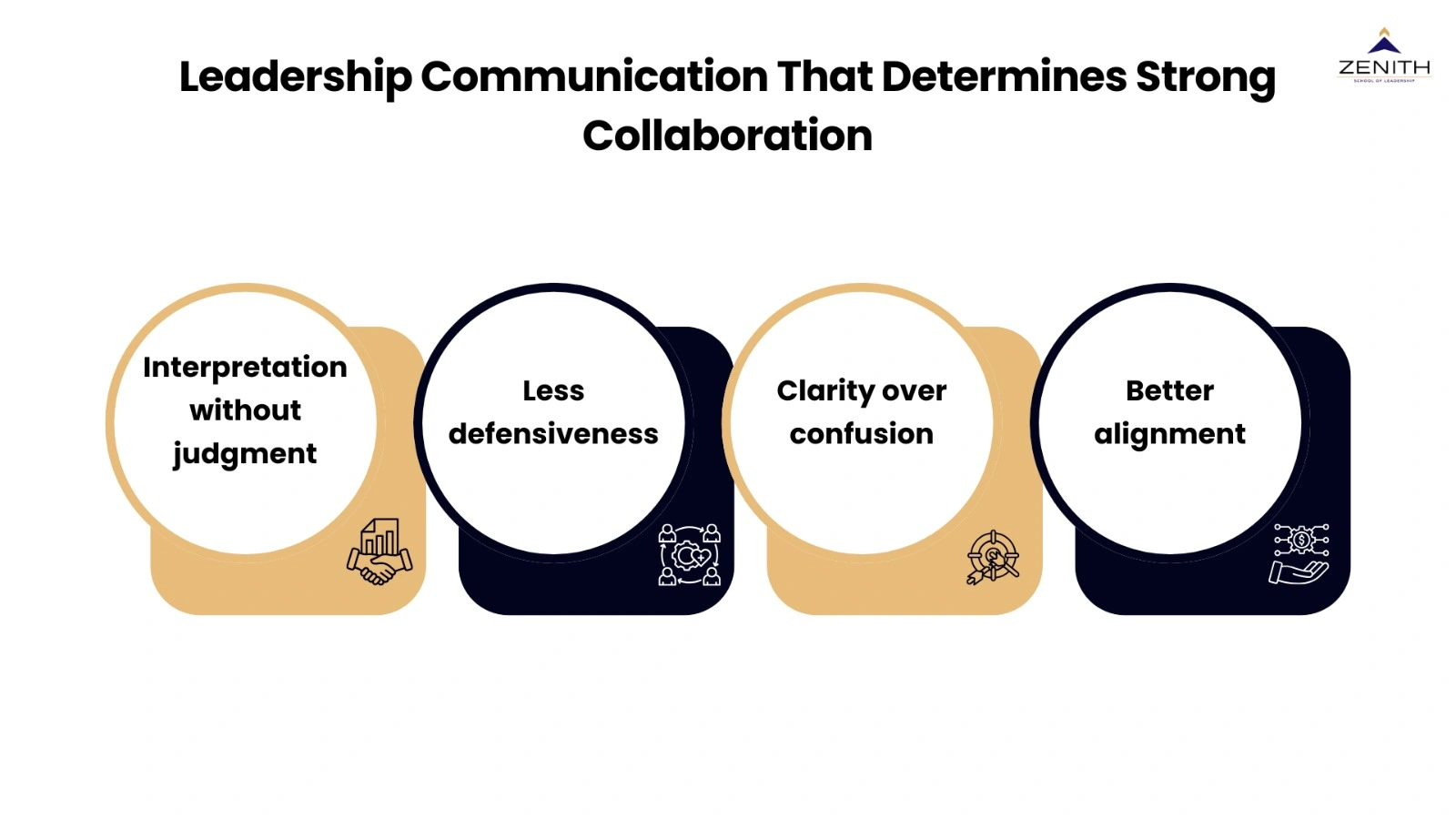
By focusing on interpretation rather than judgment, feedback stops feeling personal and starts becoming useful. It reduces defensiveness, highlights where meaning is unclear, and allows creators to improve without feeling attacked.
Over time, this approach has helped Pixar maintain consistently high storytelling quality.
The leadership insight is simple but powerful:
The way feedback is communicated determines whether collaboration strengthens or stalls.
The Pattern Behind Strong Collaboration
Teams do not collaborate effectively simply because individuals are capable. They collaborate effectively when interpretation remains consistent.
When meaning is shared, priorities become clear, responsibilities stabilize, and decisions move faster. Execution feels coordinated.
When meaning varies, goals feel ambiguous, ownership becomes unclear, and decisions slow down. Execution becomes fragmented.
This is why high-performing teams invest more in aligning interpretation than in increasing communication volume.
Shared meaning reduces friction. Reduced friction improves coordination. Coordinated execution improves performance reliability.
What Weakens Collaboration
Collaboration often breaks not because of effort, but because of how communication is structured.
When teams assume agreement means alignment, individuals move forward with different interpretations. When feedback evaluates people instead of clarifying gaps, defensiveness increases and improvement slows. When responsibility boundaries are unclear, hesitation and duplication appear. When context is fragmented, decisions become locally optimized but globally misaligned.
What Strengthens Collaboration in Practice
Strong communication skills correct collaboration breakdowns by making meaning visible and consistent across the team.
Leaders who improve collaboration do not just increase communication. They clarify what success looks like, how it will be measured, and which assumptions remain constant. They frame feedback around clarity instead of judgment, which reduces defensiveness and makes alignment easier.
They also stabilize role clarity early. When it is clear who decides, who contributes, and who executes, coordination becomes faster and more reliable.
One practical way to reinforce this is by structuring communication around four elements:
Objective — What success means
Definition — How success is measured
Interpretation — What assumptions remain consistent
Coordinated Action — How efforts integrate
This simple structure reduces ambiguity and ensures that teams are not just working together, but working with the same understanding.
A Small Habit That Creates Clarity
At the start of any collaborative discussion, ask one simple question:
“Before we begin, does everyone share the same definition of success for this objective?”
This takes less than two minutes, but it prevents hours of misalignment later. Shared meaning drives alignment, making it easier for teams to move in the same direction from the beginning. When expectations are clearly defined, it also brings clear success and roles into focus.
At the end of discussions, another question helps surface hidden gaps:
“What part of this objective could be interpreted differently?”
This simple check strengthens understanding because feedback improves clarity and helps uncover assumptions early.
Over time, these small interventions create a rhythm where structure ensures coordination, reducing confusion and improving execution.
These small interventions make invisible misalignment visible before it affects execution.
Final Thought
Teams do not collaborate effectively because they communicate more.
They collaborate effectively because they understand the same meaning.
When leaders stabilize interpretation, clarify expectations, and align context, collaboration moves from effort to precision.
And in environments where coordination determines performance, that clarity becomes a decisive advantage.
FAQs
They create shared understanding, reduce interpretation gaps, and improve coordination across team members.
Because individuals interpret goals, roles, and priorities differently, even when they agree on the objective.
Assuming agreement equals alignment without clarifying shared meaning.
By defining success clearly, stabilizing roles, and framing feedback around interpretation gaps.
Yes. Clear communication improves coordination efficiency, decision speed, and execution consistency.
Yes. When meaning is shared and expectations are clear, misunderstandings and friction reduce significantly.