Read summarized version with
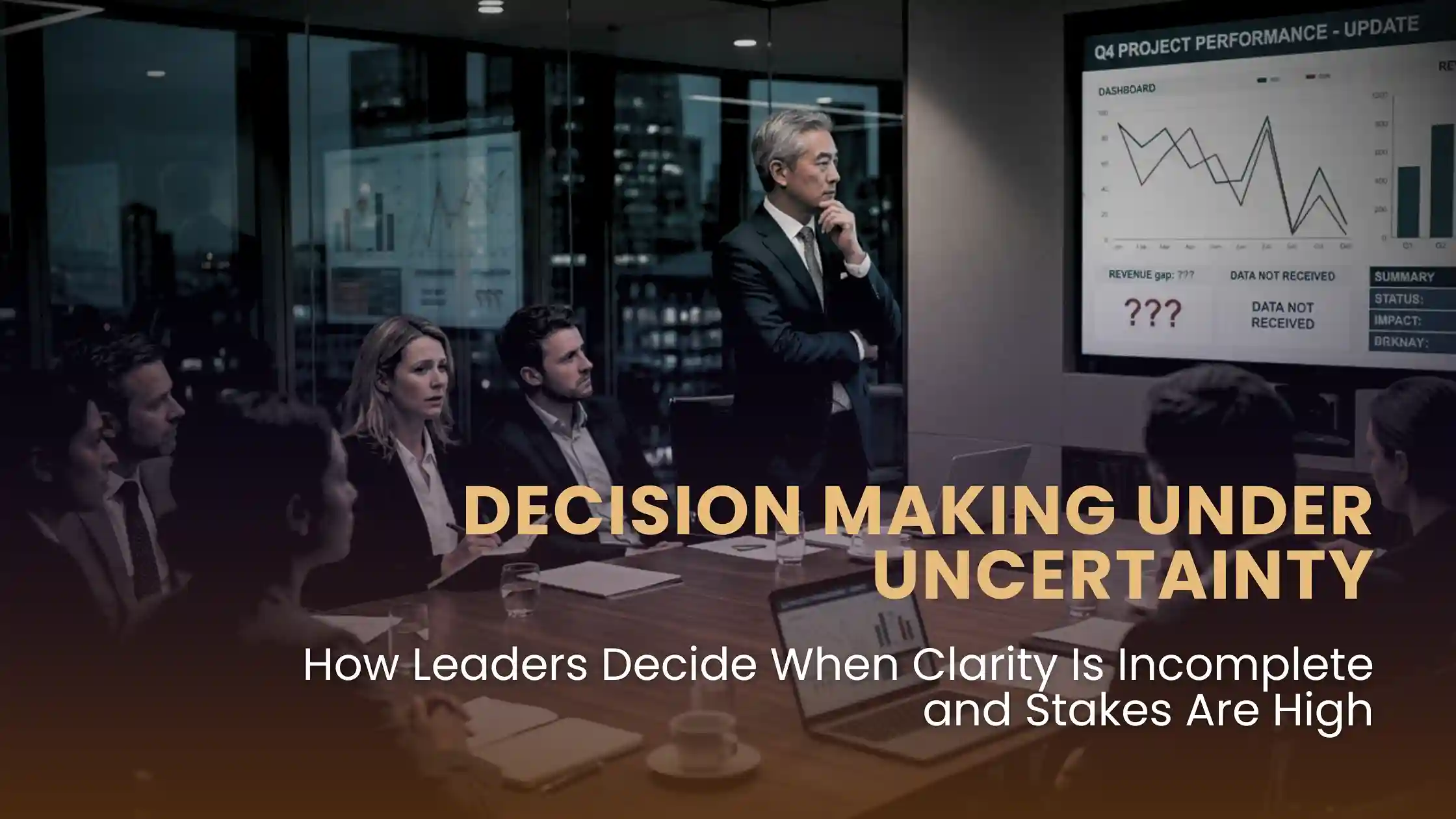
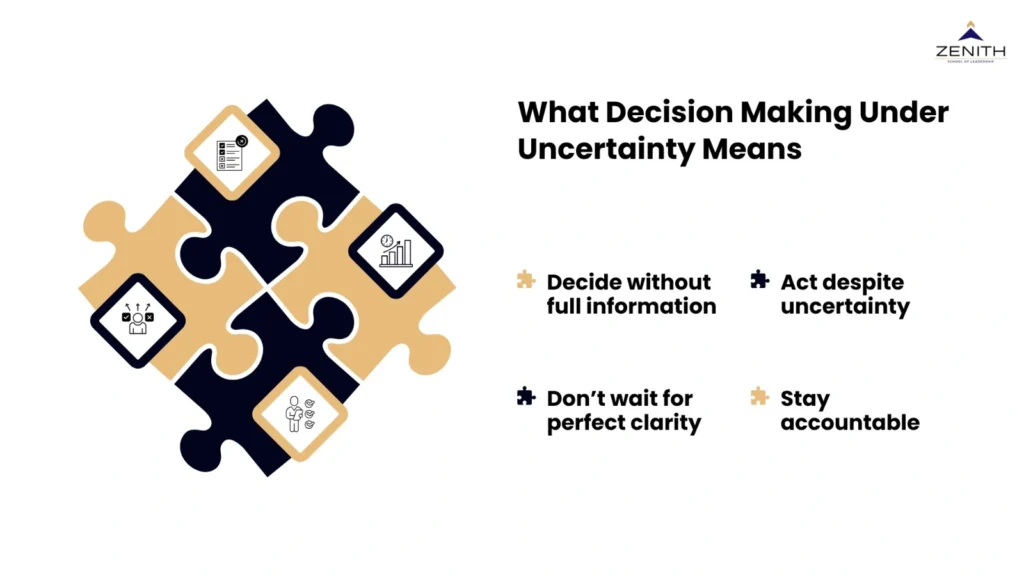
Decision Making Under Uncertainty is the ability to take responsible, timely decisions when information is incomplete, outcomes are unpredictable, and pressure is present.
It is not about guessing.
And it is not about waiting for perfect clarity.
It is about recognising what can be known, what cannot be known, and still moving forward with judgement and accountability.
At senior levels, most decisions are made without full certainty.
This skill determines whether leaders act with clarity or hesitation when it matters most.
As leaders rise, decisions become:
- More ambiguous
- More visible
- More consequential
- More emotionally loaded
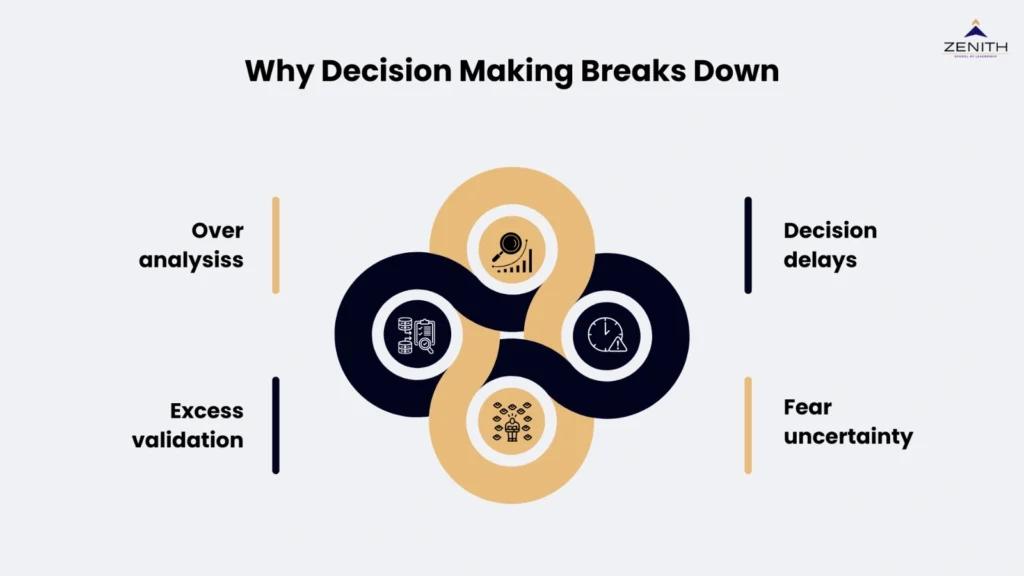
Without decision making ability even capable leaders fall into fail patterns such as:
- Over analysis without commitment
- Delaying decisions to avoid risk
- Seeking excessive validation
- Relying on familiar solutions in unfamiliar situations
These behaviours are often mistaken for caution.
In reality, they signal discomfort with uncertainty.
Research in decision science and organisational leadership shows that uncertainty does not reduce decision making ability.
It exposes it.
Leadership frameworks used in complex environments emphasise that different situations require different decision approaches.
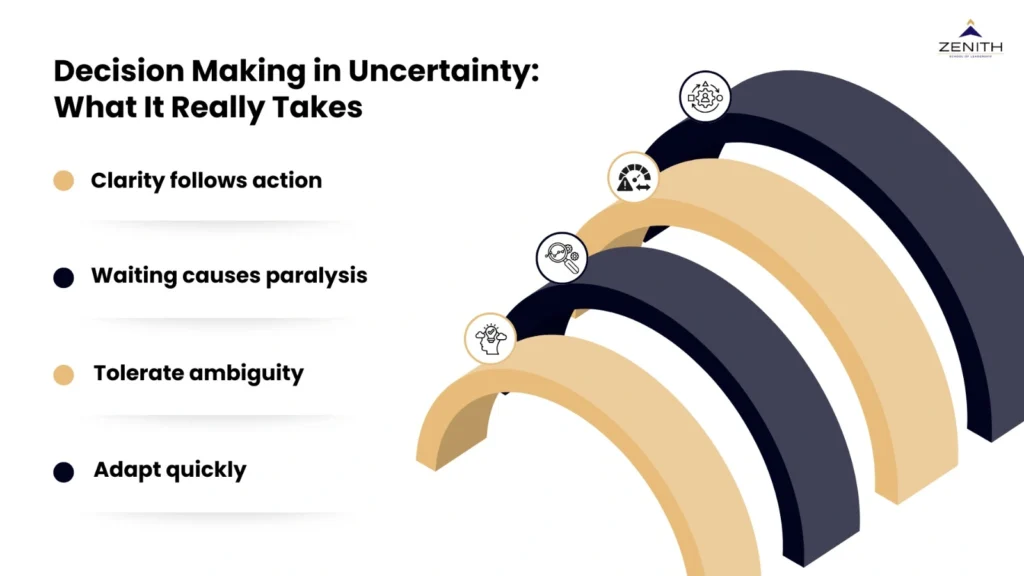
The Dave Snowden Cynefin framework highlights that in complex and uncertain contexts, clarity emerges after action, not before.
This means waiting for certainty often creates paralysis rather than safety.
Research across high responsibility roles consistently shows that leaders who can:
- Tolerate ambiguity
- Make provisional decisions
- Adjust based on feedback
outperform those who wait for complete information.
Decision quality under uncertainty is less about accuracy and more about judgement and adaptability.
Today’s leaders operate in environments shaped by rapid change, incomplete data, and constant evaluation.
Markets shift.
Teams are distributed.
Information is noisy and contradictory.
In such conditions, leaders who require certainty before acting lose momentum and credibility.
Decision Making Under Uncertainty allows leaders to:
- Move forward responsibly
- Signal confidence without arrogance
- Create direction even when outcomes are unclear
This is not recklessness.
It is calibrated leadership.
Leaders who demonstrate this skill:
- Separate reversible from irreversible decisions
- Act with intent rather than perfection
- Communicate decisions with clarity and ownership
- Adjust course without defensiveness
- Maintain credibility even when outcomes evolve
They are trusted not because they are always right, but because they are consistently grounded and accountable.
This skill is not built through logic alone.
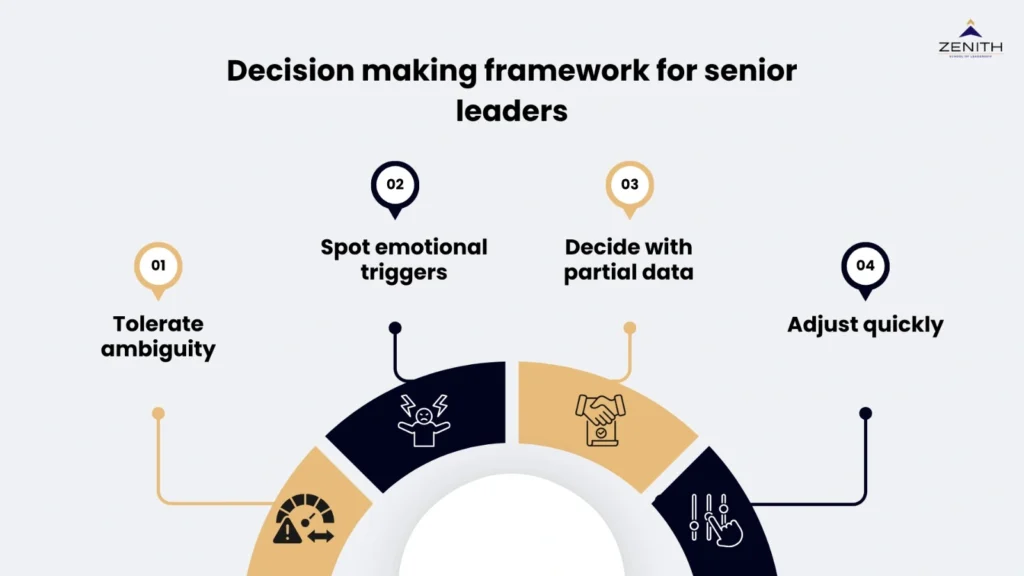
It is developed by:
- Strengthen tolerance for ambiguity
- Recognise emotional discomfort that drives delay
- Learn to decide with partial information
- Course correction without self judgement
Leaders who build this capability stop equating certainty with safety.
They learn to lead through motion.
At Zenith, Decision Making Under Uncertainty is developed as a leadership capability, not a cognitive trick.
Leaders are guided to recognise the emotional and psychological patterns that surface when certainty is unavailable.
The Zenith approach helps leaders distinguish between analysis that creates clarity and analysis that delays action.
Through mentor led reflection and real decision context work, leaders build the confidence to decide responsibly, communicate clearly, and stay adaptable as conditions change.
The focus is not on eliminating uncertainty, but on strengthening judgement within it.
This is how leaders learn to act decisively without becoming rigid.
Decision Making Under Uncertainty sits at the intersection of:
- Intellectual Intelligence through clarity of thought
- Emotional Intelligence through regulation under pressure
- Personal Intelligence through accountability and self trust
When these Intelligences work together, leaders stop avoiding uncertainty and start leading through it.
This skill becomes critical when you notice patterns such as:
- Delaying decisions despite sufficient insight
- Over relying on consensus
- Repeatedly revisiting the same choice
- Feeling stuck between options
These are not intelligence gaps.
They are uncertainty tolerance signals.
Leadership maturity is not measured by how well decisions work out.
It is measured by how leaders decide when outcomes are unclear.
Decision Making Under Uncertainty allows leaders to move forward with responsibility, presence, and credibility even when the path is still forming.