Public Speaking for Executives: How to Speak with Gravitas, Executive Presence, and Confidence Under Pressure

Public Speaking for Executives: How to Speak with Gravitas, Executive Presence, and Confidence Under Pressure

Public Speaking for Executives: How to Speak with Gravitas, Executive Presence, and Confidence Under Pressure

Public Speaking for Executives: How to Speak with Gravitas, Executive Presence, and Confidence Under Pressure

Table of Content

Read summarized version with

“The first thing people register is not your words - it is your presence.”

In leadership moments town halls, board discussions, crisis updates people decide whether to trust you before they fully process what you say. Tone, pace, stillness, and composure quietly signal authority long before content does. Public speaking at senior levels is not about performance or persuasion. It is about how steadily a leader can command attention, communicate direction, and remain grounded when visibility is high and pressure is real.

Confident leadership is sensed before it is understood.

When executive presence is tested in real time

Public speaking at the executive level rarely breaks during preparation. It gets challenged in live situations when authority is being observed and evaluated in the moment.

A sharp question disrupts your flow.
A senior leader interjects mid-sentence.
A stakeholder’s silence lingers a second longer than expected.

And suddenly, your pace shifts. Your tone tightens. Your mind starts racing not to communicate, but to safeguard credibility.

You begin adding layers of explanation. You over-justify. You move from leading to proving.

This is the precise moment where executive presence and gravitas stop being ideas. They become visible in behaviour.

What gravitas actually means in executive communication

Gravitas is not dominance. It is controlled by steadiness under pressure.

  • Your message stays intact
  • Your tone remains calm
  • Your thinking stays structured
  • Your presence creates direction not tension

According to Harvard Business Review, executive presence is primarily driven by gravitas and communication, not just appearance. And in high-stakes conversations,
how you speak matters more than what you know.

TLDR

  1. Gravitas rises when your pace and structure stay steady under pressure, even when questions get sharper.
  2. Senior audiences decide trust early. Your opening order and your delivery signals shape whether they track your thinking or start scanning for doubt.
  3. Most executive speaking issues show up as delivery signals, not knowledge gaps. When you remove the signals that create uncertainty, your authority becomes easier to trust.
  4. Presence is built as a pattern. Over time, people experience your consistency as your leadership brand. (ccl.org)
  5. One repeatable speaking sequence beats extra content. Outcome, composure, risk, commitment.

Gravitas is the real executive speaking skill

Gravitas is control- Control of pace. Control of tone. Control of what you say next. Control of where the conversation goes.

Harvard Business Review frames executive presence through gravitas and communication, which matters because public speaking is where those two become visible instantly. (hbr.org) Your audience may not remember every detail you shared, but they will remember whether your thinking felt organised and whether your presence stayed steady when pressure increased.

What quietly erodes executive authority on stage

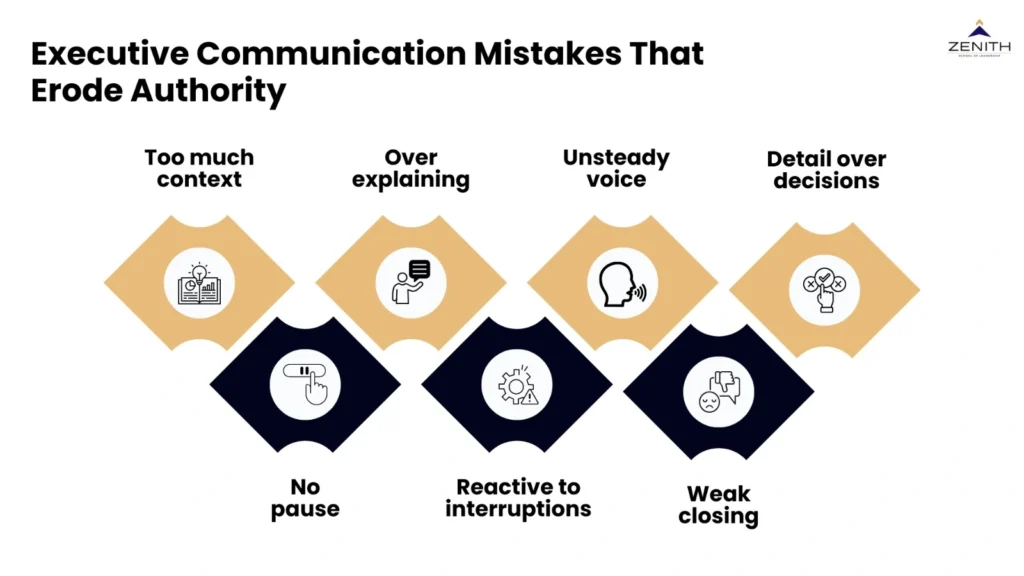
In executive public speaking, authority is rarely lost because your idea is weak. It erodes through delivery signals that make the audience feel uncertainty, even when your logic is strong.

1. Starting with too much context (executive communication clarity)

Senior leaders don’t process chronologically. They process direction first.

Without a clear outcome:

  • Attention drops
  • Interruptions increase
  • Confidence weakens

2. Over-explaining to prove credibility (confident communication skills)

When you lead with excessive data:

  • It signals self-protection
  • Not leadership

Direction first. Proof later.

3. Voice instability under pressure (speaking with confidence)

The last few words of your sentence carry authority.

If your voice drops, rushes, or fades- your message weakens, even if your logic is strong.

4. Answering details instead of decisions (decision-making communication)

Senior audiences pull you into detail.

Leaders bring it back to:
👉 “What decision are we making?”

5. Filling silence instead of using it (power of pause in communication)

Research on persuasive communication shows that strategic pauses increase perceived confidence, credibility, and authority.

Silence is not awkward. Silence is control.

6. Losing composure during interruptions (handling difficult questions)

Interruptions are not disruptions.

They are status tests.

React → you lose control
Reframe → you gain authority

7. Ending without commitment (leadership communication skills)

If your talk ends without a decision:

You created awareness.
Not leadership.

The hidden pattern senior leaders miss

Executives often treat public speaking like an event. A presentation. A keynote. A town hall.

Your audience experiences it as a pattern.

They remember how you handle pushback. How you hold your tone when challenged. Whether your point stays intact when someone tries to pull you into explanation. Whether you can keep direction alive in a tense moment.

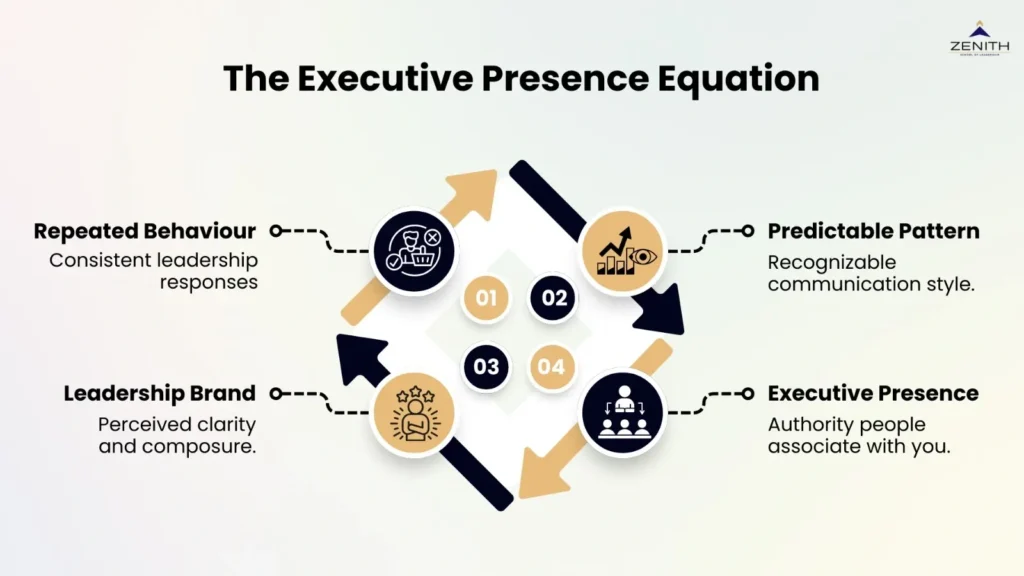
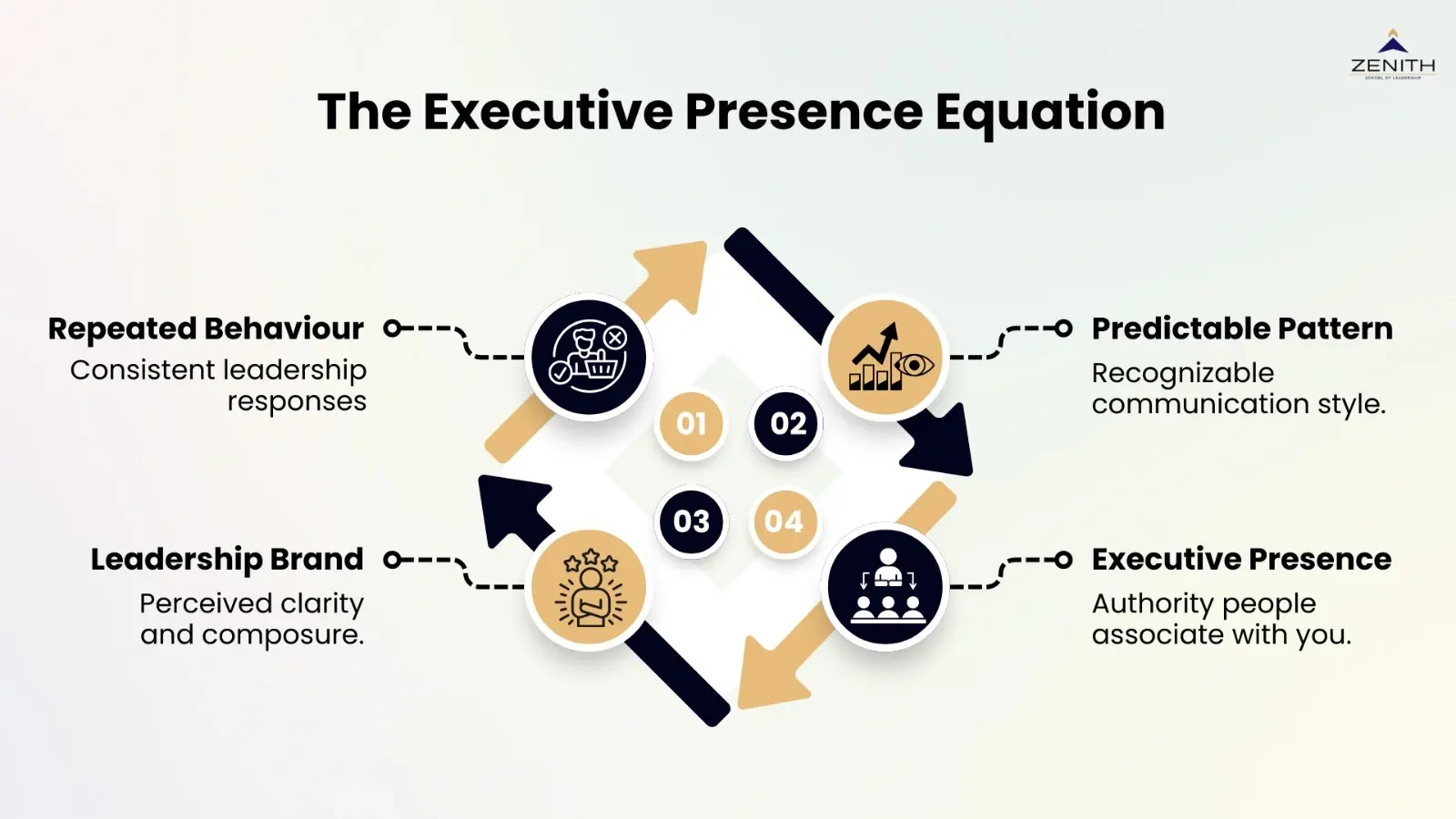
Executive presence equation framework for senior professionals by Zenith School of Leadership

This is why leadership brand becomes relevant. CCL describes leadership brand as how your value and results are experienced through your interactions. (ccl.org) In practical terms, people learn what to expect from you. They learn whether you create clarity, whether you hold composure, whether you move decisions forward. Over time, that pattern becomes your executive presence.

Executive Presence Example: How Barack Obama Demonstrates Gravitas and Confidence in High-Pressure Public Speaking

A widely studied example of executive presence and speaking with gravitas is Barack Obama during his national addresses, especially in moments of crisis.

Whether it was during economic uncertainty, national security briefings, or emotionally charged events, Obama was often speaking to millions of people under intense scrutiny.

What made his communication stand out was not complexity but control.

  • He never rushed his delivery, even when stakes were high
  • He used intentional pauses after key lines, allowing the message to land
  • His tone remained measured and steady, even when addressing fear or uncertainty
  • He simplified decisions into clear direction, rather than overwhelming with detail
  • He acknowledged challenges without letting his composure break

Researchers analyzing his speeches found that strategic pauses significantly increased perceived confidence, credibility, and leadership presence.

When you:

  • Slow down instead of speeding up
  • Pause instead of filling silence
  • Stay steady instead of reacting

You signal something powerful: “I am not overwhelmed by this moment.”

And that is the essence of gravitas and executive presence.

Zenith Speaking Architecture-

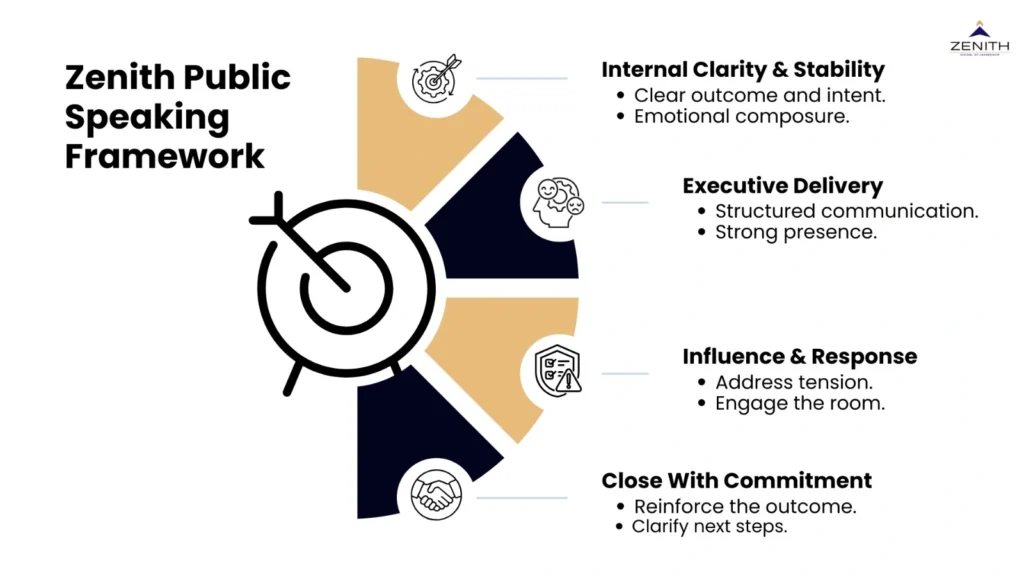
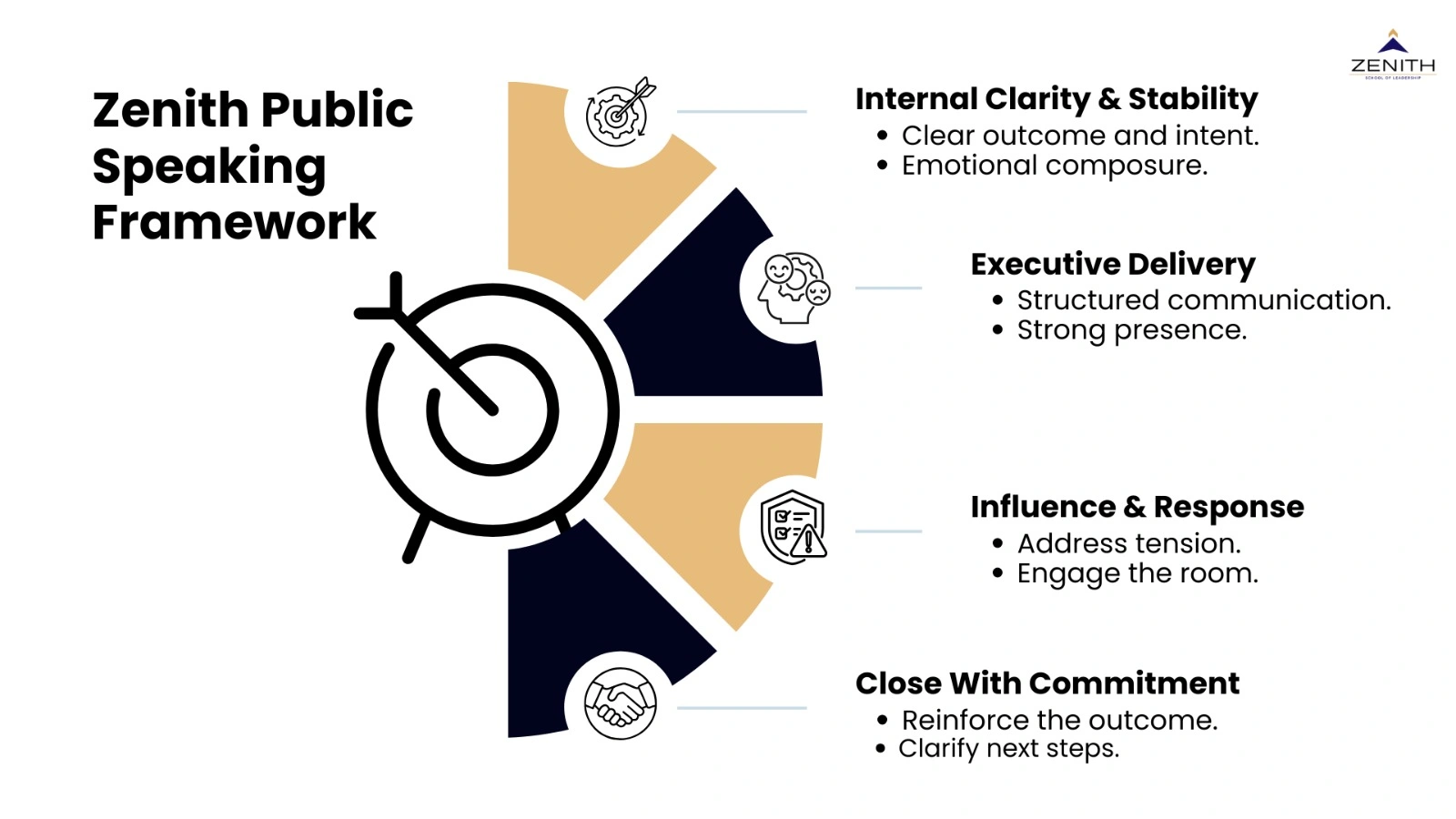
Public speaking framework for senior professionals by Zenith School of Leadership

This is a practical, repeatable speaking sequence for executives. Built for board updates, leadership reviews, client meetings, town halls, and Q and A. It gives you a clean path through pressure without adding more words.

1. Speak Outcome First

Open with the outcome you are driving, not the background you are carrying. Your Leadership has too much on their mind, they appreciate sharp and crisp communication that shows the outcome without drama.

Examples
Today my goal is to align us on one decision.
By the end of this update, we should be aligned on next steps.
My intention is to create clarity on direction and risk.

2. Hold Composure

“When you learn to hold Composure, then Composure Holds you” - Gurleen Kaur

Composure is a choice you keep making while you speak. 

Hold your pace. Shorten your sentences. Place one deliberate pause after your outcome line. That pause is where gravitas becomes felt.

A useful self test while speaking
Can I hear control in my own voice?

3. Name the Risk

Do not let the audience guess what is at stake. Don’t avoid naming the issue.  Name the tradeoff so clearly that the unsurfaced tension also becomes manageable.

Examples
The tradeoff here is speed versus certainty.
The risk is not the cost. The risk is delay.
This decision protects customer trust while we accelerate delivery.

4. Close with Commitment

End with a commitment the group can agree to. A commitment is stronger than a conclusion because it creates action.

Examples
If we are aligned, the commitment for this week is X.
The next step we can commit to today is Y.
If we agree on the outcome, this is the decision we lock now.

Executive speaking scripts

Use one. Keep it clean.

  1. Outcome opener
    Today my goal is to align us on one decision. (Then actually keep focus on a single outcome)
  2. Risk clarity line (No hesitation, no change in tonality when you say it.)
    The tradeoff here is speed versus certainty.
  3. Commitment close ( Make people commit)
    If we are aligned, the next step we commit to today is X.

One week practice to build steadiness fast

For the next seven days, do not practice longer. Practice cleaner.

🕮 Choose one high stakes moment each day where you speak with senior stakeholders.

🕮 Write four lines: Outcome, Composure cue, Risk, Commitment.

🕮 Say those lines out loud once, slowly enough that you can hear control in your voice.

🕮 Add one deliberate pause after your outcome line.

Visible impact looks like this. Your voice stays steady when challenged. Your answers get shorter. People follow your thinking without pulling you into excessive explanation

Proof checklist

Unlock your first coaching session →

Book Your 1-on-1 Session

Table of Content

Read summarized version with

“The first thing people register is not your words - it is your presence.”

 In leadership moments town halls, board discussions, crisis updates people decide whether to trust you before they fully process what you say. Tone, pace, stillness, and composure quietly signal authority long before content does. Public speaking at senior levels is not about performance or persuasion. It is about how steadily a leader can command attention, communicate direction, and remain grounded when visibility is high and pressure is real.

Confident leadership is sensed before it is understood.

When executive presence is tested in real time

Public speaking at the executive level rarely breaks during preparation. It gets challenged in live situations when authority is being observed and evaluated in the moment.

A sharp question disrupts your flow.
A senior leader interjects mid-sentence.
A stakeholder’s silence lingers a second longer than expected.

And suddenly, your pace shifts. Your tone tightens. Your mind starts racing not to communicate, but to safeguard credibility.

You begin adding layers of explanation. You over-justify. You move from leading to proving.

This is the precise moment where executive presence and gravitas stop being ideas. They become visible in behaviour.

What gravitas actually means in executive communication

Gravitas is not dominance. It is controlled by steadiness under pressure.

  • Your message stays intact
  • Your tone remains calm
  • Your thinking stays structured
  • Your presence creates direction not tension

According to Harvard Business Review, executive presence is primarily driven by gravitas and communication, not just appearance. And in high-stakes conversations,
how you speak matters more than what you know.

TLDR

  1. Gravitas rises when your pace and structure stay steady under pressure, even when questions get sharper.
  2. Senior audiences decide trust early. Your opening order and your delivery signals shape whether they track your thinking or start scanning for doubt.
  3. Most executive speaking issues show up as delivery signals, not knowledge gaps. When you remove the signals that create uncertainty, your authority becomes easier to trust.
  4. Presence is built as a pattern. Over time, people experience your consistency as your leadership brand. (ccl.org)
  5. One repeatable speaking sequence beats extra content. Outcome, composure, risk, commitment.

Gravitas is the real executive speaking skill

Gravitas is control. Control of pace. Control of tone. Control of what you say next. Control of where the conversation goes.

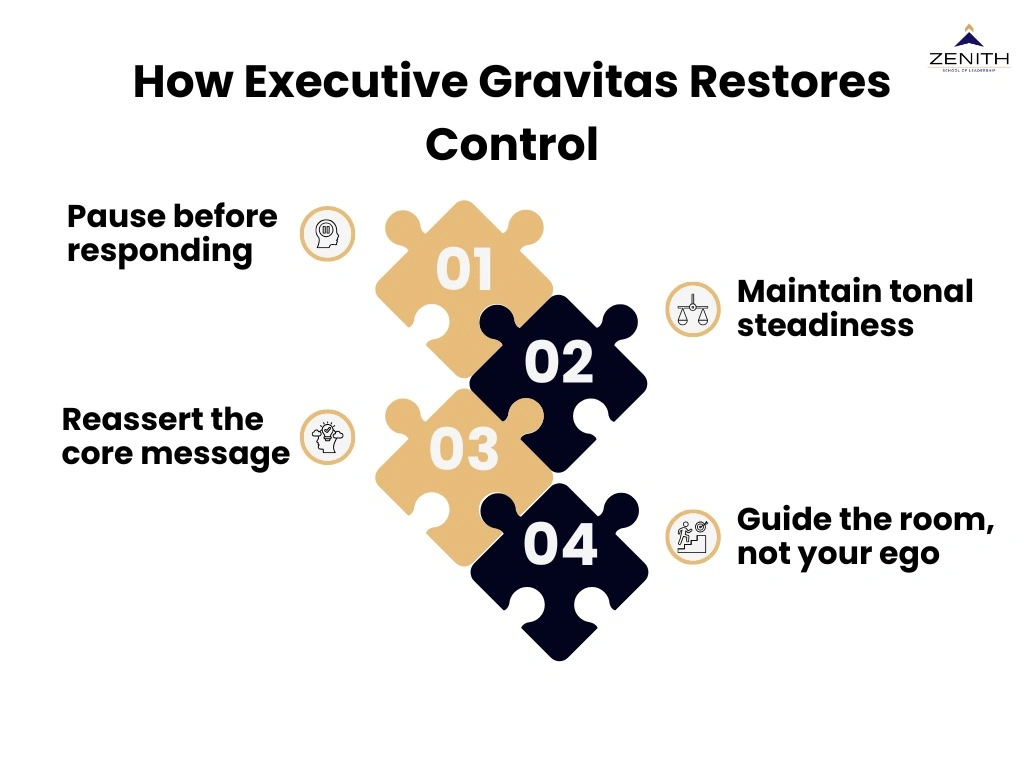
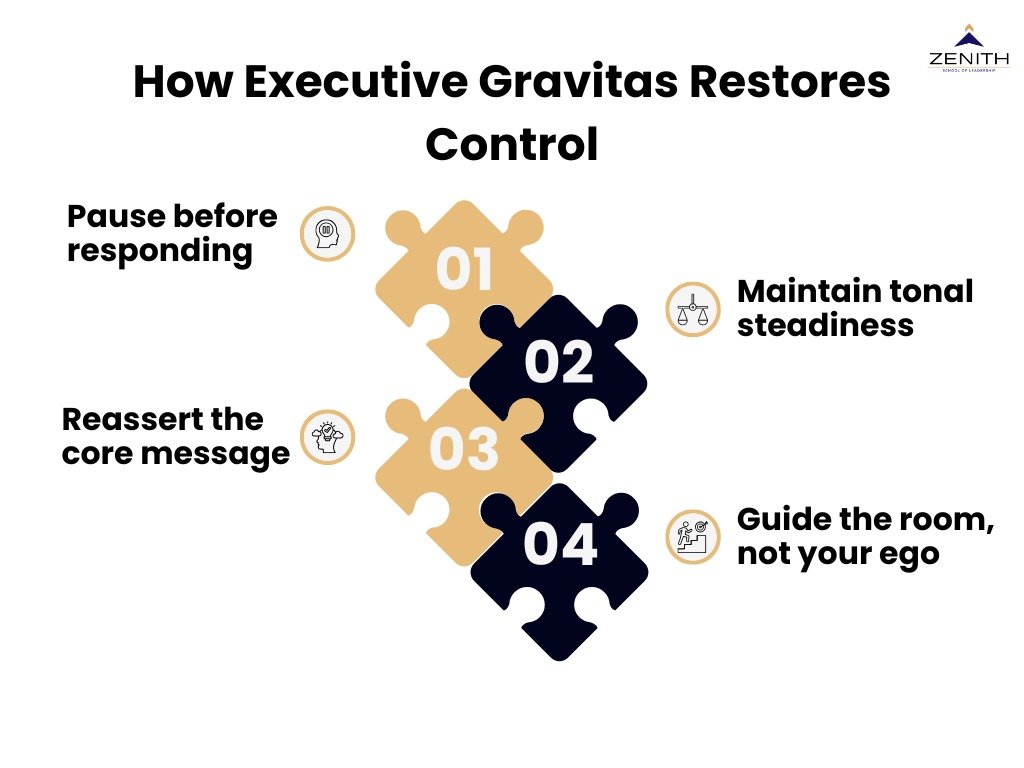
Executive gravitas that restores control framework explained for senior professionals by Zenith School of Leadership

Harvard Business Review frames executive presence through gravitas and communication, which matters because public speaking is where those two become visible instantly. (hbr.org) Your audience may not remember every detail you shared, but they will remember whether your thinking felt organised and whether your presence stayed steady when pressure increased.

What quietly erodes executive authority on stage

In executive public speaking, authority is rarely lost because your idea is weak. It erodes through delivery signals that make the audience feel uncertainty, even when your logic is strong.

1. Starting with too much context (executive communication clarity)

Senior leaders don’t process chronologically. They process direction first.

Without a clear outcome:

  • Attention drops
  • Interruptions increase
  • Confidence weakens

2. Over-explaining to prove credibility (confident communication skills)

When you lead with excessive data:

  • It signals self-protection
  • Not leadership

Direction first. Proof later.

3. Voice instability under pressure (speaking with confidence)

The last few words of your sentence carry authority.

If your voice drops, rushes, or fades- your message weakens, even if your logic is strong.

4. Answering details instead of decisions (decision-making communication)

Senior audiences pull you into detail.

Leaders bring it back to:
👉 “What decision are we making?”

5. Filling silence instead of using it (power of pause in communication)

Research on persuasive communication shows that strategic pauses increase perceived confidence, credibility, and authority.

Silence is not awkward. Silence is control.

6. Losing composure during interruptions (handling difficult questions)

Interruptions are not disruptions.

They are status tests.

React → you lose control
Reframe → you gain authority

7. Ending without commitment (leadership communication skills)

If your talk ends without a decision:

You created awareness.
Not leadership.

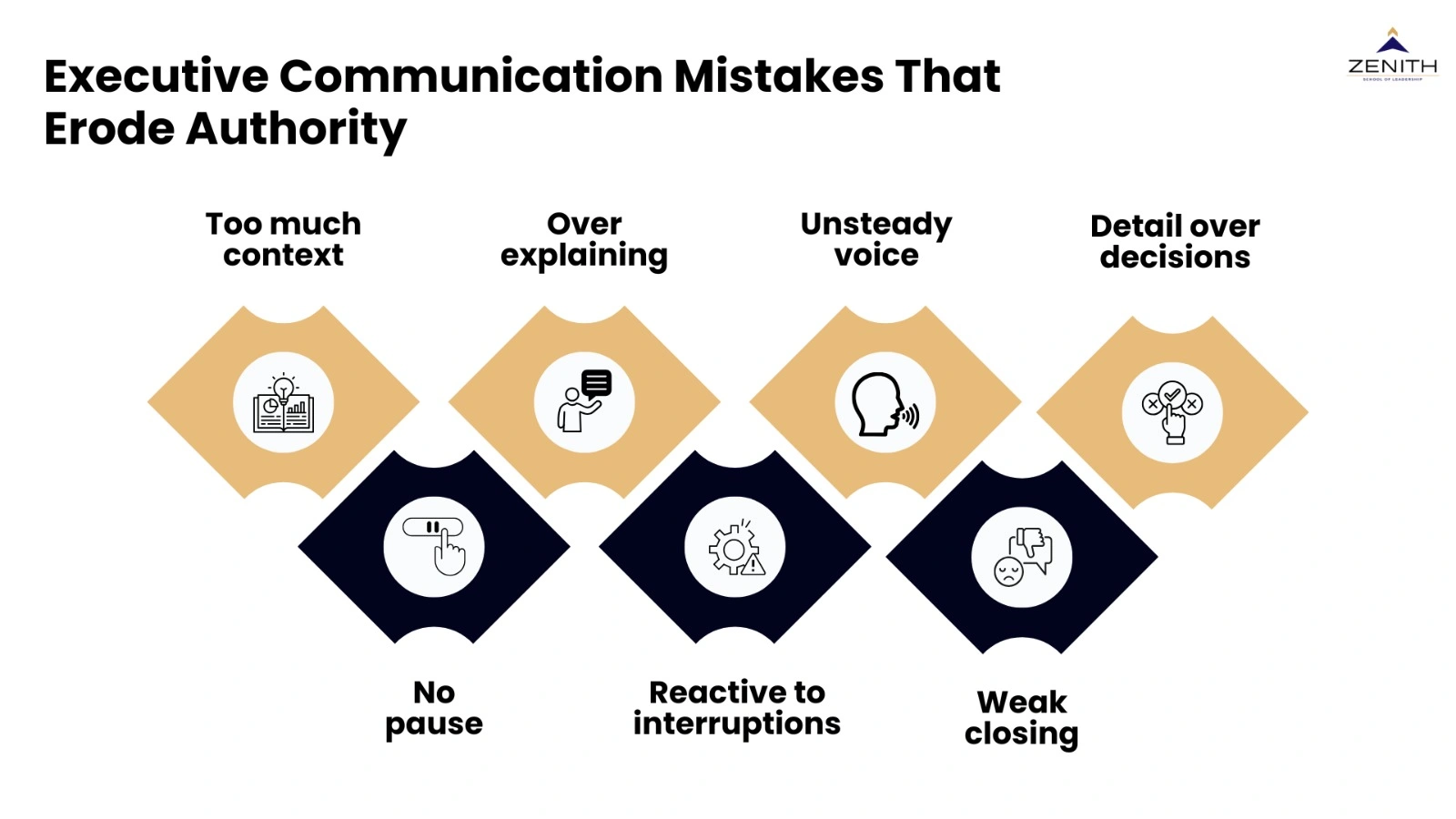
What Executive communication mistakes erode authority for senior professionals by Zenith School of Leadership

The hidden pattern senior leaders miss

Executives often treat public speaking like an event. A presentation. A keynote. A town hall.

Your audience experiences it as a pattern.

They remember how you handle pushback. How you hold your tone when challenged. Whether your point stays intact when someone tries to pull you into explanation. Whether you can keep direction alive in a tense moment.

Executive presence equation framework for senior professionals by Zenith School of Leadership

This is why leadership brand becomes relevant. CCL describes leadership brand as how your value and results are experienced through your interactions. (ccl.org) In practical terms, people learn what to expect from you. They learn whether you create clarity, whether you hold composure, whether you move decisions forward. Over time, that pattern becomes your executive presence.

Executive Presence Example: How Barack Obama Demonstrates Gravitas and Confidence in High-Pressure Public Speaking

A widely studied example of executive presence and speaking with gravitas is Barack Obama during his national addresses, especially in moments of crisis.

Whether it was during economic uncertainty, national security briefings, or emotionally charged events, Obama was often speaking to millions of people under intense scrutiny.

What made his communication stand out was not complexity but control.

  • He never rushed his delivery, even when stakes were high
  • He used intentional pauses after key lines, allowing the message to land
  • His tone remained measured and steady, even when addressing fear or uncertainty
  • He simplified decisions into clear direction, rather than overwhelming with detail
  • He acknowledged challenges without letting his composure break

Researchers analyzing his speeches found that strategic pauses significantly increased perceived confidence, credibility, and leadership presence.

When you:

  • Slow down instead of speeding up
  • Pause instead of filling silence
  • Stay steady instead of reacting

You signal something powerful: “I am not overwhelmed by this moment.”

And that is the essence of gravitas and executive presence.

Zenith Speaking Architecture-

Public speaking framework for senior professionals by Zenith School of Leadership

This is a practical, repeatable speaking sequence for executives. Built for board updates, leadership reviews, client meetings, town halls, and Q and A. It gives you a clean path through pressure without adding more words.

1. Speak Outcome First

Open with the outcome you are driving, not the background you are carrying. Your Leadership has too much on their mind, they appreciate sharp and crisp communication that shows the outcome without drama.

Examples
Today my goal is to align us on one decision.
By the end of this update, we should be aligned on next steps.
My intention is to create clarity on direction and risk.

2. Hold Composure

“When you learn to hold Composure, then Composure Holds you” - Gurleen Kaur

Composure is a choice you keep making while you speak. 

Hold your pace. Shorten your sentences. Place one deliberate pause after your outcome line. That pause is where gravitas becomes felt.

A useful self test while speaking
Can I hear control in my own voice?

3. Name the Risk

Do not let the audience guess what is at stake. Don’t avoid naming the issue.  Name the tradeoff so clearly that the unsurfaced tension also becomes manageable.

Examples
The tradeoff here is speed versus certainty.
The risk is not the cost. The risk is delay.
This decision protects customer trust while we accelerate delivery.

4. Close with Commitment

End with a commitment the group can agree to. A commitment is stronger than a conclusion because it creates action.

Examples
If we are aligned, the commitment for this week is X.
The next step we can commit to today is Y.
If we agree on the outcome, this is the decision we lock now.

Executive speaking scripts

Use one. Keep it clean.

  1. Outcome opener
    Today my goal is to align us on one decision. (Then actually keep focus on a single outcome)
  2. Risk clarity line (No hesitation, no change in tonality when you say it.)
    The tradeoff here is speed versus certainty.
  3. Commitment close ( Make people commit)
    If we are aligned, the next step we commit to today is X.

One week practice to build steadiness fast

For the next seven days, do not practice longer. Practice cleaner.

🕮 Choose one high stakes moment each day where you speak with senior stakeholders.

🕮 Write four lines: Outcome, Composure cue, Risk, Commitment.

🕮 Say those lines out loud once, slowly enough that you can hear control in your voice.

🕮 Add one deliberate pause after your outcome line.

Visible impact looks like this. Your voice stays steady when challenged. Your answers get shorter. People follow your thinking without pulling you into excessive explanation.
Proof checklist

Unlock your first coaching session →

Book Your 1-on-1 Session