
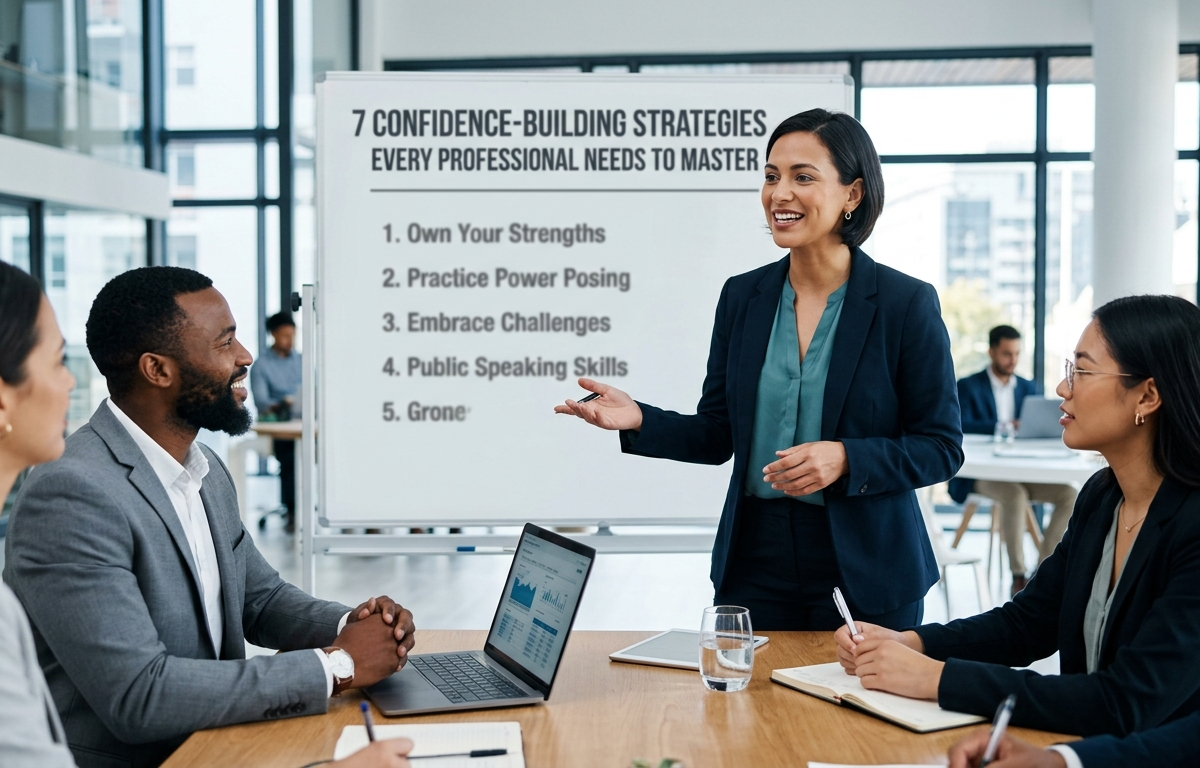
7 Confidence-Building Strategies Every Professional Needs to Master
If you have ever Googled “how to be more confident at work”, you already know the standard advice.
Fake it till you make it. Stand in a power pose. Speak more slowly. Make eye contact. Smile more.
This advice is not wrong, exactly. But it is insufficient. It addresses the surface of confidence without touching the structure beneath it. And surface solutions are the first to crumble under real professional pressure.
What actually works – what produces durable, pressure-resistant professional confidence – are confidence-building strategies that work from the inside out. Strategies that change not just how you look, but how you think, how you communicate, and ultimately, how you relate to yourself and your own capability.
Here are seven of them.
Strategy 1: Redefine What Confidence Actually Means to You
The first confidence-building strategy is cognitive – it is about changing the definition you are working with.
Most professionals hold an implicit definition of confidence that looks something like this: confidence is the absence of fear or doubt, and the certainty that you will succeed. By this definition, most people will never feel confident, because fear and doubt are permanent features of ambitious professional life.
Replace this definition with one that actually serves you: confidence is the willingness to act clearly despite uncertainty. By this definition, every time you speak up in a meeting despite discomfort, every time you volunteer for a challenging project despite uncertainty, every time you deliver a difficult message despite anxiety – you are being confident. And each act of courage builds the next.
Strategy 2: Build a Deliberate Evidence Bank
Self-doubt is primarily a memory problem. When we feel unconfident, we selectively remember our failures, our stumbles, and our most uncomfortable moments – while systematically forgetting or discounting our successes.
One of the most effective confidence-building strategies is to deliberately correct this imbalance by building and maintaining an evidence bank: a written record of professional achievements, positive feedback, challenges navigated, skills developed, and moments when you showed up fully.
Review this bank regularly – especially before high-stakes moments. Evidence is more powerful than reassurance because it is specific, personal, and verifiable.
Strategy 3: Master the Pre-Performance Reset
Every high-stakes professional moment – a critical presentation, a difficult conversation, a leadership review, a client pitch – deserves intentional mental preparation.
Develop a personal pre-performance reset routine: a sequence of physical and mental actions that shift your internal state before you walk into the room. This might include a specific breathing technique, a review of your evidence bank, a physical movement practice, a confidence-affirming phrase, or a moment of deliberate stillness.
The specifics matter less than the consistency. A reset ritual works because it becomes a trained signal – your nervous system learns to associate the ritual with a shift into a more resourceful, focused state. This is one of the most underused confidence-building strategies available to professionals.
Strategy 4: Speak Earlier in Every Room
There is a reliable dynamic in almost every professional meeting: the longer you wait to speak, the harder it becomes. Silence accumulates into a kind of social weight that makes contribution feel increasingly difficult.
Counter this by practising speaking in the first few minutes of every meeting or group interaction – before the weight of silence accumulates. You do not need to say something profound. You need to participate.
This simple discipline – contribute early, consistently, in every room – is one of the most powerful confidence-building strategies available because it changes both the external perception (you become known as an active contributor) and the internal experience (each early contribution makes the next one easier).
Strategy 5: Separate Feedback From Identity
One of the most confidence-destroying patterns in professional life is the fusion of feedback and identity. When critical feedback is received as evidence that I am not enough, rather than information that my output could be different, it attacks confidence at its root.
Developing the ability to receive feedback as data – useful, directional, impersonal – is a critical confidence-building strategy. It requires practising a simple cognitive separation: this feedback is about something I did, not about who I am. That separation, maintained consistently, protects the confidence base even when performance is imperfect.
Strategy 6: Seek Discomfort Deliberately
Confidence does not grow in comfort zones. It grows in the space just beyond them – in situations that stretch your capability, challenge your self-concept, and require you to function effectively despite discomfort.
Make a practice of deliberately seeking these situations. Volunteer to present when you could stay quiet. Attend the networking event you have been avoiding. Take on the project that feels slightly beyond your current level. Have the difficult conversation you have been postponing.
Each time you do, you expand the territory in which you can operate confidently. And the territory of confidence, once expanded, does not easily shrink back.
Strategy 7: Invest in Structured Development
All of the above strategies are powerful. But they are most powerful when pursued within a structured development environment – one that provides expert guidance, personalised feedback, progressive challenges, and a community of peers committed to the same growth.
The most effective confidence-building strategy of all is the decision to invest seriously in your own development. To treat your professional presence, communication, and confidence not as fixed attributes but as skills that deserve the same rigorous, intentional development as any technical expertise.
At Zenith School of Leadership, this is precisely what we provide. Our structured programs are built on the understanding that confidence is a trainable skill – and that with the right environment, the right coaching, and the right confidence-building strategies, every professional is capable of showing up as a more powerful, more present, and more genuinely confident version of themselves.
Thousands of professionals across India and globally have trusted Zenith School of Leadership with this journey. The results are not just felt – they are visible, measurable, and lasting. Our confidence-building strategies are not theoretical. They are drawn from real coaching engagements, refined through real results, and delivered by coaches who have walked this path themselves.
