The Leadership Communication Problem No One Notices Until Growth Slows
- April 2, 2026
- Gurleen Kaur
The Leadership Communication Problem No One Notices Until Growth Slows
- April 2, 2026
- Gurleen Kaur
Table of Content
Read summarized version with
TL;DR
- Protect strategic meaning as it moves across layers
Growth doesn’t break strategy—it distorts it. Leaders must ensure core intent stays intact as it travels. - Clarify what is fixed, what can flex, and what matters most now
Without this, teams interpret differently. Clear boundaries create alignment without slowing execution. - Anticipate misunderstanding before it spreads
Strong leaders don’t just communicate clearly—they think ahead to how their message will be interpreted at every level.
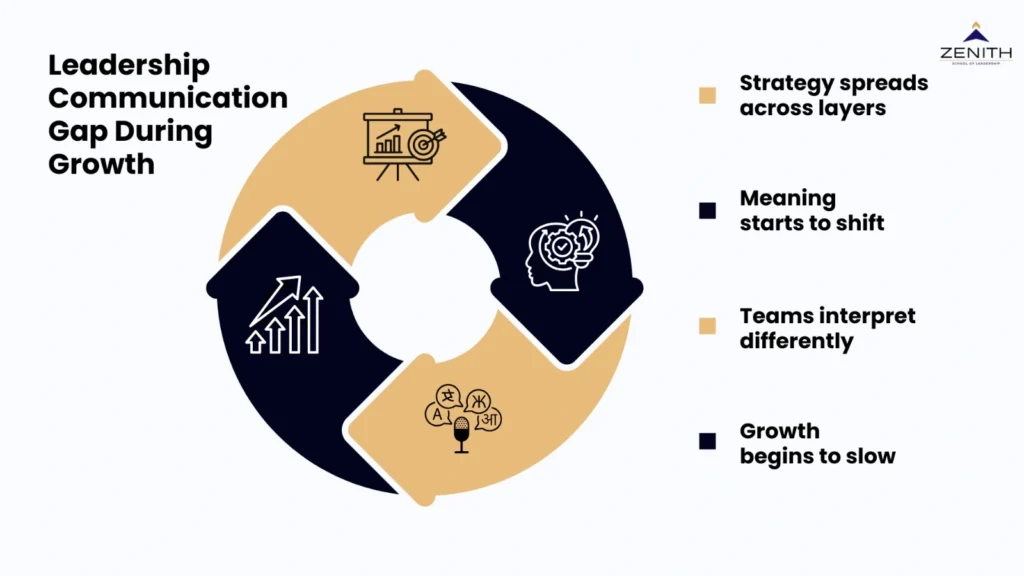
Growth rarely slows all at once. It slows when a strategy that once felt clear at the top starts meaning different things to different parts of the organization.
At first, nothing looks obviously wrong. Teams are working. Meetings continue. Decisions are being made. On the surface, the business still appears active. Yet something subtle begins changing underneath that motion.
The strategy is still the same. The intent is still the same. The ambition may still be strong. What starts weakening is how clearly and consistently that strategy is being understood as it moves.
That is the leadership communication problem most organizations do not notice early enough.
As organizations grow, strategy is no longer held by a small circle of leaders working close to the point of execution. It now has to be understood and carried through more managers, more teams, more functions, and more day to day decisions. The Center for Creative Leadership defines leadership through three outcomes, direction, alignment, and commitment, which makes this issue especially important. Growth may preserve direction at the top while alignment and commitment begin weakening across the wider system.
This is why growth often becomes harder even when the strategy itself remains sound. The issue is not always that the strategy changed. The issue is that too many different versions of it have started entering the system.
The Real Reasons for Slow Organizational Growth
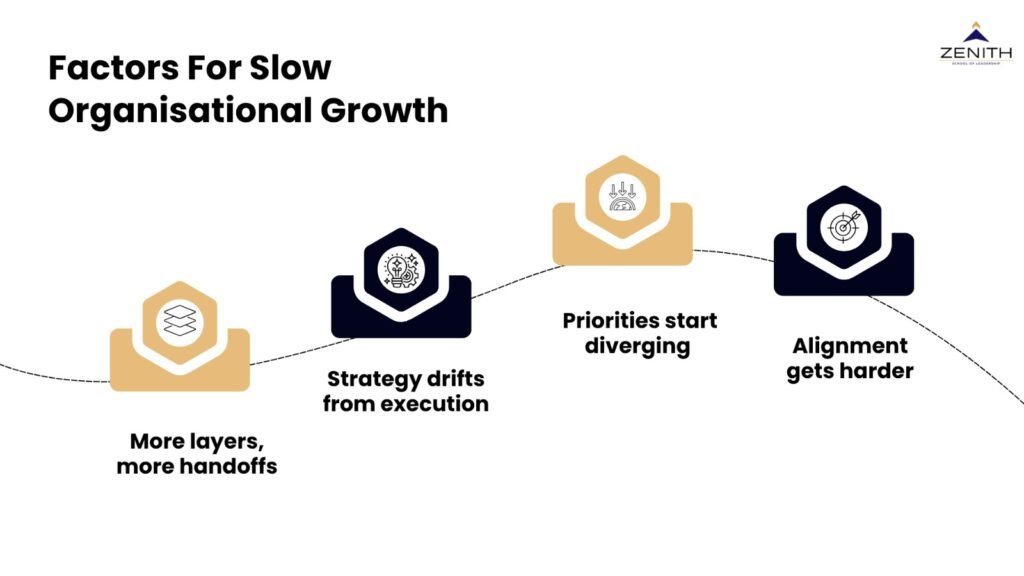
In a smaller organization, strategy stays close to execution.
The people deciding are often close to the people acting. Questions get clarified quickly. Priorities are easier to reinforce. Misunderstandings are easier to catch before they spread.
Growth changes that environment.
- It adds more people carrying the strategy.
- It adds more handoffs between intent and action.
- It adds more local pressures and functional priorities.
- It adds more distance between the top and the point where execution happens.
That is where the communication challenge becomes more serious.
McKinsey describes middle managers as the connective tissue between strategy and execution because they are the ones translating direction between layers of hierarchy and helping ideas move into coordinated action. In a growing organization, that translation role becomes even more important.
Once strategy has to travel through more people, it becomes more vulnerable to what I would call translation loss.
The Hidden Problem: Translation Loss
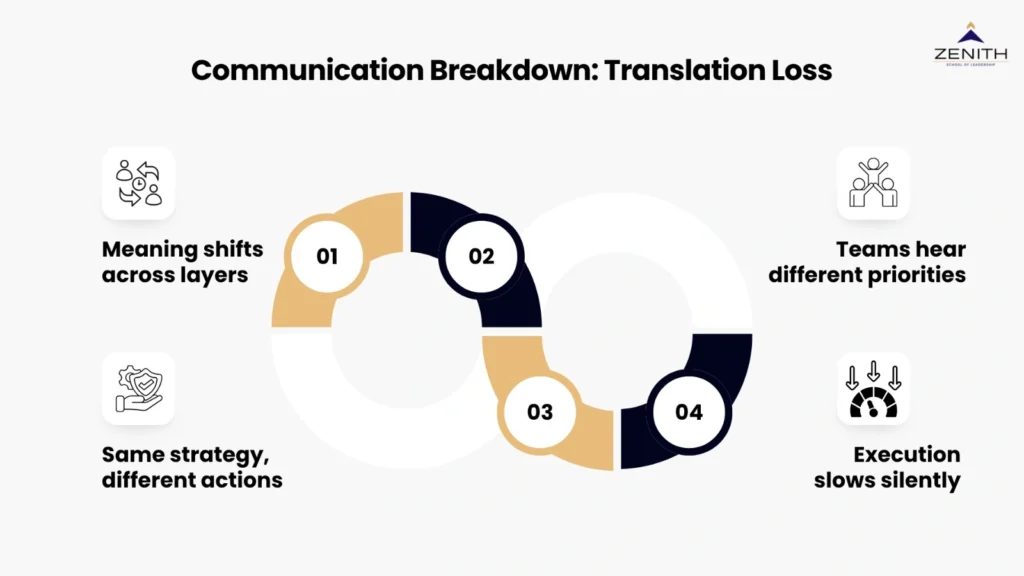
Translation loss begins when the original meaning of a strategy starts getting softened, stretched, localized, or reinterpreted as it moves through layers. No one is necessarily being careless.
Each leader is trying to make sense of the strategy through the lens of their own pressures. Each function is trying to apply it to its own reality. Each team is trying to act in a way that feels right from where they sit.
That is exactly why this problem is easy to miss. The strategy may still sound the same in leadership conversations. Yet as it moves:
One team hears urgency.
Another hears caution.
One layer thinks speed matters most.
Another thinks consistency matters most.
One function believes a major shift is underway.
Another still behaves as though the older priorities remain intact.
This is how strategy execution begins slowing without any visible collapse. The strategy did not disappear. Its meaning stopped arriving intact. That is the real communication problem growth introduces.
Why This Matters More Than Leaders Realize
Research and practice both point to the same truth. High performing organizations do not lose value only because they lack insight. They often lose value between strategy and delivery.
McKinsey notes that even strong companies can see a significant gap between the full potential of their strategy and what is actually delivered, often because the operating model and the system carrying the strategy do not support execution cleanly enough.
That is what makes strategic communication so important in growth. This is not about speaking more often. This is about making sure the core meaning of the strategy survives as it moves.
Because once shared understanding starts splitting, three things usually follow:
- Decision speed weakens.
- Execution becomes uneven.
- Growth starts losing coordinated momentum.
- Teams remain busy.
They simply stop moving from the same understanding.
A Real Example of the Problem Before Growth Slows Further
A strong example comes from Howard Schultz at Starbucks.
As Starbucks expanded, the company was no longer being carried by a small group of leaders close to the business every day. It was being carried by far more stores, managers, teams, and operational layers. McKinsey’s interview with Schultz framed the company’s challenge as pursuing healthier, more disciplined growth across both emerging and developed markets.
That is what makes this example relevant.
The challenge was never only about growing faster. It was also about preserving what the business needed to remain as scale increased.
Because once a company grows to that level, leadership can no longer assume that what feels obvious at the top still feels obvious across the system.
Different parts of the business begin emphasizing different things.
- One area pushes speed.
- Another protects consistency.
- One layer focuses on expansion.
- Another becomes shaped by local operational pressure.
And slowly, the organization starts moving through multiple interpretations of what should remain true. That is where leadership communication becomes decisive. The deeper lesson from Schultz is simple.
As organizations grow, leaders cannot rely on the original strategy statement alone. They have to keep reinforcing what the company must still stand for, what must remain consistent, and what growth must not dilute.
What leaders can apply immediately
When your organization is growing, do not assume drift is always caused by lack of discipline. Very often, drift begins because scale has introduced more layers, more pressures, and more interpretation.
So instead of only repeating the strategy, clarify these three things more often:
- What must remain true as we grow
- What teams can adapt locally
- What must not get diluted as this moves across the system
That is how leaders protect meaning before growth starts weakening execution.
What Leaders Usually Miss
Most leaders assume that if they have said something clearly once, alignment will follow.
In reality, growth makes one time clarity far less reliable.
A message that feels obvious at the top may reach the next layer with slightly different emphasis. By the time it reaches the next team, it may already be mixed with local context, immediate pressures, and personal judgment.
This is why repetition alone does not solve the problem. Repetition can create familiarity. It does not automatically create shared understanding.
Leaders often think they have an execution problem when they are actually dealing with a meaning problem. That is a crucial distinction. Because when the meaning is unstable, execution becomes unstable with it.
What Protects Meaning as Organizations Grow
To preserve alignment at scale, leaders need more than good intention. They need simple disciplines that protect strategic meaning before translation loss expands.
Here are the three strongest tools for that.
1. The Translation Test
Before a strategic message moves further down, ask:
If three different teams acted on this tomorrow, would they act in the same direction or in three different ways?
This is one of the most useful questions a leader can ask.
- It exposes ambiguity quickly.
- It reveals whether the message is truly clear.
- It catches fragmentation before execution begins drifting.
If the answer suggests teams would act in different directions, the strategy has not yet been communicated clearly enough.
2. The Fixed vs Flexible Framework
Every major message should clarify three things:
- What stays fixed
What must remain true everywhere - What can flex
What teams can adapt locally - What matters most now
What deserves immediate focus
This framework is powerful because growth creates two risks at the same time. Some teams adapt too much. Some teams wait too long because they are unsure what they are allowed to adjust.
When leaders clarify what is fixed and what is flexible, they reduce unnecessary hesitation and protect alignment at scale.
3. The Carry Forward Line
At the end of every major strategic discussion, leaders should complete this sentence:
The one thing that must remain true as this moves across teams is ______.
This line is powerful because it forces prioritization.
It identifies the core meaning that must survive as the message travels. It also gives every layer something clear enough to repeat.
In a growing organization, that matters enormously.
Because strategy does not usually weaken in one dramatic moment. It weakens when too many different versions of what matters start entering the system.
A Weekly Habit That Catches Distortion Early
For one week, introduce this question at the end of every important leadership discussion:
What are people most likely to misunderstand as this moves further down?
This is the Misunderstanding Check. It shifts the leader’s mindset from:
I said it clearly to: Will it still stay clear after more layers carry it
That single shift can change the quality of communication significantly. It helps leaders think beyond their own clarity. It makes them anticipate distortion before distortion becomes execution drag.
A Practical Way to Use These Tools Together
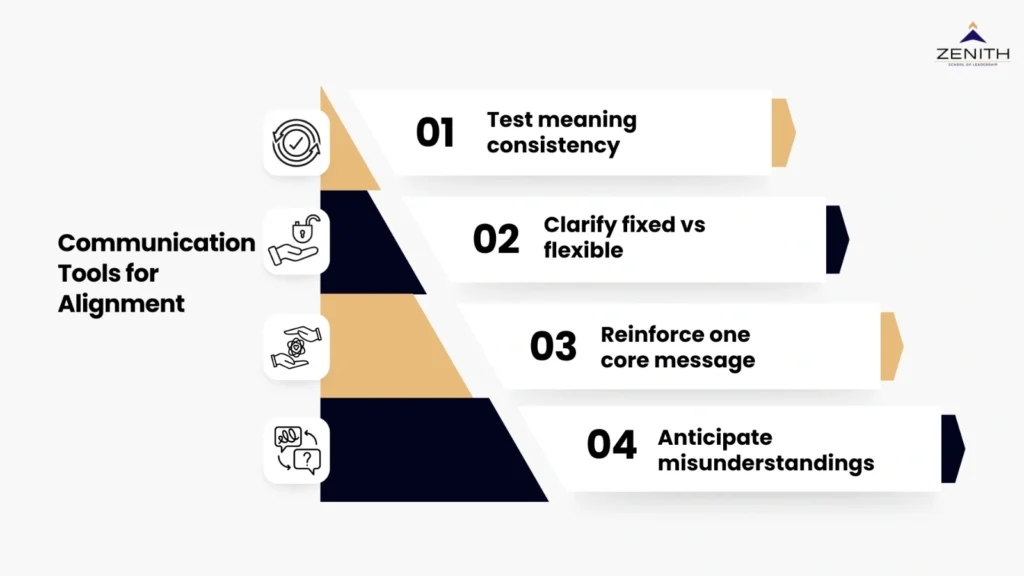
Before a major strategic message leaves the room, pause and run this quick sequence:
First, do the Translation Test Would different teams act on this in the same direction
Then apply the Fixed vs Flexible Framework
- What stays fixed
- What can flex
- What matters most now
Then close with the Carry Forward Line
The one thing that must remain true as this moves across teams is ______
And finally ask the Misunderstanding Check, What are people most likely to misunderstand as this moves further down This takes very little time. But it can prevent enormous coordination loss later.
Why keep proving yourself silently? Step into influence that gets recognized.
- 1:1 Strategy Session for precision diagnosis of communication gaps
- Defined Success Signals to align perception with performance
- Interpretation Clarity to eliminate misunderstanding at leadership level
- Executive Presence Framing to strengthen how your value is perceived
- Leverage Mapping to unlock high-impact visibility and influence
- Invitation-Only Access for professionals ready for next-level growth
Final Thought
The leadership communication problem that slows growth is rarely loud at first.
- It does not always show up as open conflict.
- It often looks like activity without shared movement.
- It looks like intelligent people working hard while execution starts pulling in slightly different directions.
That is why it gets missed.
As organizations grow, strategy is no longer held by a small group. It has to be understood and carried by far more people, teams, and layers. That is where the communication burden changes. The strategy may remain the same.
What determines whether growth stays healthy is whether that strategy can still travel clearly enough to be carried, reinforced, and acted on in the same spirit across the system.
Because growth rarely slows only when people stop working. It slows when people keep working hard, but stop moving from the same understanding.
Zenith helped me see my blind spots, strengthen my communication, and gain confidence that’s visible to everyone around me.

Sanjay Sheth
Head – Technical Accounting & Financial | EWEC
Table of Content
Read summarized version with
TLDR | 3 Leadership Realities
- As organizations grow, strategy is no longer held by a small group. It has to be understood and carried by far more people, teams, and layers
- The moment leaders leave something unclear, each layer starts filling the gap with its own interpretation
- Growth starts slowing when teams are still working hard, but no longer moving from the same understanding
Growth rarely slows all at once.
It slows when a strategy that once felt clear at the top starts meaning different things to different parts of the organization.
At first, nothing looks obviously wrong. Teams are working. Meetings continue. Decisions are being made. On the surface, the business still appears active.
Yet something subtle begins changing underneath that motion.
The strategy is still the same. The intent is still the same. The ambition may still be strong. What starts weakening is how clearly and consistently that strategy is being understood as it moves.
That is the leadership communication problem most organizations do not notice early enough.
As organizations grow, strategy is no longer held by a small circle of leaders working close to the point of execution. It now has to be understood and carried through more managers, more teams, more functions, and more day to day decisions. The Center for Creative Leadership defines leadership through three outcomes, direction, alignment, and commitment, which makes this issue especially important. Growth may preserve direction at the top while alignment and commitment begin weakening across the wider system.
This is why growth often becomes harder even when the strategy itself remains sound.
The issue is not always that the strategy changed.
The issue is that too many different versions of it have started entering the system.
Why Growth Changes with Communication Challenge
In a smaller organization, strategy stays close to execution.
The people deciding are often close to the people acting. Questions get clarified quickly. Priorities are easier to reinforce. Misunderstandings are easier to catch before they spread.
Growth changes that environment.
It adds more people carrying the strategy.
It adds more handoffs between intent and action.
It adds more local pressures and functional priorities.
It adds more distance between the top and the point where execution happens.
That is where the communication challenge becomes more serious.
McKinsey describes middle managers as the connective tissue between strategy and execution because they are the ones translating direction between layers of hierarchy and helping ideas move into coordinated action. In a growing organization, that translation role becomes even more important.
Once strategy has to travel through more people, it becomes more vulnerable to what I would call translation loss.
The Hidden Problem: Translation Loss
Translation loss begins when the original meaning of a strategy starts getting softened, stretched, localized, or reinterpreted as it moves through layers.
No one is necessarily being careless.
Each leader is trying to make sense of the strategy through the lens of their own pressures. Each function is trying to apply it to its own reality. Each team is trying to act in a way that feels right from where they sit.
That is exactly why this problem is easy to miss.
The strategy may still sound the same in leadership conversations. Yet as it moves:
One team hears urgency.
Another hears caution.
One layer thinks speed matters most.
Another thinks consistency matters most.
One function believes a major shift is underway.
Another still behaves as though the older priorities remain intact.
This is how strategy execution begins slowing without any visible collapse.
The strategy did not disappear.
Its meaning stopped arriving intact.
That is the real communication problem growth introduces.
Why This Matters More Than Leaders Realize
Research and practice both point to the same truth. High performing organizations do not lose value only because they lack insight. They often lose value between strategy and delivery.
McKinsey notes that even strong companies can see a significant gap between the full potential of their strategy and what is actually delivered, often because the operating model and the system carrying the strategy do not support execution cleanly enough.
That is what makes strategic communication so important in growth.
This is not about speaking more often.
This is about making sure the core meaning of the strategy survives as it moves.
Because once shared understanding starts splitting, three things usually follow:
Decision speed weakens.
Execution becomes uneven.
Growth starts losing coordinated momentum.
Teams remain busy.
They simply stop moving from the same understanding.
A Real Example of the Problem Before Growth Slows Further
A strong example comes from Howard Schultz at Starbucks.
As Starbucks expanded, the company was no longer being carried by a small group of leaders close to the business every day. It was being carried by far more stores, managers, teams, and operational layers. McKinsey’s interview with Schultz framed the company’s challenge as pursuing healthier, more disciplined growth across both emerging and developed markets.
That is what makes this example relevant.
The challenge was never only about growing faster. It was also about preserving what the business needed to remain as scale increased.
Because once a company grows to that level, leadership can no longer assume that what feels obvious at the top still feels obvious across the system.
Different parts of the business begin emphasizing different things.
One area pushes speed.
Another protects consistency.
One layer focuses on expansion.
Another becomes shaped by local operational pressure.
And slowly, the organization starts moving through multiple interpretations of what should remain true.
That is where leadership communication becomes decisive.
The deeper lesson from Schultz is simple.
As organizations grow, leaders cannot rely on the original strategy statement alone. They have to keep reinforcing what the company must still stand for, what must remain consistent, and what growth must not dilute.
What leaders can apply immediately
When your organization is growing, do not assume drift is always caused by lack of discipline.
Very often, drift begins because scale has introduced more layers, more pressures, and more interpretation.
So instead of only repeating the strategy, clarify these three things more often:
What must remain true as we grow
What teams can adapt locally
What must not get diluted as this moves across the system
That is how leaders protect meaning before growth starts weakening execution.
What Leaders Usually Miss
Most leaders assume that if they have said something clearly once, alignment will follow.
In reality, growth makes one time clarity far less reliable.
A message that feels obvious at the top may reach the next layer with slightly different emphasis. By the time it reaches the next team, it may already be mixed with local context, immediate pressures, and personal judgment.
This is why repetition alone does not solve the problem.
Repetition can create familiarity. It does not automatically create shared understanding.
Leaders often think they have an execution problem when they are actually dealing with a meaning problem.
That is a crucial distinction.
Because when the meaning is unstable, execution becomes unstable with it.
What Protects Meaning as Organizations Grow
To preserve alignment at scale, leaders need more than good intention. They need simple disciplines that protect strategic meaning before translation loss expands.
Here are the three strongest tools for that.
1. The Translation Test
Before a strategic message moves further down, ask:
If three different teams acted on this tomorrow, would they act in the same direction or in three different ways?
This is one of the most useful questions a leader can ask.
It exposes ambiguity quickly.
It reveals whether the message is truly clear.
It catches fragmentation before execution begins drifting.
If the answer suggests teams would act in different directions, the strategy has not yet been communicated clearly enough.
2. The Fixed vs Flexible Framework
Every major message should clarify three things:
What stays fixed
What must remain true everywhere
What can flex
What teams can adapt locally
What matters most now
What deserves immediate focus
This framework is powerful because growth creates two risks at the same time.
Some teams adapt too much.
Some teams wait too long because they are unsure what they are allowed to adjust.
When leaders clarify what is fixed and what is flexible, they reduce unnecessary hesitation and protect alignment at scale.
3. The Carry Forward Line
At the end of every major strategic discussion, leaders should complete this sentence:
The one thing that must remain true as this moves across teams is ______.
This line is powerful because it forces prioritization.
It identifies the core meaning that must survive as the message travels. It also gives every layer something clear enough to repeat.
In a growing organization, that matters enormously.
Because strategy does not usually weaken in one dramatic moment. It weakens when too many different versions of what matters start entering the system.
A Weekly Habit That Catches Distortion Early
For one week, introduce this question at the end of every important leadership discussion:
What are people most likely to misunderstand as this moves further down?
This is the Misunderstanding Check.
It shifts the leader’s mindset from:
I said it clearly
to:
Will it still stay clear after more layers carry it
That single shift can change the quality of communication significantly.
It helps leaders think beyond their own clarity. It makes them anticipate distortion before distortion becomes execution drag.
A Practical Way to Use These Tools Together
Before a major strategic message leaves the room, pause and run this quick sequence:
First, do the Translation Test
Would different teams act on this in the same direction
Then apply the Fixed vs Flexible Framework
What stays fixed
What can flex
What matters most now
Then close with the Carry Forward Line
The one thing that must remain true as this moves across teams is ______
And finally ask the Misunderstanding Check
What are people most likely to misunderstand as this moves further down
This takes very little time.
But it can prevent enormous coordination loss later.
Final Thought
The leadership communication problem that slows growth is rarely loud at first.
It does not always show up as open conflict.
It often looks like activity without shared movement.
It looks like intelligent people working hard while execution starts pulling in slightly different directions.
That is why it gets missed.
As organizations grow, strategy is no longer held by a small group. It has to be understood and carried by far more people, teams, and layers.
That is where the communication burden changes.
The strategy may remain the same.
What determines whether growth stays healthy is whether that strategy can still travel clearly enough to be carried, reinforced, and acted on in the same spirit across the system.
Because growth rarely slows only when people stop working.
It slows when people keep working hard, but stop moving from the same understanding.