
Leadership Communication Techniques Used by Successful CEOs
- April 2, 2026
- Gurleen Kaur
Leadership Communication Techniques Used by Successful CEOs
- April 2, 2026
- Gurleen Kaur
Table of Content
Read summarized version with
TLDR | 3 Executive Actions for Leaders to Communicate with CEO-Level Clarity
- Clarify priorities to eliminate decision hesitation
When priorities are explicit, teams move faster. Ambiguity slows execution more than complexity ever does. - Structure communication to stabilize interpretation
It’s not what you say-it’s how consistently it’s understood. Strong structure ensures everyone acts from the same meaning. - Signal composure to strengthen leadership credibility
In high-stakes moments, your steadiness becomes the message. Calm, controlled delivery builds trust and authority.
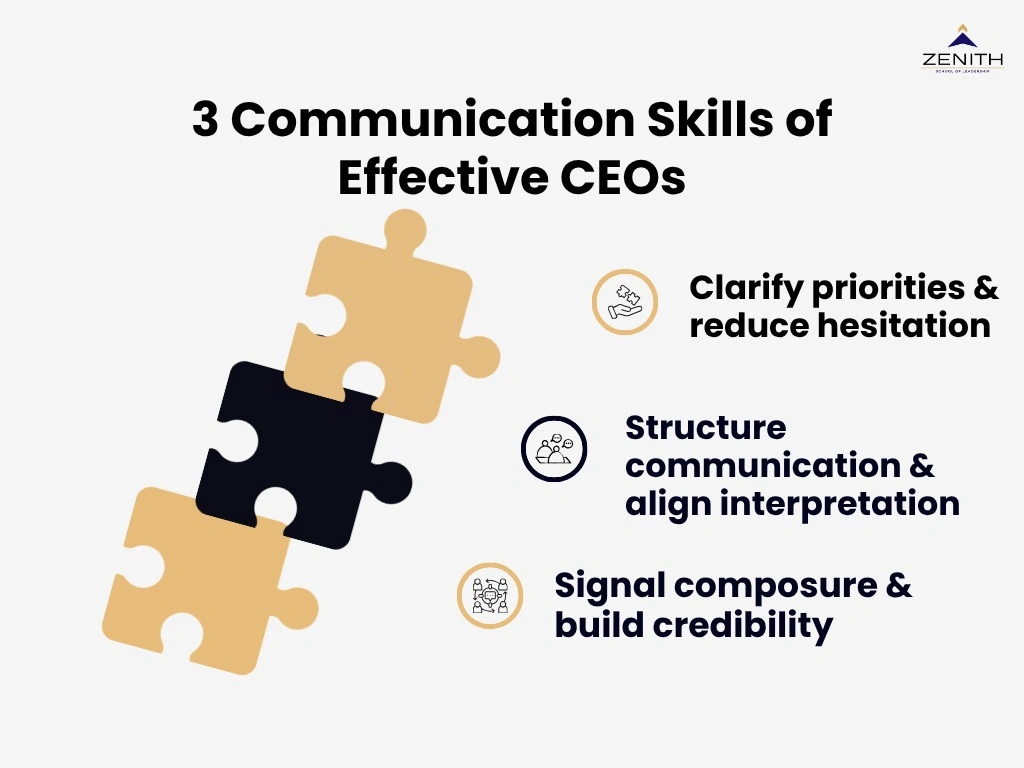
- Clarify priorities to reduce decision hesitation
- Structure communication to stabilize interpretation
- Signal composure to strengthen leadership credibility
Some leaders have access to the same data, the same strategy, and the same intent. Yet what people experience from them is very different.
In stable environments, that difference can go unnoticed. But when expectations are unclear, outcomes feel exposed, and stakeholders are watching closely, leadership communication becomes highly visible.
At senior levels, information is rarely the main issue. What is often missing is interpretive precision. People may hear the same update and still leave with different conclusions. One person hears caution. Another hears urgency. One team assumes a pause. Another assumes acceleration. The message was shared. The meaning was not.
This is where leadership communication techniques become critical. Successful CEOs understand that people do not respond to data first. They respond to the meaning built around the data.
They do not speak more. They reduce interpretive noise.
-Every sentence signals priority.
-Every pause signals confidence.
-Every response signals direction.
This is why clarity in executive communication is not a style choice. It is a leadership advantage. Because when leaders clarify interpretation, they accelerate alignment.
Why Leadership Communication Matters More at the CEO Level
At senior levels, communication does far more than convey information. It shapes how people interpret strategy, risk, accountability, and direction.
This is why two CEOs can present similar updates and create very different organizational responses. One creates confidence, movement, and alignment. The other creates analysis, hesitation, and mixed assumptions.
The difference is rarely intelligence. It is usually a communication structure.
Strong strategic communication helps people understand not only what is happening, but what that reality means for action. It reduces interpretive effort. It gives teams a cleaner frame through which to think, prioritize, and decide.
When that structure is missing, even good strategy can begin to feel uncertain. An organization may look active on the surface and still remain directionally unstable underneath.
This is why leadership communication is not a support function sitting beside strategy. At the highest level, it is one of the mechanisms through which strategy becomes executable.
How 3 Successful CEOs Use Leadership Communication to Shape Direction

The most effective CEOs do not use communication only to inform people. They use it to remove confusion, shape interpretation, and make action easier.
What makes them powerful is not only what they say. It is how clearly they help others understand what matters, what changes now, and what cannot be misunderstood.
Here are three CEO examples that show how this works in very different ways and what leaders can learn from each of them.
1. Reed Hastings used precision when culture could no longer run on assumption
In the early growth stage of a company, a lot can run on energy, talent, and shared instinct. People work closely, move fast, and often understand expectations without everything being spelled out. But as a company grows, that stops being enough.
That was one of the big challenges Reed Hastings faced at Netflix.
As Netflix scaled, he could see that if expectations remained implied instead of clearly stated, the culture would start becoming inconsistent. Different leaders would define performance differently. Teams would operate from different assumptions. Accountability would become uneven. And over time, that creates a culture that looks strong on the outside but feels confusing from within.
So instead of waiting for that confusion to grow, Hastings chose to make expectations unusually clear.
Netflix became widely known for language such as “adequate performance gets a generous severance” and the framing that it is “a team, not a family.” The company’s official culture material has continued that same logic through its “dream team” language, comparing the culture more to a professional sports team than a family environment.
Why was this communication powerful?
Because it did not leave people guessing about what kind of culture they were entering or what standards would define success there.
It made three things clear:
- Performance standards were high.
- Belonging did not remove accountability.
- Cultural clarity mattered more than emotional softening.
Now this is where many readers may raise a valid objection.
Does this mean leaders have to become harsh to be clear?
No.
That is not the lesson.
The lesson is not to copy Netflix’s tone. The lesson is to copy the courage of specificity.
Hastings was not trying to be rude for effect. He was being proactive. He understood that when expectations stay vague, discomfort does not disappear. It just gets delayed. And delayed discomfort often becomes much messier because it shows up later as resentment, confusion, uneven performance standards, and avoidable people issues.
That is the leadership lesson here.
Clear expectations may create a moment of discomfort.
Unclear expectations create months of it. What leaders can apply immediately Most leaders do not need language as sharp as Netflix’s. But they do need far more clarity than they currently use.
Instead of saying:
“We need stronger ownership.”
“We need people to step up.”
“We need more accountability.”
Say:
“What ownership looks like in this role is this.”
“This standard is non-negotiable.”
“If this does not improve by this point, we will need to take a different decision.”
That is not unkind.
In many cases, it is more respectful because people deserve to know what is actually expected instead of being left to decode it.
The real lesson from Hastings is simple:
Do not wait for confusion to become culture before you clarify what matters.
2. Satya Nadella used empathy to make clarity easier to receive
When Satya Nadella stepped into Microsoft, the challenge was not only about business performance. It was also about culture.
Microsoft had tremendous capability, but it was also carrying habits that could slow collaboration, learning, and innovation. Nadella understood that changing a culture at that scale was not only a strategy problem. It was a communication problem.
If people feel blamed, cornered, or diminished, they resist change even when the direction is right. That is why Nadella’s leadership communication became so distinctive.
He consistently emphasized empathy, learning, and growth mindset.
Why was this communication powerful?
Because it showed that clarity does not always have to arrive through hardness. It can also arrive through receptivity.
Nadella helped people feel that the direction was serious, but not hostile. Clear, but not demeaning. Challenging, but not dismissive. That matters because many leaders make one of two mistakes.
They become so careful that the message loses edge.
Or they become so blunt that the message triggers resistance.
Nadella’s communication showed a more intelligent middle path.
He made clarity easier to receive by making people feel understood first.
This does not mean empathy should dilute standards. It means empathy can improve how standards are heard. That is the lesson normal leaders can apply every day.
When people feel that you understand the pressure, complexity, or effort involved, they become more open to hearing what now needs to change.
What leaders can apply immediately
Before giving a difficult direction, first acknowledge the human reality around it.
Instead of saying:
“This team needs to move faster.”
Say:
“I know this team has been carrying complexity and cross functional pressure. That said, the next phase requires faster decision speed, and here is where we need to tighten.”
That small shift does something powerful.
- It lowers defensiveness.
- It keeps dignity intact.
- It makes the message easier to receive without weakening the direction.
The lesson from Nadella is this:
If you want clarity to land, make it easier for people to stay open while receiving it.
3. Andy Grove used direct framing to help people see when the game had changed
One of the biggest communication mistakes leaders make is this:
They speak about major shifts as though they are minor developments.
That is dangerous because when a leader underframe the scale of a change, the organization underreacts. People keep operating from yesterday’s assumptions, even though the environment no longer supports them. Andy Grove understood this deeply.
At Intel, he became known for the idea of the strategic inflection point.
Why was this communication powerful?
Because it named the scale of change honestly.
It told people, in effect:
- This is not a routine adjustment.
- This is not a small variation.
- This is the kind of shift that requires us to think and act differently.
That kind of framing matters more than many leaders realize.
Because before people can respond well to a shift, they have to understand that a shift has actually happened.
Now here too, some readers may hesitate.
Do I need to sound dramatic every time something changes?
No.
That is not the lesson.
The lesson is not to dramatize. The lesson is to frame proportionately. Small changes should be framed as small. Major changes should be framed as major.
What weak leaders often do is flatten both. And once everything is communicated with the same level of weight, people lose the ability to judge what really matters.
Grove’s strength was that he helped people see when the old map no longer worked.
What leaders can apply immediately
When the context has changed sharply, do not communicate it like a routine update.
Avoid saying:
“We are making a few adjustments.”
Instead say:
“The environment has changed enough that our previous way of operating will no longer protect performance. This requires a different level of speed, focus, and decision discipline.”
That kind of communication helps people understand the scale of the moment and respond accordingly.
The lesson from Grove is this:
If the game has changed, say so clearly enough that people stop playing by the old rules.
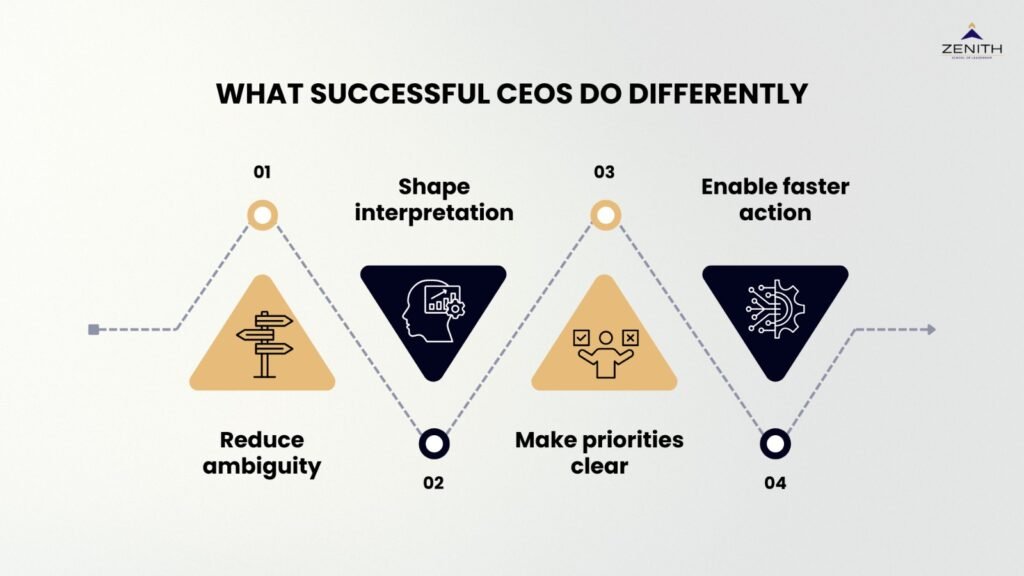
What All 3 CEOs Reveal
These three examples show that strong CEO communication is not one style. It is one discipline expressed in different ways.
Reed Hastings shows the power of specificity when expectations must not remain vague. Satya Nadella shows the power of empathy with direction when change must be received, not resisted. Andy Grove shows the power of clear framing when people need to understand that the context itself has shifted.
Different leaders. Different tones. Different situations. But the communication advantage is the same.
- They reduce ambiguity.
- They shape interpretation.
- They make action easier.
And that is the real lesson for every leader.
You do not need to sound like them. You need to understand what they were solving through communication.
Because in most leadership situations, people are not struggling only because the work is hard. They are struggling because what matters, what changes, and what is expected have not been made clear enough.
The Hidden Pattern: Strategic Clarity Compression
One of the less discussed strengths of successful CEOs is their ability to reduce complexity without reducing meaning. They do not always use more words. They use clearer implications. This is what I would call Strategic Clarity Compression.
It is the ability to communicate in a way that makes priorities, boundaries, and direction easier to understand without oversimplifying reality.
When communication expands without enough structure, several problems begin to appear.
- Stakeholders interpret differently.
- Expectations become inconsistent.
- Decision confidence weakens.
- Execution slows because people are moving from different assumptions.
Strong CEOs compress that confusion before it spreads.
Their communication tends to do four things well.
- It defines priorities.
- It clarifies boundaries.
- It signals direction.
- It preserves confidence under pressure.
Clarity does not make reality simpler. It makes interpretation more stable. And when interpretation stabilizes, momentum follows.
The Zenith Lens: Why Communication Shapes Leadership Credibility
At senior levels, people are not only listening to what is being said. They are reading what the communication reveals.
This is where Communication Intelligence becomes especially relevant.
It explains why two leaders can share similar updates and still create very different levels of trust, alignment, and credibility. Because stakeholders are never evaluating communication only at the surface level.
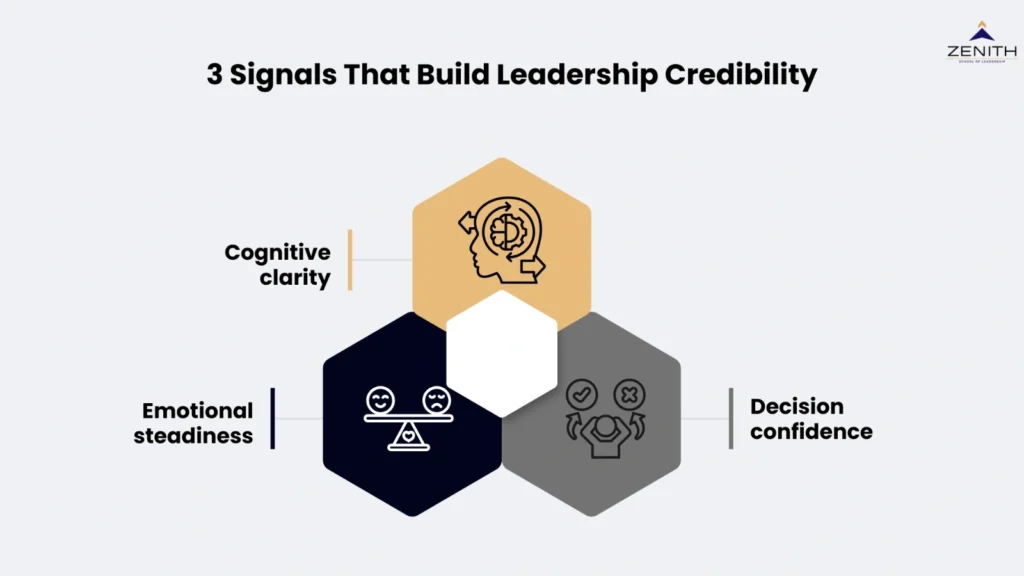
They are responding to three underlying signals.
- Cognitive clarity
Does this reduce confusion or increase it - Emotional steadiness
Does the leader feel composed or reactive - Decision confidence
Does this help me understand what to do next
When these three signals are strong, something important begins to shift across the system.
- Interpretation starts aligning.
- Conversations become shorter.
- Decisions move faster.
- People stop spending unnecessary energy decoding the message.
Every message carries a signal.
- Is this leader clear or uncertain
- Composed or pressured
- Directional or still figuring it out
Over time, these signals shape how leadership is experienced.
This is why executive communication does not influence credibility only through content. It influences credibility through signal quality.
What Weakens Leadership Communication: The Comfort Trap
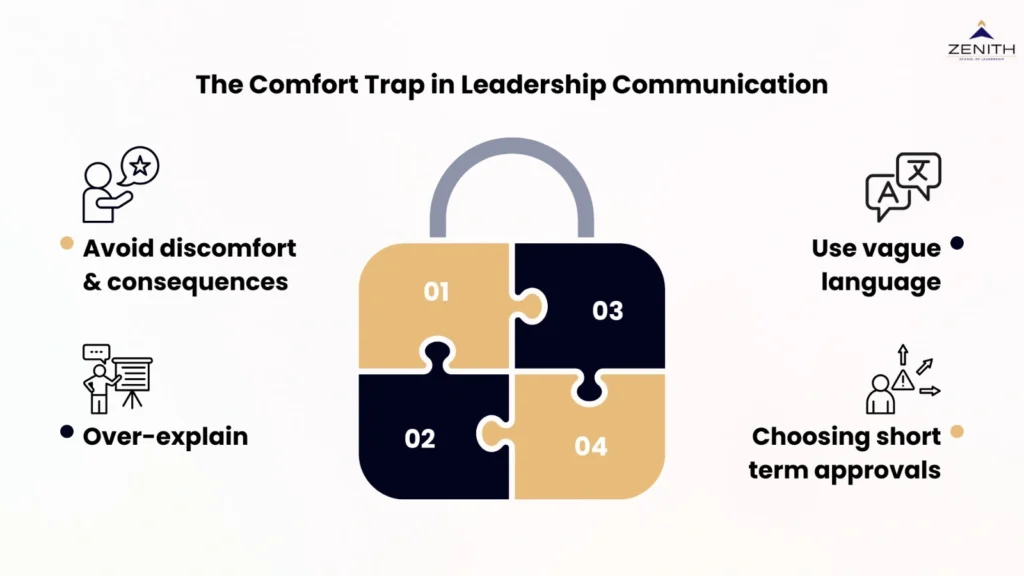
Leaders do not usually lose clarity because they lack intelligence. They lose clarity because they try to protect comfort. That is where many communication failures begin.
- A leader softens expectations to avoid discomfort.
- Uses diplomatic language where precision is needed.
- Over explains to appear balanced.
- Avoids naming consequences directly.
- Chooses short term approval over long term clarity.
All of this may feel safer at the moment. But it creates a dangerous illusion. People feel comfortable. They do not feel clear.
And comfort without clarity does not create alignment. It creates vague standards, slower decisions, and fragmented execution.
This is why the real risk in leadership communication is not being too clear. It is being unclear in the hope of being more comfortable.
What Strengthens Leadership Communication Techniques
Strong leadership communication techniques are built through structured clarity.
1. Communicate Expectations with Precision
People should not have to guess what good performance means. The more senior the environment, the more expensive that ambiguity becomes.
Strong leaders define expectations clearly. They help people understand what success looks like, what standards apply, what decisions guide direction, and which boundaries remain stable.
This reduces interpretive effort and improves consistency in execution.
2. Reduce Communication Noise
Many messages become weak not because the idea is poor, but because the structure is messy.
Strong leaders bring sequence to communication.
- They define the situation.
- They clarify what it means.
- They state the decision direction.
- They confirm the priority.
This is what makes strategic communication easier to absorb. People do not need more words. They need a cleaner path through the message.
3. Signal Authority Through Composure
Authority is not built only through what a leader says. It is built through the steadiness with which they say it.
People notice pacing, response structure, emotional control, and language discipline. These cues shape whether communication feels grounded or pressured.
Strong executive communication carries a calm structure. That steadiness increases trust, reduces noise, and strengthens leadership credibility.
A Practical Tool: Strategic Clarity Compression™ Model
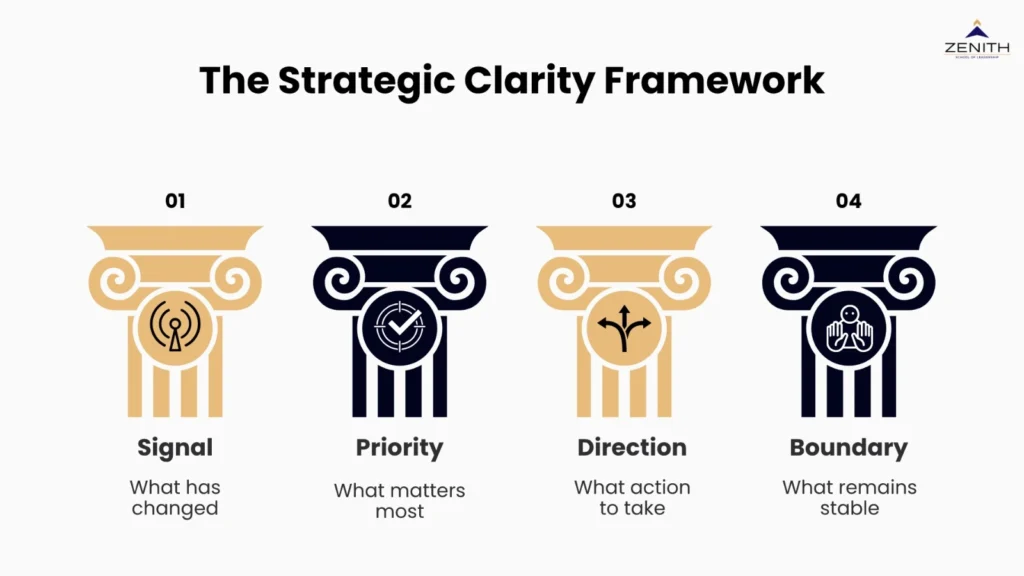
A useful communication discipline for senior leaders is to structure important messages through four elements.
- Signal
What has changed - Priority
What matters most now - Direction
What decision or action should guide people now - Boundary
What remains stable and should not be misread as changing
This simple model helps reduce interpretive effort without oversimplifying complexity.
It is especially useful in:
- Board meetings
- Investor communication
- Change communication
- Performance expectation alignment
- Strategic announcements
The value of the model is simple. It makes communication easier to follow, easier to repeat, and easier to act on.
A Simple Discipline to Build Clarity and Alignment
In high stakes environments, clarity is rarely accidental. It is built through small, repeatable communication habits.
Before communicating any strategic decision, pause and define four things:
- What has changed
- What matters most now
- What decision guides action
- What remains stable
This discipline immediately strengthens message clarity and reduces unnecessary repetition. To make the shift even more practical, add one sentence to every important conversation over the next seven days:
The priority guiding this decision is ______.
That one line does a great deal of work.
- It anchors attention.
- It reduces interpretive drift.
- It makes direction more visible.
- It shortens the distance between communication and action.
Over time, you are likely to notice:
- Faster decision alignment
- Fewer clarification loops
- Stronger follow through
- Reduced meeting time
Clarity compounds just as quickly as confusion does when it is practiced consistently.

A Quick Self Audit for Senior Leaders
To assess whether your communication is creating clarity or adding interpretive load, ask yourself:
- Does my communication reduce or increase interpretive effort
- Are expectations clear enough to be repeated consistently
- Does my communication signal calm authority
- Have I clarified what matters most now
- Would others prioritize the same action after hearing me
These patterns become visible quickly. And when they do, communication stops feeling like effort. It starts becoming leadership leverage.
Key Takeaways: Public Speaking as a Leadership Multiplier
Public speaking for executives acts as a leadership multiplier within organizations.
Clear and disciplined communication allows ideas to spread more effectively, enables teams to understand complex decisions, and accelerates alignment across departments.
Leaders who communicate with structured thinking and calm authority help organizations navigate uncertainty with greater confidence. Over time this communication clarity becomes one of the most visible signals of leadership capability.
Executives who master this skill are not simply delivering presentations. They are guiding decisions and shaping how organizations move forward.
Why keep proving yourself silently? Step into influence that gets recognized.
- 1:1 Strategy Session for precision diagnosis of communication gaps
- Defined Success Signals to align perception with performance
- Interpretation Clarity to eliminate misunderstanding at leadership level
- Executive Presence Framing to strengthen how your value is perceived
- Leverage Mapping to unlock high-impact visibility and influence
- Invitation-Only Access for professionals ready for next-level growth
Final Thought
Leadership influence is rarely determined by how much a CEO says. It is determined by how clearly others understand what matters most. That is why the most effective CEOs do not rely on volume, charisma, or verbal polish alone.
They use leadership communication techniques that reduce confusion, stabilize interpretation, and make action easier. And in environments where hesitation is costly, that clarity becomes a strategic advantage.
Frequently Asked Questions
They are structured communication approaches that help leaders create clarity, alignment, and direction. They improve how complex information is interpreted so that people can act with stronger consistency and confidence.
Because CEOs are not only sharing information. They are shaping interpretation. Strong communication helps reduce ambiguity, improve alignment speed, and strengthen leadership credibility in high pressure environments.
They simplify complexity without becoming vague. They clarify priorities, define direction, and communicate in a way that stabilizes interpretation.
Yes. Communication improves through structured thinking, deliberate frameworks, and repeated practice. Leaders strengthen it by improving clarity, sequencing, and decision logic.
Over explaining, vague expectations, reactive tone shifts, unclear decision framing, and communication designed to protect comfort more than clarity.
It shapes how a leader is experienced. When communication carries composure, structure, and clarity, it strengthens authority and makes executive presence more visible.
I’ve seen many corporate programs, but rarely this level of personal commitment. Her guidance made a leader with clarity, insight, and confidence visible in every decision I make.

Raja Nippani
Assistant Vice President | Genpact
Table of Content
Read summarized version with
TLDR | 3 Executive Actions for Leaders
Clarify priorities to reduce decision hesitation
Structure communication to stabilize interpretation
Signal composure to strengthen leadership credibility
Some leaders have access to the same data, the same strategy, and the same intent.
Yet what people experience from them is very different.
In stable environments, that difference can go unnoticed.
But when expectations are unclear, outcomes feel exposed, and stakeholders are watching closely, leadership communication becomes highly visible.
At senior levels, information is rarely the main issue. What is often missing is interpretive precision.
People may hear the same update and still leave with different conclusions. One person hears caution. Another hears urgency. One team assumes a pause. Another assumes acceleration. The message was shared. The meaning was not.
This is where leadership communication techniques become critical.
Successful CEOs understand that people do not respond to data first. They respond to the meaning built around the data.
They do not speak more. They reduce interpretive noise.
-Every sentence signals priority.
-Every pause signals confidence.
-Every response signals direction.
This is why clarity in executive communication is not a style choice. It is a leadership advantage.
Because when leaders clarify interpretation, they accelerate alignment.
Why Leadership Communication Matters More at the CEO Level
At senior levels, communication does far more than convey information.
It shapes how people interpret strategy, risk, accountability, and direction.
This is why two CEOs can present similar updates and create very different organizational responses. One creates confidence, movement, and alignment. The other creates analysis, hesitation, and mixed assumptions.
The difference is rarely intelligence.
It is usually a communication structure.
Strong strategic communication helps people understand not only what is happening, but what that reality means for action. It reduces interpretive effort. It gives teams a cleaner frame through which to think, prioritize, and decide.
When that structure is missing, even good strategy can begin to feel uncertain.
An organization may look active on the surface and still remain directionally unstable underneath.
This is why leadership communication is not a support function sitting beside strategy.
At the highest level, it is one of the mechanisms through which strategy becomes executable.
How 3 Successful CEOs Use Leadership Communication to Shape Direction
The most effective CEOs do not use communication only to inform people.
They use it to remove confusion, shape interpretation, and make action easier.
What makes them powerful is not only what they say. It is how clearly they help others understand what matters, what changes now, and what cannot be misunderstood.
Here are three CEO examples that show how this works in very different ways and what leaders can learn from each of them.
1. Reed Hastings used precision when culture could no longer run on assumption
In the early growth stage of a company, a lot can run on energy, talent, and shared instinct. People work closely, move fast, and often understand expectations without everything being spelled out. But as a company grows, that stops being enough.
That was one of the big challenges Reed Hastings faced at Netflix.
As Netflix scaled, he could see that if expectations remained implied instead of clearly stated, the culture would start becoming inconsistent. Different leaders would define performance differently. Teams would operate from different assumptions. Accountability would become uneven. And over time, that creates a culture that looks strong on the outside but feels confusing from within.
So instead of waiting for that confusion to grow, Hastings chose to make expectations unusually clear.
Netflix became widely known for language such as “adequate performance gets a generous severance” and the framing that it is “a team, not a family.” The company’s official culture material has continued that same logic through its “dream team” language, comparing the culture more to a professional sports team than a family environment.
Why was this communication powerful?
Because it did not leave people guessing about what kind of culture they were entering or what standards would define success there.
It made three things clear:
Performance standards were high.
Belonging did not remove accountability.
Cultural clarity mattered more than emotional softening.
Now this is where many readers may raise a valid objection.
Does this mean leaders have to become harsh to be clear?
No.
That is not the lesson.
The lesson is not to copy Netflix’s tone.
The lesson is to copy the courage of specificity.
Hastings was not trying to be rude for effect. He was being proactive. He understood that when expectations stay vague, discomfort does not disappear. It just gets delayed. And delayed discomfort often becomes much messier because it shows up later as resentment, confusion, uneven performance standards, and avoidable people issues.
That is the leadership lesson here.
Clear expectations may create a moment of discomfort.
Unclear expectations create months of it.
What leaders can apply immediately
Most leaders do not need language as sharp as Netflix’s. But they do need far more clarity than they currently use.
Instead of saying:
“We need stronger ownership.”
“We need people to step up.”
“We need more accountability.”
Say:
“What ownership looks like in this role is this.”
“This standard is non-negotiable.”
“If this does not improve by this point, we will need to take a different decision.”
That is not unkind.
In many cases, it is more respectful because people deserve to know what is actually expected instead of being left to decode it.
The real lesson from Hastings is simple:
Do not wait for confusion to become culture before you clarify what matters.
2. Satya Nadella used empathy to make clarity easier to receive
When Satya Nadella stepped into Microsoft, the challenge was not only about business performance. It was also about culture.
Microsoft had tremendous capability, but it was also carrying habits that could slow collaboration, learning, and innovation. Nadella understood that changing a culture at that scale was not only a strategy problem. It was a communication problem.
If people feel blamed, cornered, or diminished, they resist change even when the direction is right.
That is why Nadella’s leadership communication became so distinctive.
He consistently emphasized empathy, learning, and growth mindset.
Why was this communication powerful?
Because it showed that clarity does not always have to arrive through hardness.
It can also arrive through receptivity.
Nadella helped people feel that the direction was serious, but not hostile. Clear, but not demeaning. Challenging, but not dismissive.
That matters because many leaders make one of two mistakes.
Either they become so careful that the message loses edge.
Or they become so blunt that the message triggers resistance.
Nadella’s communication showed a more intelligent middle path.
He made clarity easier to receive by making people feel understood first.
This does not mean empathy should dilute standards.
It means empathy can improve how standards are heard.
That is the lesson normal leaders can apply every day.
When people feel that you understand the pressure, complexity, or effort involved, they become more open to hearing what now needs to change.
What leaders can apply immediately
Before giving a difficult direction, first acknowledge the human reality around it.
Instead of saying:
“This team needs to move faster.”
Say:
“I know this team has been carrying complexity and cross functional pressure. That said, the next phase requires faster decision speed, and here is where we need to tighten.”
That small shift does something powerful.
It lowers defensiveness.
It keeps dignity intact.
It makes the message easier to receive without weakening the direction.
The lesson from Nadella is this:
If you want clarity to land, make it easier for people to stay open while receiving it.
3. Andy Grove used direct framing to help people see when the game had changed
One of the biggest communication mistakes leaders make is this:
They speak about major shifts as though they are minor developments.
That is dangerous because when a leader underframes the scale of a change, the organization underreacts. People keep operating from yesterday’s assumptions, even though the environment no longer supports them.
Andy Grove understood this deeply.
At Intel, he became known for the idea of the strategic inflection point.
Why was this communication powerful?
Because it named the scale of change honestly.
It told people, in effect:
This is not a routine adjustment.
This is not a small variation.
This is the kind of shift that requires us to think and act differently.
That kind of framing matters more than many leaders realize.
Because before people can respond well to a shift, they have to understand that a shift has actually happened.
Now here too, some readers may hesitate.
Do I need to sound dramatic every time something changes?
No.
That is not the lesson.
The lesson is not to dramatize.
The lesson is to frame proportionately.
Small changes should be framed as small.
Major changes should be framed as major.
What weak leaders often do is flatten both. And once everything is communicated with the same level of weight, people lose the ability to judge what really matters.
Grove’s strength was that he helped people see when the old map no longer worked.
What leaders can apply immediately
When the context has changed sharply, do not communicate it like a routine update.
Avoid saying:
“We are making a few adjustments.”
Instead say:
“The environment has changed enough that our previous way of operating will no longer protect performance. This requires a different level of speed, focus, and decision discipline.”
That kind of communication helps people understand the scale of the moment and respond accordingly.
The lesson from Grove is this:
If the game has changed, say so clearly enough that people stop playing by the old rules.
What All 3 CEOs Reveal
These three examples show that strong CEO communication is not one style.
It is one discipline expressed in different ways.
Reed Hastings shows the power of specificity when expectations must not remain vague.
Satya Nadella shows the power of empathy with direction when change must be received, not resisted.
Andy Grove shows the power of clear framing when people need to understand that the context itself has shifted.
Different leaders. Different tones. Different situations.
But the communication advantage is the same.
They reduce ambiguity.
They shape interpretation.
They make action easier.
And that is the real lesson for every leader.
You do not need to sound like them.
You need to understand what they were solving through communication.
Because in most leadership situations, people are not struggling only because the work is hard.
They are struggling because what matters, what changes, and what is expected have not been made clear enough.
The Hidden Pattern: Strategic Clarity Compression
One of the less discussed strengths of successful CEOs is their ability to reduce complexity without reducing meaning.
They do not always use more words. They use clearer implications.
This is what I would call Strategic Clarity Compression.
It is the ability to communicate in a way that makes priorities, boundaries, and direction easier to understand without oversimplifying reality.
When communication expands without enough structure, several problems begin to appear.
Stakeholders interpret differently.
Expectations become inconsistent.
Decision confidence weakens.
Execution slows because people are moving from different assumptions.
Strong CEOs compress that confusion before it spreads.
Their communication tends to do four things well.
It defines priorities.
It clarifies boundaries.
It signals direction.
It preserves confidence under pressure.
Clarity does not make reality simpler.
It makes interpretation more stable.
And when interpretation stabilizes, momentum follows.
The Zenith Lens: Why Communication Shapes Leadership Credibility
At senior levels, people are not only listening to what is being said.
They are reading what the communication reveals.
This is where Communication Intelligence becomes especially relevant.
It explains why two leaders can share similar updates and still create very different levels of trust, alignment, and credibility.
Because stakeholders are never evaluating communication only at the surface level.
They are responding to three underlying signals.
Cognitive clarity
Does this reduce confusion or increase it
Emotional steadiness
Does the leader feel composed or reactive
Decision confidence
Does this help me understand what to do next
When these three signals are strong, something important begins to shift across the system.
Interpretation starts aligning.
Conversations become shorter.
Decisions move faster.
People stop spending unnecessary energy decoding the message.
Every message carries a signal.
Is this leader clear or uncertain
Composed or pressured
Directional or still figuring it out
Over time, these signals shape how leadership is experienced.
This is why executive communication does not influence credibility only through content. It influences credibility through signal quality.
What Weakens Leadership Communication: The Comfort Trap
Leaders do not usually lose clarity because they lack intelligence.
They lose clarity because they try to protect comfort.
That is where many communication failures begin.
A leader softens expectations to avoid discomfort.
Uses diplomatic language where precision is needed.
Over explains to appear balanced.
Avoids naming consequences directly.
Chooses short term approval over long term clarity.
All of this may feel safer at the moment.
But it creates a dangerous illusion.
People feel comfortable.
They do not feel clear.
And comfort without clarity does not create alignment.
It creates vague standards, slower decisions, and fragmented execution.
This is why the real risk in leadership communication is not being too clear.
It is being unclear in the hope of being more comfortable.
What Strengthens Leadership Communication Techniques
Strong leadership communication techniques are built through structured clarity.
1. Communicate Expectations with Precision
People should not have to guess what good performance means.
The more senior the environment, the more expensive that ambiguity becomes.
Strong leaders define expectations clearly. They help people understand what success looks like, what standards apply, what decisions guide direction, and which boundaries remain stable.
This reduces interpretive effort and improves consistency in execution.
2. Reduce Communication Noise
Many messages become weak not because the idea is poor, but because the structure is messy.
Strong leaders bring sequence to communication.
They define the situation.
They clarify what it means.
They state the decision direction.
They confirm the priority.
This is what makes strategic communication easier to absorb.
People do not need more words. They need a cleaner path through the message.
3. Signal Authority Through Composure
Authority is not built only through what a leader says.
It is built through the steadiness with which they say it.
People notice pacing, response structure, emotional control, and language discipline. These cues shape whether communication feels grounded or pressured.
Strong executive communication carries a calm structure.
That steadiness increases trust, reduces noise, and strengthens leadership credibility.
A Practical Tool: Strategic Clarity Compression™ Model
A useful communication discipline for senior leaders is to structure important messages through four elements.
Signal
What has changed
Priority
What matters most now
Direction
What decision or action should guide people now
Boundary
What remains stable and should not be misread as changing
This simple model helps reduce interpretive effort without oversimplifying complexity.
It is especially useful in:
Board meetings
Investor communication
Change communication
Performance expectation alignment
Strategic announcements
The value of the model is simple.
It makes communication easier to follow, easier to repeat, and easier to act on.
A Simple Discipline to Build Clarity and Alignment
In high stakes environments, clarity is rarely accidental.
It is built through small, repeatable communication habits.
Before communicating any strategic decision, pause and define four things:
What has changed
What matters most now
What decision guides action
What remains stable
This discipline immediately strengthens message clarity and reduces unnecessary repetition.
To make the shift even more practical, add one sentence to every important conversation over the next seven days:
The priority guiding this decision is ______.
That one line does a great deal of work.
It anchors attention.
It reduces interpretive drift.
It makes direction more visible.
It shortens the distance between communication and action.
Over time, you are likely to notice:
Faster decision alignment
Fewer clarification loops
Stronger follow through
Reduced meeting time
Clarity compounds just as quickly as confusion does when it is practiced consistently.
A Quick Self Audit for Senior Leaders
To assess whether your communication is creating clarity or adding interpretive load, ask yourself:
Does my communication reduce or increase interpretive effort
Are expectations clear enough to be repeated consistently
Does my communication signal calm authority
Have I clarified what matters most now
Would others prioritize the same action after hearing me
These patterns become visible quickly.
And when they do, communication stops feeling like effort.
It starts becoming leadership leverage.
Key Takeaways: Public Speaking as a Leadership Multiplier
Public speaking for executives acts as a leadership multiplier within organizations.
Clear and disciplined communication allows ideas to spread more effectively, enables teams to understand complex decisions, and accelerates alignment across departments.
Leaders who communicate with structured thinking and calm authority help organizations navigate uncertainty with greater confidence.
Over time this communication clarity becomes one of the most visible signals of leadership capability.
Executives who master this skill are not simply delivering presentations. They are guiding decisions and shaping how organizations move forward.
Final Thought
Leadership influence is rarely determined by how much a CEO says.
It is determined by how clearly others understand what matters most.
That is why the most effective CEOs do not rely on volume, charisma, or verbal polish alone.
They use leadership communication techniques that reduce confusion, stabilize interpretation, and make action easier.
And in environments where hesitation is costly, that clarity becomes a strategic advantage.
Frequently Asked Questions
They are structured communication approaches that help leaders create clarity, alignment, and direction. They improve how complex information is interpreted so that people can act with stronger consistency and confidence.
Because CEOs are not only sharing information. They are shaping interpretation. Strong communication helps reduce ambiguity, improve alignment speed, and strengthen leadership credibility in high pressure environments.
They simplify complexity without becoming vague. They clarify priorities, define direction, and communicate in a way that stabilizes interpretation.
Yes. Communication improves through structured thinking, deliberate frameworks, and repeated practice. Leaders strengthen it by improving clarity, sequencing, and decision logic.
Over explaining, vague expectations, reactive tone shifts, unclear decision framing, and communication designed to protect comfort more than clarity.
It shapes how a leader is experienced. When communication carries composure, structure, and clarity, it strengthens authority and makes executive presence more visible.