Emotional Intelligence in Leadership: The Invisible Moments That Build or Break Trust
- March 10, 2026
- Gurleen Kaur
Emotional Intelligence in Leadership: The Invisible Moments That Build or Break Trust
- March 10, 2026
- Gurleen Kaur
Table of Content
Read summarized version with
TLDR | 3 Leadership Realities
- Leaders rarely lose trust only through major mistakes. More often, trust tightens in small moments when emotional pressure starts shaping tone, pace, and response
- What people remember in leadership is not only what was decided. They remember how safe, steady, and open the conversation felt while the decision was being made
- Performance often weakens after trust has already started shrinking, which is why emotional intelligence in leadership matters long before visible problems appear
The Invisible Moment That Reveals Leadership
Leadership rarely weakens in dramatic moments first.
It begins to weaken in smaller moments that most people do not name early enough.
A leader is challenged in a meeting.
A concern is raised at the wrong time.
A disagreement carries more force than expected.
Nothing visibly collapses.
The leader keeps speaking.
The discussion keeps moving.
The meeting continues on the surface.
But something inside the interaction tightens.
People become more careful.
Their honesty becomes more filtered.
The quality of what they are willing to say begins to shrink.
This is one of the most important truths about emotional intelligence in leadership.
Leaders do not lose trust only through major mistakes. More often, they lose it through subtle emotional signals that quietly make people less open, less brave, and less truthful around them.
And once that begins, performance problems usually come later.
Trust tightens first.
What Emotional Intelligence in Leadership Really Means
Emotional intelligence in leadership is often reduced to broad words like empathy, self awareness, or people skills. Those matter, but they do not fully explain what leaders are dealing with in real time.
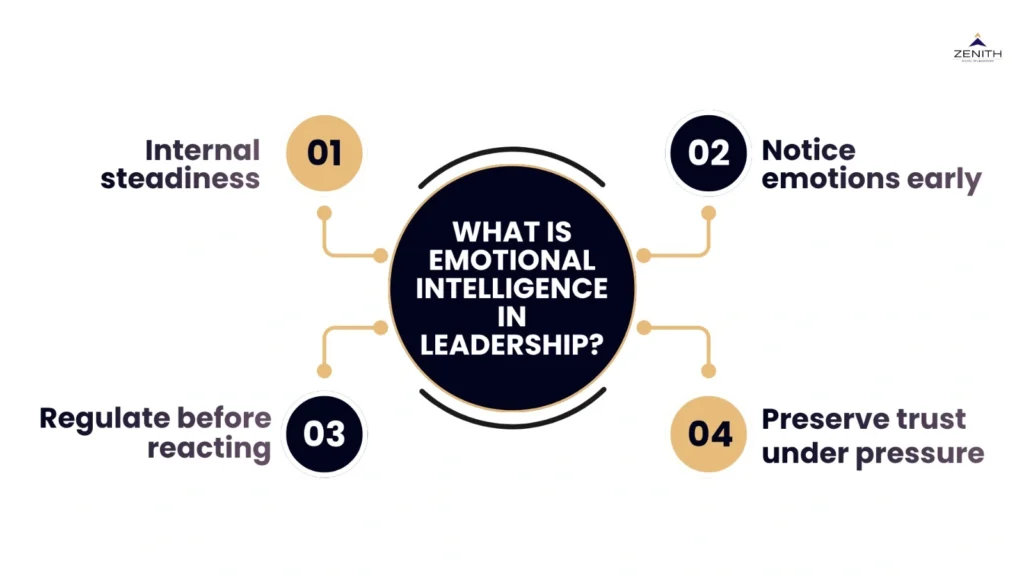
In practice, emotional intelligence is the ability to notice emotional signals early, regulate internal reactions before they begin shaping the conversation, and respond in ways that preserve trust, clarity, and sound judgment.
This matters because teams are always reading more than a leader’s words.
They are reading:
How safe it feels to disagree
How costly it feels to raise a concern
How steady the leader remains when challenged
How much truth the conversation can still hold
That is why emotional intelligence is not about appearing calm on the surface.
It is about whether pressure starts leaking into leadership behavior in ways that quietly make people less open, less honest, and less willing to contribute fully.
The Hidden Problem: Emotional Leakage
The hidden problem in many leadership environments is not emotional drama.
It is emotional leakage.
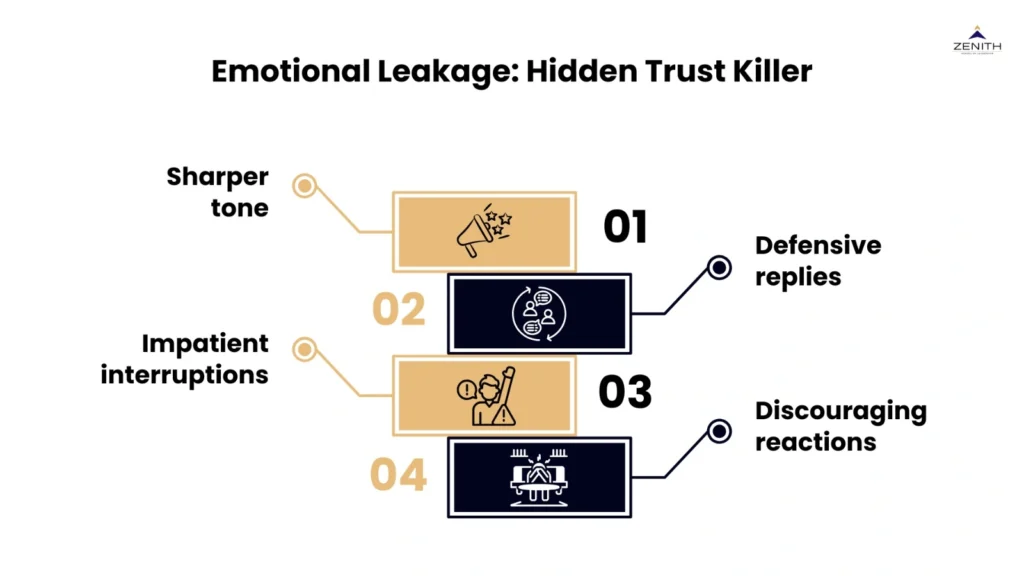
Emotional leakage is the subtle spillover of internal pressure into leadership behavior before the leader has consciously managed it.
It may show up as:
A sharper tone than intended
A rushed answer during disagreement
A defensive explanation instead of a curious question
An interruption that carries impatience
A facial response that makes challenge feel unwelcome
These moments often look too small to matter.
But they matter precisely because they are repeated, subtle, and easy to dismiss.
Trust rarely breaks all at once.
It tightens quietly through emotional leakage.
And once that begins, people adapt faster than leaders realize.
They become more diplomatic.
They take fewer interpersonal risks.
They share less unfinished thinking.
They protect themselves instead of strengthening the conversation.
That is when a team can still look functional on the surface while becoming less honest underneath.
Why Emotional Intelligence Matters So Much in Leadership
Daniel Goleman’s work in Harvard Business Review helped establish emotional intelligence as one of the strongest differentiators in leadership effectiveness, beyond technical skill and IQ. His argument was not that expertise stops mattering. It was that leadership effectiveness depends heavily on self awareness, self regulation, empathy, and social skill.
That becomes even more important at senior levels.
A senior leader’s emotional state does not stay private for long. It affects the emotional climate around decisions, conflict, feedback, and collaboration.
When a leader becomes visibly defensive, people start filtering what they say.
When a leader becomes sharp under pressure, honesty starts narrowing.
When a leader remains steady while tension rises, people keep contributing fully.
This is why emotional intelligence in leadership is not an optional refinement.
It shapes whether leadership creates openness or caution, trust or guardedness, clarity or emotional drag.
Why Trust Often Tightens Before Performance Slows
Amy Edmondson’s research on psychological safety helps explain why these small emotional moments matter so much. Psychological safety refers to an environment where people feel able to speak up, ask questions, share concerns, and challenge assumptions without fear of embarrassment or punishment.
A leader does not need to be openly hostile to weaken that environment.
A few repeated emotional signals are enough.
If disagreement is met with visible irritation, people learn.
If questions are treated as resistance, people learn.
If emotional reactions feel less predictable under pressure, people learn.
And what they learn is simple:
Say less.
Risk less.
Reveal less.
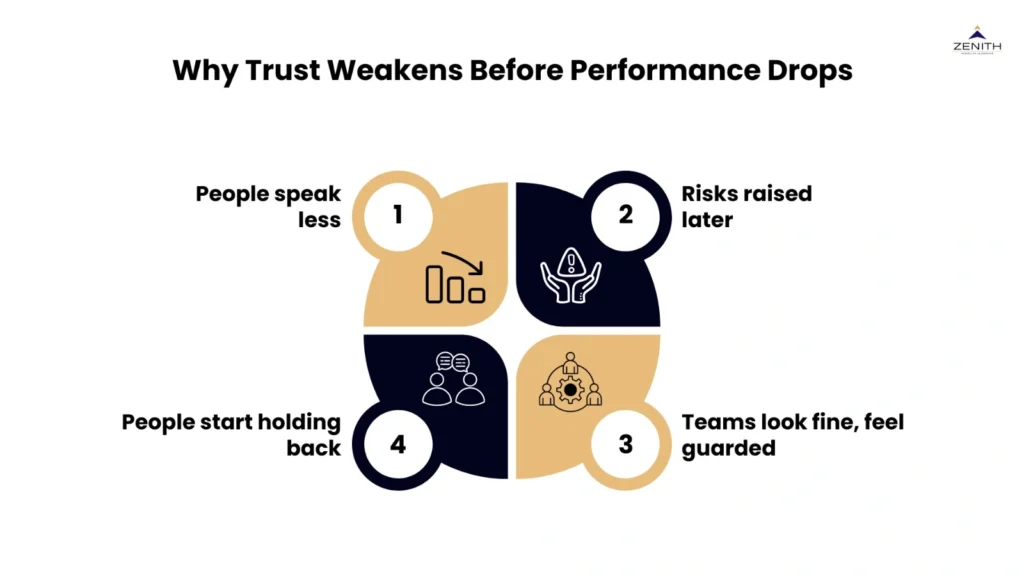
This is why performance often weakens after trust has already started shrinking.
By the time innovation slows, risks are raised too late, or meetings become performative instead of honest, the emotional signal has already been shaping behavior for much longer.
That is the real cost of weak emotional regulation in leadership.
A Real Leadership Example: Indra Nooyi
A powerful example comes from Indra Nooyi.
During her years leading PepsiCo, she became known not only for sharp leadership, but for deeply human acts of recognition. One of the most discussed examples was her habit of writing letters to the parents of senior executives, thanking them for the gift of their child to PepsiCo. She described the gesture as a way of recognizing the person and upbringing behind achievement. (forbes.com)
What makes this example powerful is not just that it was kind.
It was emotionally intelligent.
Nooyi understood that people do not enter organizations as roles alone. They bring effort, sacrifice, identity, pride, family history, and emotional memory. When leaders relate to people only through targets and output, they may still secure compliance. But they do not build the deeper trust that makes people feel seen, valued, and willing to stay open.
That is the leadership lesson here.
Emotional intelligence is not only revealed in how leaders handle pressure. It is also revealed in whether people feel deeply respected before pressure arrives.
That matters because trust is not built in one dramatic act.
It is built through repeated evidence that leadership sees the human being behind the performance.
What leaders can apply immediately
You do not have to copy Nooyi’s exact gesture.
But you do need to ask a sharper question:
Do people experience my leadership as purely evaluative, or also deeply human?
Then act on that.
Acknowledge effort specifically.
Recognize the person, not only the output.
Communicate value in a way that feels personal, not generic.
That is not softness.
It is one of the ways leadership trust gets built before pressure tests it.
What Emotional Intelligence Looks Like in Real Leadership Moments
In leadership, emotional intelligence becomes visible in moments like these:
A project is challenged in front of others
A colleague raises an uncomfortable concern
A deadline is missed
A decision you backed starts receiving criticism
Someone disagrees with your view in a tense conversation
In those moments, people are watching for more than the outcome.
They are watching:
Can this leader stay clear without becoming cold
Can this leader stay open without losing direction
Can this leader hear challenge without becoming defensive
Can this leader protect honesty while pressure rises
This is why emotional intelligence in leadership builds trust, presence, and performance at the same time.
It builds trust because people feel safer telling the truth.
It builds presence because steadiness is felt before it is described.
It builds performance because teams think better when conversations stay open.
The Zenith 3R Emotional Regulation Loop
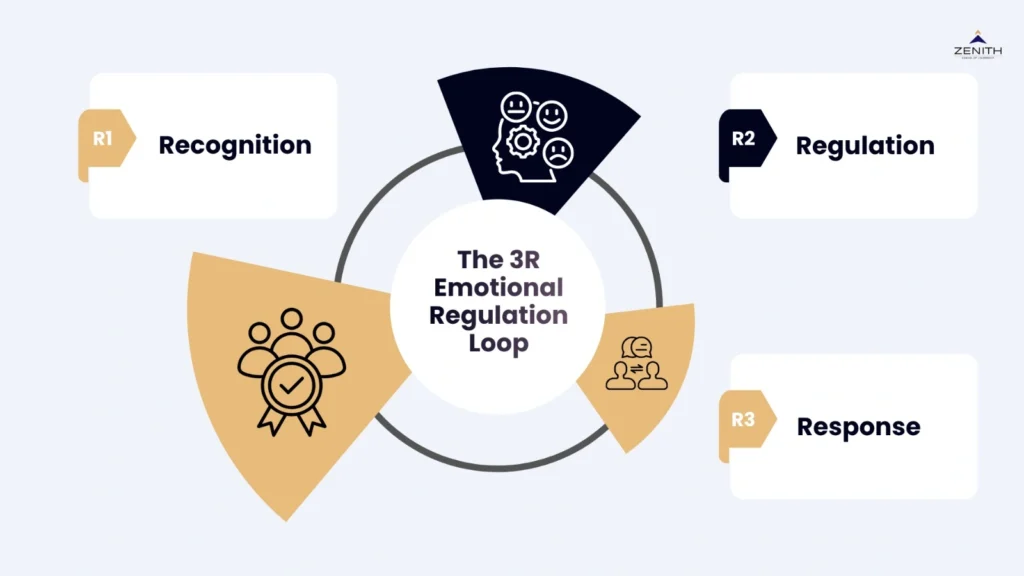
Within the Zenith lens, one of the most practical ways to understand emotional intelligence in leadership is through the Zenith Emotional Regulation Loop.
1. Recognition
The first discipline is recognition.
Before leaders can regulate anything, they must become aware of what is rising inside them.
This may be:
Frustration during disagreement
Defensiveness during criticism
Impatience during delay
Tightness when authority feels questioned
Emotional urgency when the discussion is not moving as expected
This is where emotional intelligence stops being abstract and starts becoming observable.
2. Regulation
The second discipline is regulation.
This is the moment where a leader interrupts automatic reaction.
Instead of letting emotion shape tone, pacing, or language, the leader pauses internally and stabilizes.
That pause is small, but it changes everything.
Because when the reaction slows, choice returns.
3. Response
The third discipline is response.
Now the leader can choose a response that protects both clarity and openness.
They can ask instead of defend.
Clarify instead of harden.
Slow the tone instead of tightening the room.
Keep the conversation productive instead of making honesty feel costly.
This is what makes a leader feel reliable under pressure.
People begin to learn that even when things get difficult, this leader will not let emotional leakage start steering the interaction.
That lesson becomes culture.
Common Leadership Mistakes That Quietly Weaken Trust
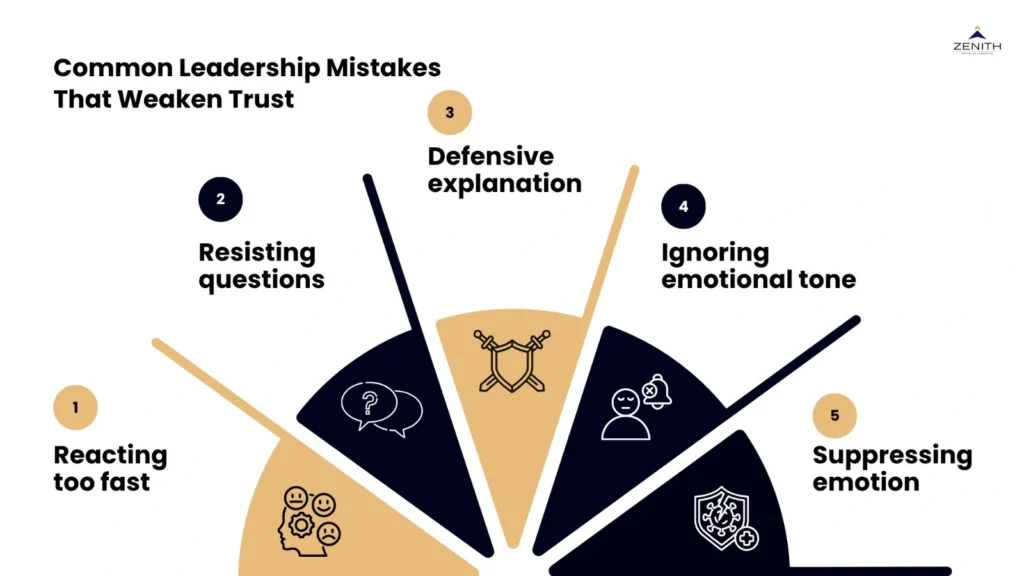
Even experienced leaders weaken trust in ways they do not always notice.
Reacting too quickly
Fast responses can feel decisive, but under pressure they often reveal emotion before judgment. People feel the reaction first and the leadership second.
Treating questions like resistance
A leader may think they are protecting authority. What the team experiences instead is that challenge may not be welcome.
Over explaining from defensiveness
Sometimes leaders keep speaking because they want to restore control. But when explanation is emotionally driven, confidence drops instead of rising.
Ignoring emotional climate
Some leaders assume emotional tone is secondary compared with strategy. In reality, emotional climate shapes how strategy is questioned, understood, and executed.
Confusing composure with suppression
Emotionally intelligent leaders are not expressionless. They are simply disciplined enough not to let emotion quietly poison the interaction.
A Practical Self Check for Leaders
Before responding in a tense leadership moment, pause and ask:
- What emotion is entering my tone right now
- What will this reaction make other people less willing to say
- What response would protect both clarity and openness
This self check is powerful because it shifts the question from:
What do I feel
to:
What will this feeling do to the conversation if I let it lead
That is where leadership presence becomes emotional discipline.
Simple Practices to Build Emotional Intelligence Daily
Emotional intelligence grows through small, repeated acts of awareness.
Before important conversations, ask yourself what emotional trigger is most likely to rise.
During disagreement, practice listening fully before deciding what your response needs to be.
After difficult discussions, review the interaction honestly.
Ask:
- Where did I stay steady
- Where did my tone tighten
- Where might people have become more careful because of my response
- What would I want to protect better next time
These are small disciplines, but they create major leadership effects over time.
Because trust is not built only through big decisions.
It is built through repeated emotional steadiness in everyday moments.
Why Emotional Intelligence Matters Even More in an AI Driven Workplace
As work becomes more shaped by AI, automation, and data, emotional intelligence in leadership becomes more valuable, not less.
Technology can process information quickly.
It can optimize, summarize, automate, and analyze.
But it cannot stabilize emotional tension in a difficult human interaction.
It cannot sense when people are becoming less honest.
It cannot rebuild openness after defensiveness enters the exchange.
It cannot make people feel safe enough to reveal the truth beneath the surface.
This is why the future of leadership will not be defined only by who can access information.
It will also be defined by who can hold human trust together under pressure.
Final Thought
Leaders rarely lose trust only through major mistakes.
More often, they lose it in small emotional moments that quietly teach people to hold back.
That is why emotional intelligence in leadership is not a soft trait sitting beside performance.
It is one of the conditions that makes strong performance possible.
When leaders notice emotional signals early, regulate reactions well, and respond with steadiness, they protect something many organizations lose too late:
the openness people need in order to think honestly, speak clearly, challenge well, and perform fully.
Because in leadership, people do not only remember what you decided.
They remember what became harder to say around you.
Why Emotional Intelligence Will Continue to Matter More
The future of leadership will not belong only to those who are efficient, informed, or articulate. It will belong to those who can remain clear under pressure, regulate themselves through uncertainty, lead people without emotional carelessness, and sustain trust when complexity rises.
This is why emotional intelligence in leadership has become foundational. It strengthens judgment, team trust, psychological safety, executive presence, conflict resolution for leaders, and long term leadership effectiveness.
And that may be one of the clearest differences between leadership that looks impressive from a distance and leadership that people genuinely trust up close.
Table of Content
Read summarized version with
TLDR | 3 Leadership Realities
- Leaders rarely lose trust only through major mistakes. More often, trust tightens in small moments when emotional pressure starts shaping tone, pace, and response
- What people remember in leadership is not only what was decided. They remember how safe, steady, and open the conversation felt while the decision was being made
- Performance often weakens after trust has already started shrinking, which is why emotional intelligence in leadership matters long before visible problems appear
The Invisible Moment That Reveals Leadership
Leadership rarely weakens in dramatic moments first.
It begins to weaken in smaller moments that most people do not name early enough.
A leader is challenged in a meeting.
A concern is raised at the wrong time.
A disagreement carries more force than expected.
Nothing visibly collapses.
The leader keeps speaking.
The discussion keeps moving.
The meeting continues on the surface.
But something inside the interaction tightens.
People become more careful.
Their honesty becomes more filtered.
The quality of what they are willing to say begins to shrink.
This is one of the most important truths about emotional intelligence in leadership.
Leaders do not lose trust only through major mistakes. More often, they lose it through subtle emotional signals that quietly make people less open, less brave, and less truthful around them.
And once that begins, performance problems usually come later.
Trust tightens first.
What Emotional Intelligence in Leadership Really Means
Emotional intelligence in leadership is often reduced to broad words like empathy, self awareness, or people skills. Those matter, but they do not fully explain what leaders are dealing with in real time.
In practice, emotional intelligence is the ability to notice emotional signals early, regulate internal reactions before they begin shaping the conversation, and respond in ways that preserve trust, clarity, and sound judgment.
This matters because teams are always reading more than a leader’s words.
They are reading:
How safe it feels to disagree
How costly it feels to raise a concern
How steady the leader remains when challenged
How much truth the conversation can still hold
That is why emotional intelligence is not about appearing calm on the surface.
It is about whether pressure starts leaking into leadership behavior in ways that quietly make people less open, less honest, and less willing to contribute fully.
The Hidden Problem: Emotional Leakage
The hidden problem in many leadership environments is not emotional drama.
It is emotional leakage.
Emotional leakage is the subtle spillover of internal pressure into leadership behavior before the leader has consciously managed it.
It may show up as:
A sharper tone than intended
A rushed answer during disagreement
A defensive explanation instead of a curious question
An interruption that carries impatience
A facial response that makes challenge feel unwelcome
These moments often look too small to matter.
But they matter precisely because they are repeated, subtle, and easy to dismiss.
Trust rarely breaks all at once.
It tightens quietly through emotional leakage.
And once that begins, people adapt faster than leaders realize.
They become more diplomatic.
They take fewer interpersonal risks.
They share less unfinished thinking.
They protect themselves instead of strengthening the conversation.
That is when a team can still look functional on the surface while becoming less honest underneath.
Why Emotional Intelligence Matters So Much in Leadership
Daniel Goleman’s work in Harvard Business Review helped establish emotional intelligence as one of the strongest differentiators in leadership effectiveness, beyond technical skill and IQ. His argument was not that expertise stops mattering. It was that leadership effectiveness depends heavily on self awareness, self regulation, empathy, and social skill.
That becomes even more important at senior levels.
A senior leader’s emotional state does not stay private for long. It affects the emotional climate around decisions, conflict, feedback, and collaboration.
When a leader becomes visibly defensive, people start filtering what they say.
When a leader becomes sharp under pressure, honesty starts narrowing.
When a leader remains steady while tension rises, people keep contributing fully.
This is why emotional intelligence in leadership is not an optional refinement.
It shapes whether leadership creates openness or caution, trust or guardedness, clarity or emotional drag.
Why Trust Often Tightens Before Performance Slows
Amy Edmondson’s research on psychological safety helps explain why these small emotional moments matter so much. Psychological safety refers to an environment where people feel able to speak up, ask questions, share concerns, and challenge assumptions without fear of embarrassment or punishment.
A leader does not need to be openly hostile to weaken that environment.
A few repeated emotional signals are enough.
If disagreement is met with visible irritation, people learn.
If questions are treated as resistance, people learn.
If emotional reactions feel less predictable under pressure, people learn.
And what they learn is simple:
Say less.
Risk less.
Reveal less.
This is why performance often weakens after trust has already started shrinking.
By the time innovation slows, risks are raised too late, or meetings become performative instead of honest, the emotional signal has already been shaping behavior for much longer.
That is the real cost of weak emotional regulation in leadership.
A Real Leadership Example: Indra Nooyi
A powerful example comes from Indra Nooyi.
During her years leading PepsiCo, she became known not only for sharp leadership, but for deeply human acts of recognition. One of the most discussed examples was her habit of writing letters to the parents of senior executives, thanking them for the gift of their child to PepsiCo. She described the gesture as a way of recognizing the person and upbringing behind achievement. (forbes.com)
What makes this example powerful is not just that it was kind.
It was emotionally intelligent.
Nooyi understood that people do not enter organizations as roles alone. They bring effort, sacrifice, identity, pride, family history, and emotional memory. When leaders relate to people only through targets and output, they may still secure compliance. But they do not build the deeper trust that makes people feel seen, valued, and willing to stay open.
That is the leadership lesson here.
Emotional intelligence is not only revealed in how leaders handle pressure. It is also revealed in whether people feel deeply respected before pressure arrives.
That matters because trust is not built in one dramatic act.
It is built through repeated evidence that leadership sees the human being behind the performance.
What leaders can apply immediately
You do not have to copy Nooyi’s exact gesture.
But you do need to ask a sharper question:
Do people experience my leadership as purely evaluative, or also deeply human?
Then act on that.
Acknowledge effort specifically.
Recognize the person, not only the output.
Communicate value in a way that feels personal, not generic.
That is not softness.
It is one of the ways leadership trust gets built before pressure tests it.
What Emotional Intelligence Looks Like in Real Leadership Moments
In leadership, emotional intelligence becomes visible in moments like these:
A project is challenged in front of others
A colleague raises an uncomfortable concern
A deadline is missed
A decision you backed starts receiving criticism
Someone disagrees with your view in a tense conversation
In those moments, people are watching for more than the outcome.
They are watching:
Can this leader stay clear without becoming cold
Can this leader stay open without losing direction
Can this leader hear challenge without becoming defensive
Can this leader protect honesty while pressure rises
This is why emotional intelligence in leadership builds trust, presence, and performance at the same time.
It builds trust because people feel safer telling the truth.
It builds presence because steadiness is felt before it is described.
It builds performance because teams think better when conversations stay open.
The Zenith 3R Emotional Regulation Loop
Within the Zenith lens, one of the most practical ways to understand emotional intelligence in leadership is through the Zenith Emotional Regulation Loop.
1. Recognition
The first discipline is recognition.
Before leaders can regulate anything, they must become aware of what is rising inside them.
This may be:
Frustration during disagreement
Defensiveness during criticism
Impatience during delay
Tightness when authority feels questioned
Emotional urgency when the discussion is not moving as expected
This is where emotional intelligence stops being abstract and starts becoming observable.
2. Regulation
The second discipline is regulation.
This is the moment where a leader interrupts automatic reaction.
Instead of letting emotion shape tone, pacing, or language, the leader pauses internally and stabilizes.
That pause is small, but it changes everything.
Because when the reaction slows, choice returns.
3. Response
The third discipline is response.
Now the leader can choose a response that protects both clarity and openness.
They can ask instead of defend.
Clarify instead of harden.
Slow the tone instead of tightening the room.
Keep the conversation productive instead of making honesty feel costly.
This is what makes a leader feel reliable under pressure.
People begin to learn that even when things get difficult, this leader will not let emotional leakage start steering the interaction.
That lesson becomes culture.
Common Leadership Mistakes That Quietly Weaken Trust
Even experienced leaders weaken trust in ways they do not always notice.
Reacting too quickly
Fast responses can feel decisive, but under pressure they often reveal emotion before judgment. People feel the reaction first and the leadership second.
Treating questions like resistance
A leader may think they are protecting authority. What the team experiences instead is that challenge may not be welcome.
Over explaining from defensiveness
Sometimes leaders keep speaking because they want to restore control. But when explanation is emotionally driven, confidence drops instead of rising.
Ignoring emotional climate
Some leaders assume emotional tone is secondary compared with strategy. In reality, emotional climate shapes how strategy is questioned, understood, and executed.
Confusing composure with suppression
Emotionally intelligent leaders are not expressionless. They are simply disciplined enough not to let emotion quietly poison the interaction.
A Practical Self Check for Leaders
Before responding in a tense leadership moment, pause and ask:
- What emotion is entering my tone right now
- What will this reaction make other people less willing to say
- What response would protect both clarity and openness
This self check is powerful because it shifts the question from:
What do I feel
to:
What will this feeling do to the conversation if I let it lead
That is where leadership presence becomes emotional discipline.
Simple Practices to Build Emotional Intelligence Daily
Emotional intelligence grows through small, repeated acts of awareness.
Before important conversations, ask yourself what emotional trigger is most likely to rise.
During disagreement, practice listening fully before deciding what your response needs to be.
After difficult discussions, review the interaction honestly.
Ask:
- Where did I stay steady
- Where did my tone tighten
- Where might people have become more careful because of my response
- What would I want to protect better next time
These are small disciplines, but they create major leadership effects over time.
Because trust is not built only through big decisions.
It is built through repeated emotional steadiness in everyday moments.
Why Emotional Intelligence Matters Even More in an AI Driven Workplace
As work becomes more shaped by AI, automation, and data, emotional intelligence in leadership becomes more valuable, not less.
Technology can process information quickly.
It can optimize, summarize, automate, and analyze.
But it cannot stabilize emotional tension in a difficult human interaction.
It cannot sense when people are becoming less honest.
It cannot rebuild openness after defensiveness enters the exchange.
It cannot make people feel safe enough to reveal the truth beneath the surface.
This is why the future of leadership will not be defined only by who can access information.
It will also be defined by who can hold human trust together under pressure.
Final Thought
Leaders rarely lose trust only through major mistakes.
More often, they lose it in small emotional moments that quietly teach people to hold back.
That is why emotional intelligence in leadership is not a soft trait sitting beside performance.
It is one of the conditions that makes strong performance possible.
When leaders notice emotional signals early, regulate reactions well, and respond with steadiness, they protect something many organizations lose too late:
the openness people need in order to think honestly, speak clearly, challenge well, and perform fully.
Because in leadership, people do not only remember what you decided.
They remember what became harder to say around you.
Why Emotional Intelligence Will Continue to Matter More
The future of leadership will not belong only to those who are efficient, informed, or articulate. It will belong to those who can remain clear under pressure, regulate themselves through uncertainty, lead people without emotional carelessness, and sustain trust when complexity rises.
This is why emotional intelligence in leadership has become foundational. It strengthens judgment, team trust, psychological safety, executive presence, conflict resolution for leaders, and long term leadership effectiveness.
And that may be one of the clearest differences between leadership that looks impressive from a distance and leadership that people genuinely trust up close.