Leadership Decision Making Skills for Uncertain and Complex Environments
- April 6, 2026
- Gurleen Kaur
Leadership Decision Making Skills for Uncertain and Complex Environments
- April 6, 2026
- Gurleen Kaur
Table of Content
Read summarized version with
There comes a point in leadership where waiting for clarity becomes more dangerous than acting without it. The higher the stakes, the less complete the information and yet the decision still belongs to you. Decision making under uncertainty is not a flaw in leadership; it is the terrain senior leaders operate in every day. Those who learn to move forward with judgement, composure, and accountability don’t just survive ambiguity they lead through it.
Decision Making Under Uncertainty in the Modern Leadership Environment
Modern leadership no longer operates in neat, predictable lanes.
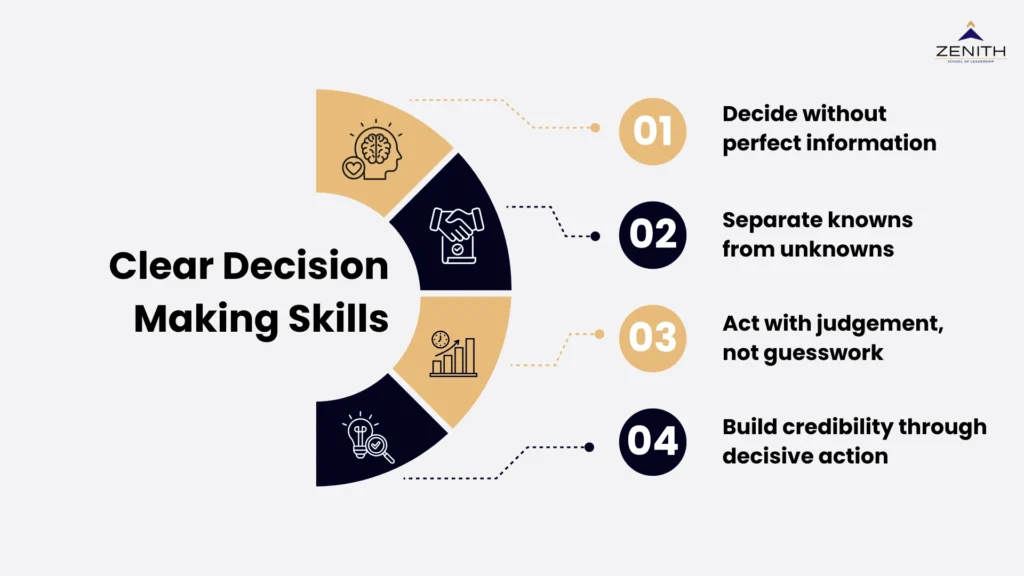
Today’s leaders make critical decisions under uncertainty, where clarity is partial, timelines are compressed, and consequences are visible in real time.
Markets shift faster than forecasts can keep up.
Teams are distributed across geographies, cultures, and time zones. Information is abundant yet noisy, fragmented, and often contradictory.
In this environment, effective leadership is not about waiting for perfect data. Leaders who demand certainty before acting don’t just slow progress they quietly lose momentum, trust, and credibility. The leaders who thrive are not the ones with all the answers, but the ones with the thinking skills to decide well when answers are incomplete.
What Decision Making Under Uncertainty Means
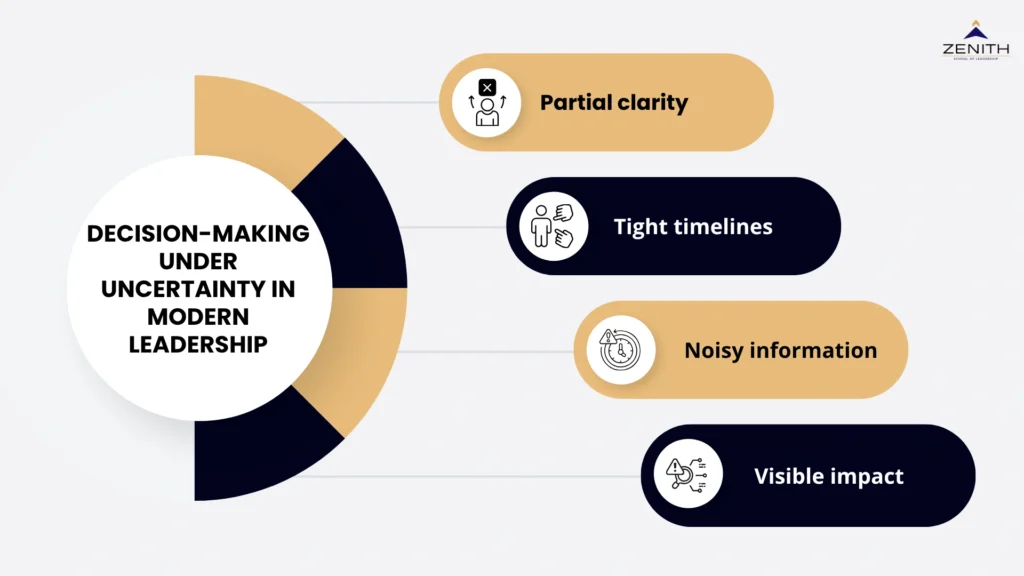
Decision Making Under Uncertainty is a critical leadership decision-making skill the ability to make responsible, timely decisions when information is incomplete, outcomes are unpredictable, and pressure is high.
It is not about guessing.
And it is not about waiting for perfect clarity.
It is the capability to distinguish what can be known from what cannot, and still move forward with sound judgement, accountability, and strategic intent.
At senior and executive levels, most leadership decisions are made without full certainty. The ability to decide under uncertainty separates leaders who act with clarity and credibility from those who hesitate when stakes are highest.
Where Most Senior Leaders Get Stuck
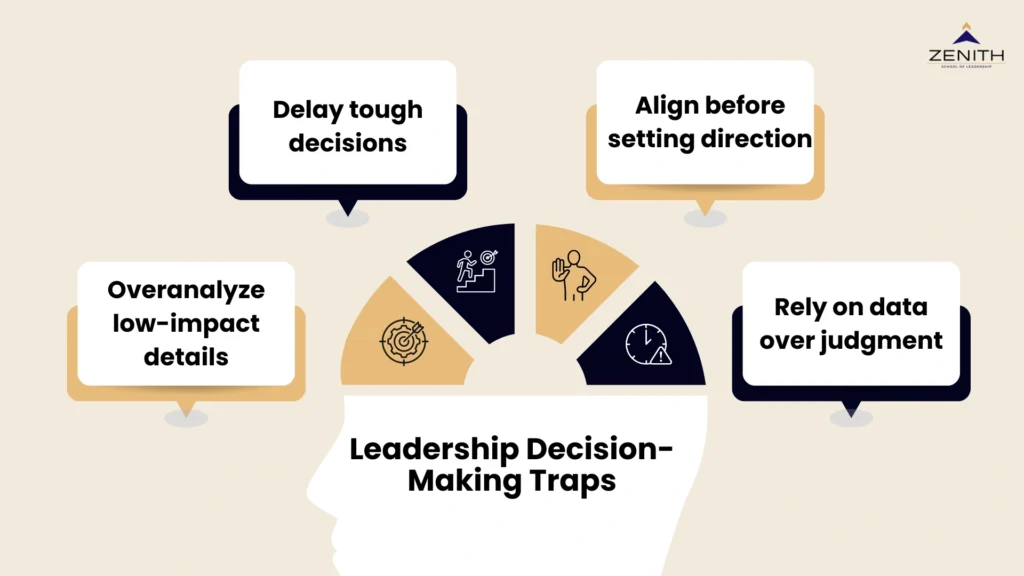
Even experienced leaders fall into patterns such as:
- Overanalyzing low-impact variables
- Delaying decisions to avoid accountability
- Seeking alignment before defining direction
- Confusing more data with better judgement
These are not capability gaps. They are decision-making behaviour patterns under pressure.And unless addressed, they quietly limit leadership effectiveness.
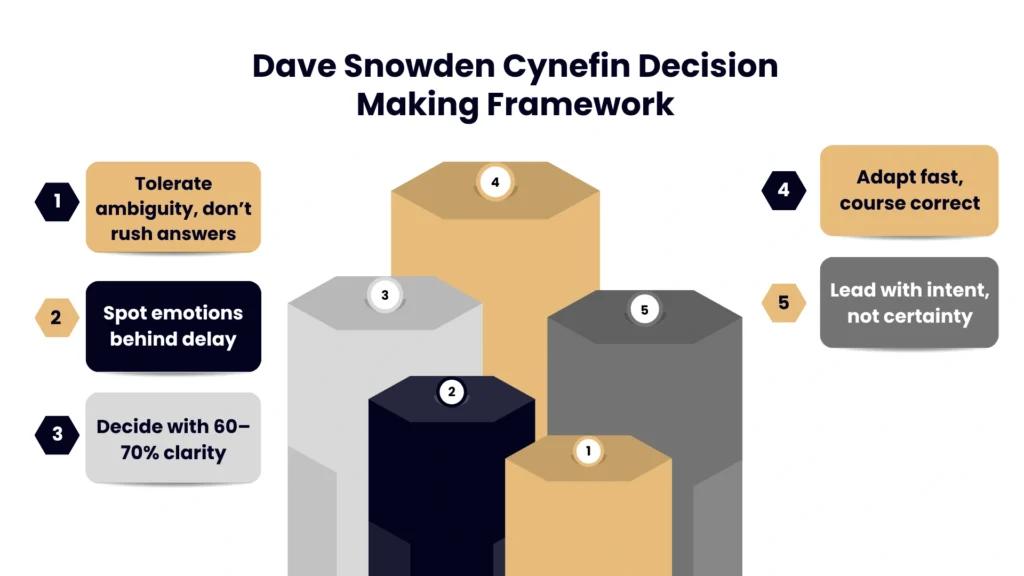
The Dave Snowden Cynefin framework highlights that in complex and uncertain contexts, clarity emerges after action, not before.
How Decision Making Under Uncertainty Is Developed
Leadership frameworks used in complex environments emphasise that different situations require different decision approaches.
This is not a skill built by sharper logic or better frameworks alone.
It is an inner leadership capability developed through awareness, emotional regulation, and disciplined action.
Step 1: Strengthen Your Tolerance for Ambiguity
Most leaders don’t struggle with decisions.
They struggle with not knowing.
Uncertainty creates discomfort because the mind wants closure. The first step is training yourself to stay present when outcomes are unclear without rushing to eliminate the discomfort.
Ask yourself:
Can I remain grounded even when the answer isn’t complete yet?
Leaders who tolerate ambiguity think more clearly under pressure because they are not reacting to uncertainty they are holding it.
Step 2: Recognise the Emotional Discomfort That Drives Delay
Delay is rarely about missing data.
It is usually about emotional resistance fear of being wrong, fear of judgment, fear of consequences.
High-impact leaders learn to identify the emotion behind hesitation:
- Is this caution or avoidance?
- Is this strategic patience or self-protection?
When the emotion is named, it stops running the decision invisibly.
Step 3: Learn to Decide with Partial Information
When information is incomplete, many leaders freeze.
Partial data often triggers hesitation, overthinking, and Analysis paralysis– not because leaders lack ability, but because uncertainty feels unsafe.
In complex leadership environments, waiting for 100% clarity becomes a liability.
Effective leaders move forward by deciding with:
- 60–70% of the available information
- Clear working assumptions
- Defined risk boundaries
They shift the internal question from
“Is this decision perfect?” to
“Is this the best decision possible with what I know right now?”
This reframes decision making as an ongoing leadership process not a one-time verdict.
Step 4: Build the Muscle of Course Correction Through Adaptability
Adaptability is any leaders true trademark!
Decisions made under uncertainty are meant to evolve.
Effective leaders stay adaptable, not attached. They navigate shifting conditions without self-judgment reviewing outcomes clearly, adjusting direction thoughtfully, and moving forward again with composure.
Course correction is not a sign of failure or indecision.
It is leadership maturity in motion the ability to stay grounded while the path reshapes.
Step 5: Separate Certainty from Safety
One of the most powerful leadership shifts is this realization:
Certainty does not equal safety.
Progress happens through movement, not guarantees.
Leaders who master decision making under uncertainty learn to lead through clarity of intent, not clarity of outcome.
They don’t freeze waiting for the path to be visible.
They walk and let the path reveal itself.
How Zenith Approaches Decision Making Under Uncertainty
At Zenith, Decision Making Under Uncertainty is cultivated as a core leadership capability, not a quick cognitive tool or formula. Leaders are guided to recognise the emotional, psychological, and behavioural patterns that emerge when clarity is incomplete and pressure is high. Through mentor-led reflection, real-world decision scenarios, and leadership context work, participants learn to distinguish between analysis that sharpens judgement and overanalysis that delays action. Zenith strengthens a leader’s ability to decide responsibly, communicate with clarity, and adapt confidently as conditions evolve. The focus is not on eliminating uncertainty because modern leadership demands it but on building sound judgement within uncertainty. This is how Zenith develops leaders who act decisively, stay flexible, and lead with credibility in complex, high stakes environments.
Conclusion: Decision Making Under Uncertainty separates reactive managers from grounded leaders. It enables leaders to move forward with judgement instead of hesitation, presence instead of pressure, and credibility instead of control. When clarity is incomplete, this capability allows leaders to lead anyway calmly, responsibly, and with conviction.
This is the point where leadership stops depending on conditions and starts coming from within.
Table of Content
Read summarized version with
There comes a point in leadership where waiting for clarity becomes more dangerous than acting without it. The higher the stakes, the less complete the information and yet the decision still belongs to you. Decision making under uncertainty is not a flaw in leadership; it is the terrain senior leaders operate in every day. Those who learn to move forward with judgement, composure, and accountability don’t just survive ambiguity they lead through it.
Decision Making Under Uncertainty in the Modern Leadership Environment
Modern leadership no longer operates in neat, predictable lanes.
Today’s leaders make critical decisions under uncertainty, where clarity is partial, timelines are compressed, and consequences are visible in real time.
Markets shift faster than forecasts can keep up.
Teams are distributed across geographies, cultures, and time zones. Information is abundant yet noisy, fragmented, and often contradictory.
In this environment, effective leadership is not about waiting for perfect data. Leaders who demand certainty before acting don’t just slow progress they quietly lose momentum, trust, and credibility. The leaders who thrive are not the ones with all the answers, but the ones with the thinking skills to decide well when answers are incomplete.
What Decision Making Under Uncertainty Means
Decision Making Under Uncertainty is a critical leadership decision-making skill the ability to make responsible, timely decisions when information is incomplete, outcomes are unpredictable, and pressure is high.
It is not about guessing.
And it is not about waiting for perfect clarity.
It is the capability to distinguish what can be known from what cannot, and still move forward with sound judgement, accountability, and strategic intent.
At senior and executive levels, most leadership decisions are made without full certainty. The ability to decide under uncertainty separates leaders who act with clarity and credibility from those who hesitate when stakes are highest.
Where Most Senior Leaders Get Stuck
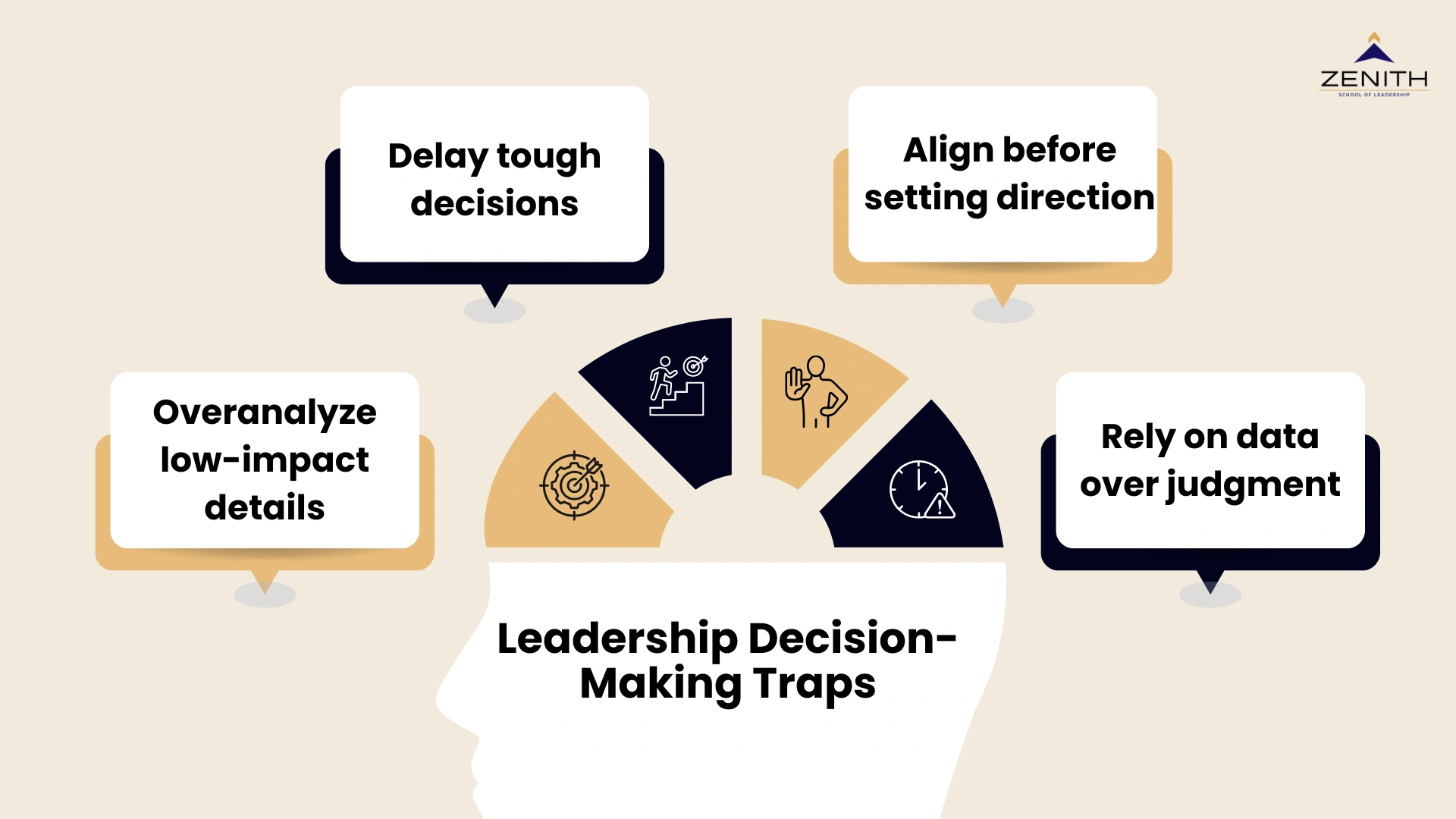
Even experienced leaders fall into patterns such as:
- Overanalyzing low-impact variables
- Delaying decisions to avoid accountability
- Seeking alignment before defining direction
- Confusing more data with better judgement
These are not capability gaps. They are decision-making behaviour patterns under pressure. And unless addressed, they quietly limit leadership effectiveness.
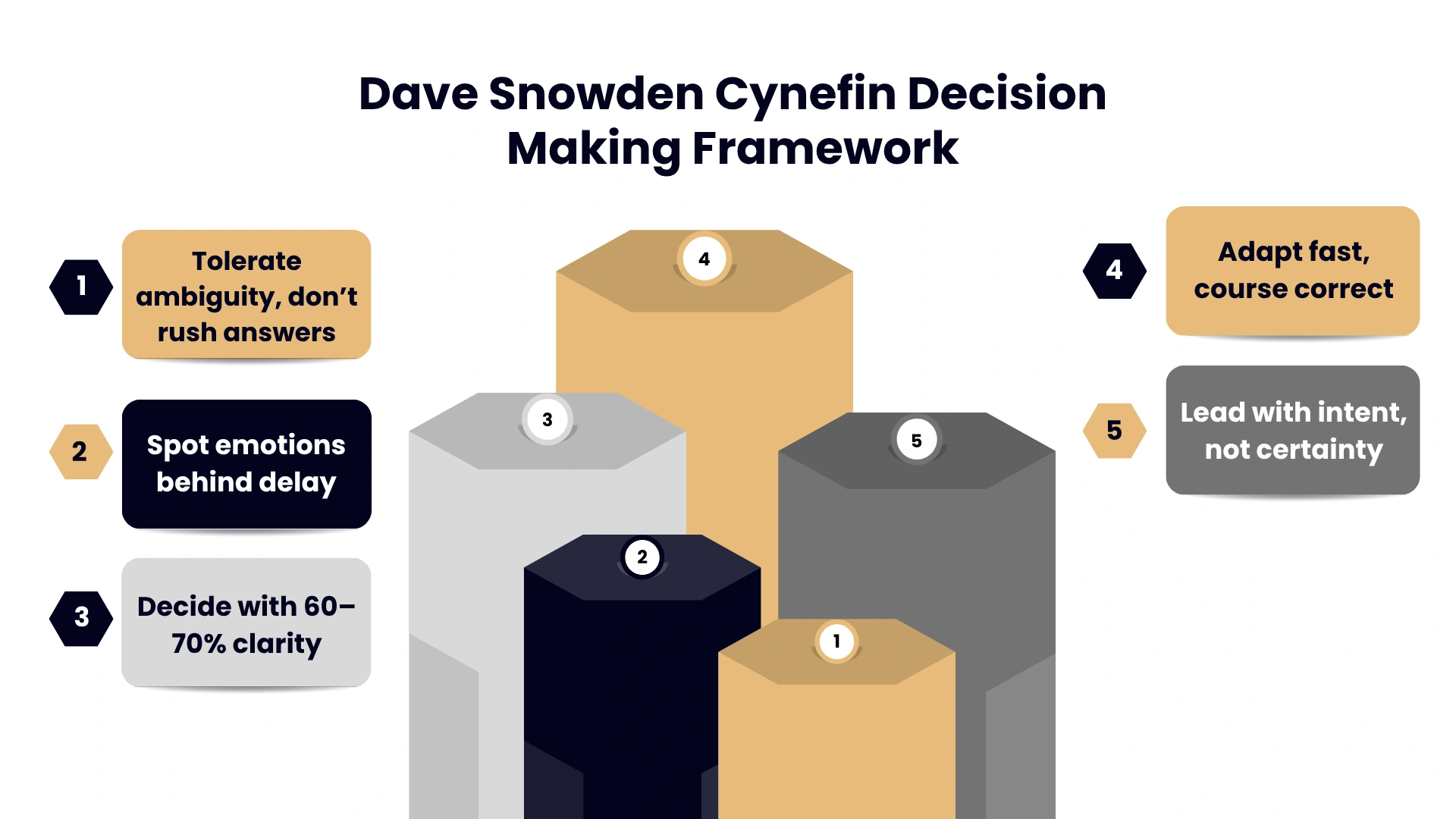
The Dave Snowden Cynefin framework highlights that in complex and uncertain contexts, clarity emerges after action, not before.
How Decision Making Under Uncertainty Is Developed
Leadership frameworks used in complex environments emphasise that different situations require different decision approaches.
This is not a skill built by sharper logic or better frameworks alone.
It is an inner leadership capability developed through awareness, emotional regulation, and disciplined action.
Step 1: Strengthen Your Tolerance for Ambiguity
Most leaders don’t struggle with decisions.
They struggle with not knowing.
Uncertainty creates discomfort because the mind wants closure. The first step is training yourself to stay present when outcomes are unclear without rushing to eliminate the discomfort.
Ask yourself:
Can I remain grounded even when the answer isn’t complete yet?
Leaders who tolerate ambiguity think more clearly under pressure because they are not reacting to uncertainty they are holding it.
Step 2: Recognise the Emotional Discomfort That Drives Delay
Delay is rarely about missing data.
It is usually about emotional resistance fear of being wrong, fear of judgment, fear of consequences.
High-impact leaders learn to identify the emotion behind hesitation:
- Is this caution or avoidance?
- Is this strategic patience or self-protection?
When the emotion is named, it stops running the decision invisibly.
Step 3: Learn to Decide with Partial Information
When information is incomplete, many leaders freeze.
Partial data often triggers hesitation, overthinking, and Analysis paralysis not because leaders lack ability, but because uncertainty feels unsafe.
In complex leadership environments, waiting for 100% clarity becomes a liability.
Effective leaders move forward by deciding with:
- 60–70% of the available information
- Clear working assumptions
- Defined risk boundaries
They shift the internal question from
“Is this decision perfect?” to
“Is this the best decision possible with what I know right now?”
This reframes decision making as an ongoing leadership process not a one-time verdict.
Step 4: Build the Muscle of Course Correction Through Adaptability
Adaptability is any leaders true trademark!
Decisions made under uncertainty are meant to evolve.
Effective leaders stay adaptable, not attached. They navigate shifting conditions without self-judgment reviewing outcomes clearly, adjusting direction thoughtfully, and moving forward again with composure.
Course correction is not a sign of failure or indecision.
It is leadership maturity in motion the ability to stay grounded while the path reshapes.
Step 5: Separate Certainty from Safety
One of the most powerful leadership shifts is this realization:
Certainty does not equal safety.
Progress happens through movement, not guarantees.
Leaders who master decision making under uncertainty learn to lead through clarity of intent, not clarity of outcome.
They don’t freeze waiting for the path to be visible.
They walk and let the path reveal itself.
How Zenith Approaches Decision Making Under Uncertainty
At Zenith, Decision Making Under Uncertainty is cultivated as a core leadership capability, not a quick cognitive tool or formula. Leaders are guided to recognise the emotional, psychological, and behavioural patterns that emerge when clarity is incomplete and pressure is high. Through mentor-led reflection, real-world decision scenarios, and leadership context work, participants learn to distinguish between analysis that sharpens judgement and overanalysis that delays action. Zenith strengthens a leader’s ability to decide responsibly, communicate with clarity, and adapt confidently as conditions evolve. The focus is not on eliminating uncertainty because modern leadership demands it but on building sound judgement within uncertainty. This is how Zenith develops leaders who act decisively, stay flexible, and lead with credibility in complex, high-stakes environments.
Conclusion: Decision Making Under Uncertainty separates reactive managers from grounded leaders. It enables leaders to move forward with judgement instead of hesitation, presence instead of pressure, and credibility instead of control. When clarity is incomplete, this capability allows leaders to lead anyway calmly, responsibly, and with conviction.
This is the point where leadership stops depending on conditions and starts coming from within.