Leadership Impact Is Built in Invisible Moments Long Before It Appears in Public Ones
- April 7, 2026
- Gurleen Kaur
Leadership Impact Is Built in Invisible Moments Long Before It Appears in Public Ones
- April 7, 2026
- Gurleen Kaur
Table of Content
Read summarized version with
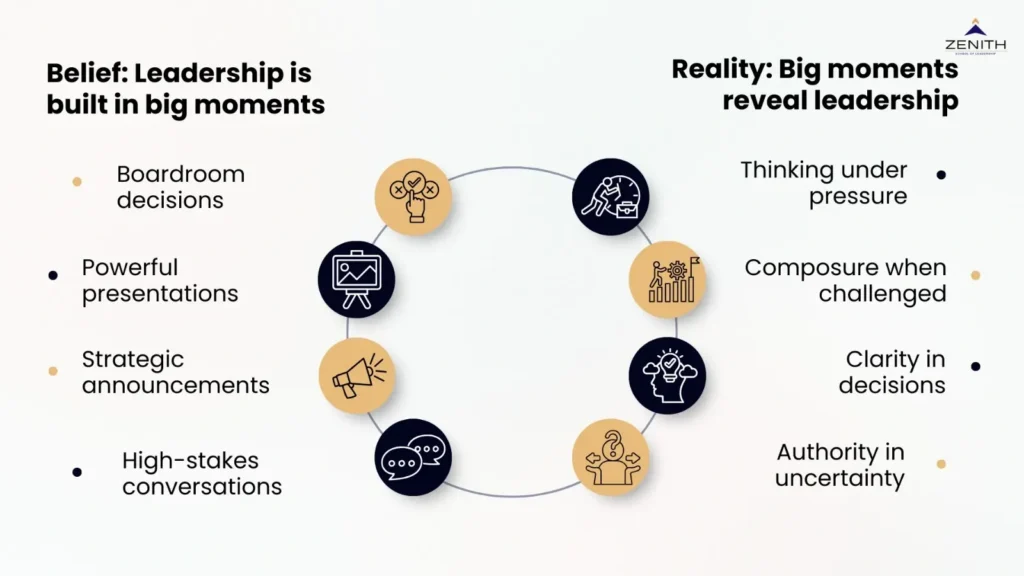
These moments attract attention because they happen in public, carry pressure, and appear to define leadership in real time. But leadership influence rarely begins there.
What most people call leadership presence in a visible moment is often the result of something far quieter that has been forming for a long time. Trust, credibility, and authority are usually not created in the spotlight. They are built through repeated behavioural signals that people observe in ordinary situations long before the public moment arrives.
Research on leadership trust and authenticity consistently points toward the same underlying principle. People assess leaders not only through what they say in important moments, but through whether their daily behaviour reflects reliability, alignment, integrity, and emotional steadiness over time. Trust grows when values and behaviour stay aligned, not when authority is performed only in public.
Why Two Smart Leaders Get Very Different Responses:
- One leader creates alignment, another creates hesitation
- The difference is rarely the message, but the pattern people have observed
- The room has already noticed how you handle pressure and challenge
- Whether you protect truth or protect image
- Whether you own mistakes
- Whether your composure holds under tension
Leadership impact is rarely decided in a single visible moment. It is usually confirmed there.
The Leadership Pyramid Most Professionals Invert
One of the most common mistakes professionals make is assuming that visible authority sits at the foundation of leadership impact.
They believe influence begins with speaking well, sounding powerful, commanding the room, or appearing decisive in senior spaces. In reality, these are not the foundation of leadership credibility. They are the visible outcome of something deeper.
Leadership works more like a pyramid than a performance.
At the bottom are the smallest behaviours.
At the top is visible influence.
When professionals focus only on the top, their authority becomes fragile. It may look impressive for a while, but it does not hold under pressure because the foundation was never built.
Here is the structure most leaders fail to recognize:
- Foundation: Micro-Behavioural Integrity
This is where leadership actually begins. It includes how you write, how you follow through, how accurately you honour commitments, how you respond to feedback, and what tone you bring when pressure rises. These behaviours look ordinary, but they quietly tell people whether you can be trusted. - Second Layer: Behavioural Consistency
A single good action does not build credibility. Consistency does. People watch whether your response to difficulty remains aligned across situations. They notice whether your standards disappear under stress or remain intact when it becomes uncomfortable.
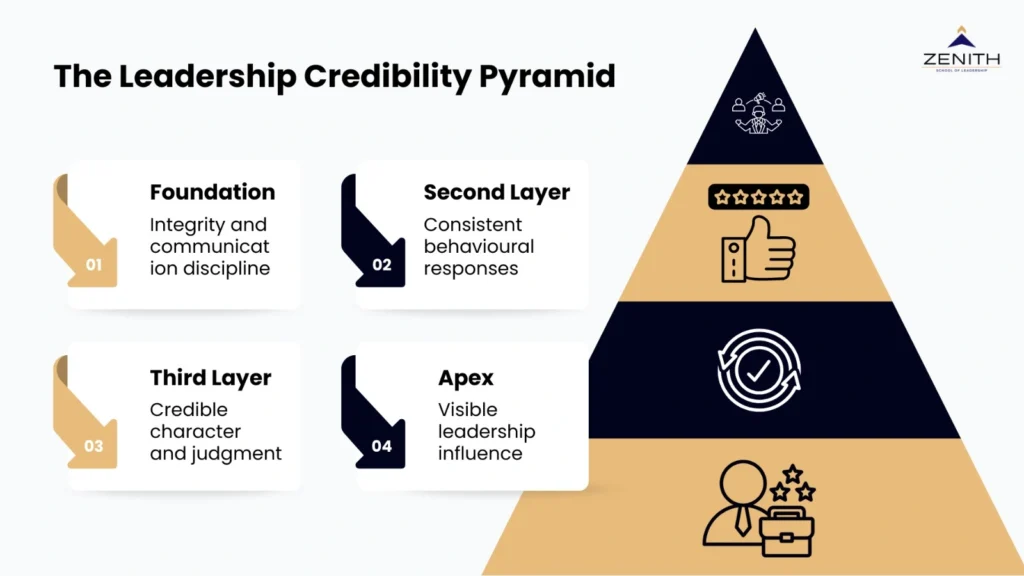
- Third Layer: Leadership Credibility
When consistency becomes visible over time, people begin to form a stable view of your leadership. They start associating you with reliability, sound judgement, emotional steadiness, accountability, and clarity of intent. - Apex: Visible Leadership Influence
This is the part most professionals chase first. It includes strategic authority, persuasive impact, executive presence, and the ability to move people in important moments. But this layer only carries real weight when the lower levels have already been built.
The professionals who invert this pyramid often spend years polishing delivery while ignoring the behaviours that make delivery believable.
That is why some leaders sound polished but still fail to create trust.
And why others do not need dramatic performance to carry authority.
Their leadership was already speaking before they opened their mouth.
The Leadership Shift That Changed Microsoft
A compelling example of this principle can be seen in Satya Nadella’s leadership at Microsoft.
When Nadella became CEO in 2014, Microsoft was widely seen as a company needing not just strategic renewal, but cultural renewal. In the years that followed, Microsoft repeatedly described its transformation around a growth mindset, learning culture, empathy, and collaboration.
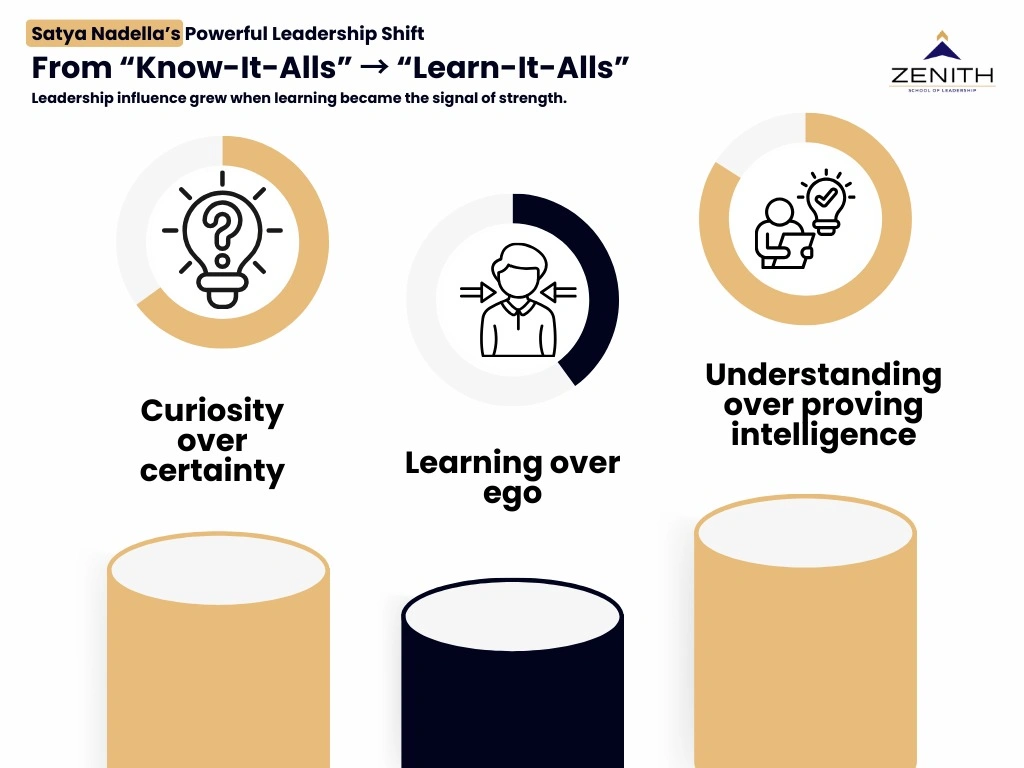
What makes this example powerful is that the change was not built only through grand speeches.
It showed up in the repeated signals of leadership culture.
A willingness to learn.
A willingness to question old assumptions.
A willingness to move away from internal defensiveness toward collaboration and curiosity. Microsoft’s own accounts of this period repeatedly describe empathy, growth mindset, and learning orientation as central to the company’s cultural evolution under Nadella.
That matters because culture does not shift through slogans alone.
It shifts when people see a leader behave in ways that make the slogan believable.
Over time, those small signals become a pattern.
And once a pattern becomes trusted, a major strategic direction begins to carry more weight.
That is leadership impact in its truest form.
Not performance first.
Pattern first.
A Small Leadership Moment That Reveals a Larger Pattern
Now bring this principle into a far more ordinary situation.
Imagine sending an introductory message to a potential partner. While drafting the second message, you accidentally leave the first recipient’s name in the text. It is a small mistake. It may never become a public embarrassment. It would be easy to ignore.
But leadership is often revealed at exactly this kind of decision point.
You can pretend it is minor and move on or you can acknowledge it cleanly and take responsibility. The size of the error is not the real issue.
When someone owns a small mistake without becoming defensive, they communicate something far bigger than correction. They communicate self-awareness, accountability, steadiness, and intellectual honesty.
And people notice more than we think they do.
They may not consciously analyze the moment, they may not even remember the exact words later. But they do register the pattern.
Over time, leadership identity is formed in these moments – not only in how a person handles visibility, but in how they handle small discomfort without trying to escape it.
That is why invisible moments matter so much. They do not look important when they happen, but they become the evidence people later use to decide whether your visible authority is real.
The Zenith Leadership Pattern Model
Within the Zenith view of communication and leadership intelligence, leadership influence does not appear suddenly. It forms through a repeated pattern cycle that most professionals overlook because the early stages seem too small to matter.
This progression can be understood through the following sequence:
- Behavioural Choice
Every leadership pattern begins with a single choice in a seemingly minor moment. Do you clarify or avoid? Do you own or deflect? Do you respond with steadiness or react from ego? These moments look small, but they are where leadership identity starts taking shape. - Repeated Response
One moment does not define you. Repetition does. When similar situations keep arising, your responses begin to reveal whether your conduct is accidental or anchored. This is the stage where people start noticing whether your standards remain intact across pressure, ambiguity, and discomfort. - Pattern Recognition
Once your responses begin to repeat, others no longer see isolated incidents. They start reading a pattern. They begin to say, even if only internally, this person is dependable, this person gets defensive, this person stays composed, this person avoids accountability, and this person handles challenges with maturity. - Leadership Identity Formation
After enough repetition, the pattern becomes identity. At this point, people are no longer evaluating only what you do. They are evaluating who they believe you are as a leader. Reliability, emotional steadiness, strategic maturity, and credibility start becoming attached to your name. - Amplified Impact in Visible Moments
Now when a major moment arrives, the visible communication carries the weight of an already established pattern. If the leader has built trust quietly, the room receives the message differently. If the leader has built inconsistency quietly, the room receives that too. - Reinforcement or Erosion
Every new moment either strengthens the pattern or weakens it. Leadership is not built once and kept forever. It is constantly being reinforced or eroded through behaviour.
This is why leadership identity cannot be manufactured through occasional brilliance.
It is built through behavioural repetition.
It becomes visible through pattern recognition.
And it gains power when people experience consistency before they experience authority.
What Jim Collins’ Level 5 Leadership Helps Us Understand
Jim Collins’ concept of Level 5 Leadership is especially relevant here because it explains why the strongest leaders are often not the most theatrical. Collins describes Level 5 leaders as those who combine deep personal humility with fierce professional will. They are ambitious, but their ambition is directed toward the cause, the work, and the institution rather than personal image.
That idea becomes even more powerful when you examine what it looks like in behaviour:
- Personal Humility
Level 5 leaders do not need to constantly perform importance. They are secure enough to stay grounded, listen, and learn. Their authority does not depend on self-display. - Professional Will
Humility does not make them soft in standards. They carry fierce resolve toward results, discipline, and what must be done. They are calm, but not weak. Measured, but not passive. - Owning Failure
Collins’ work highlights that these leaders tend to take responsibility when things go wrong rather than protecting themselves through blame. This creates a trust pattern that becomes deeply significant over time.
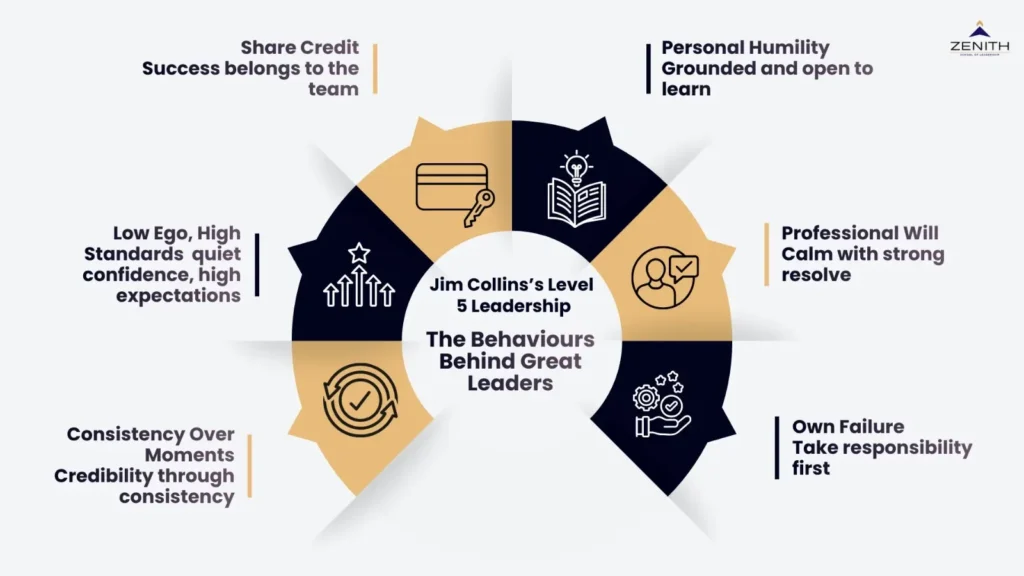
- Sharing Credit
They are more likely to direct credit outward rather than absorb it inward. This behaviour may seem small in a single instance, but repeated over time, it transforms how teams interpret the leader’s intent. - Low Ego, High Standards
This is one of the rarest combinations in leadership. A person who does not need to dominate attention, yet does not lower standards under pressure, becomes deeply credible. - Pattern Over Performance
What makes Level 5 leaders extraordinary is not one dramatic act. It is the consistency of quiet behaviours that reveal maturity, restraint, discipline, and commitment over time.
This is exactly why the concept matters in a blog like this.
Level 5 Leadership reminds us that greatness in leadership is often less visible in the moment than people expect. But over time, it becomes unmistakable.
Why Senior Leaders Pay Attention to Behavioural Micro-Signals
As professionals move higher in leadership, technical skill alone stops being enough.At senior levels, people are constantly interpreting signals.
Not only what a leader decides, but how that leader behaves while deciding.
-A brief reply.
-A delayed ownership moment.
-A defensive tone in a meeting.
-A calm response during ambiguity.
-A precise follow-through after commitment.
These become data points.
Experienced leaders understand that routine interactions are not as routine as they appear. Small moments travel through organizations faster than most people realize. Teams observe them. Peers interpret them. Stakeholders remember the feeling they leave behind.
That is why strong leaders do not treat everyday conduct as separate from leadership impact.
They know the smallest signals often shape the largest perceptions.
A Reflective Question for Leaders
If leadership influence is built through accumulated behavioural signals, then the real question is not only how you perform in public.
The real question is what your ordinary behaviour is teaching people about you.
Not the rare crisis. The daily friction. The repeated inconvenience. The moments where your tone, patience, and steadiness are being tested quietly.
Do people experience you as accountable and composed, or as defensive and image-protective?
If not, the gap will eventually show.
This is one of the costliest errors professionals make.
Because that is exactly what it is.
Every rushed email, every impatient reply, every avoided correction, every quiet act of ownership, and every moment of composure under discomfort contributes to the leadership narrative others are already forming.
Long before you speak in a visible moment, your leadership has been speaking in invisible ones, and that is where impact truly begins.
Table of Content
Read summarized version with
These moments attract attention because they happen in public, carry pressure, and appear to define leadership in real time. But leadership influence rarely begins there.
What most people call leadership presence in a visible moment is often the result of something far quieter that has been forming for a long time. Trust, credibility, and authority are usually not created in the spotlight. They are built through repeated behavioural signals that people observe in ordinary situations long before the public moment arrives.
Research on leadership trust and authenticity consistently points toward the same underlying principle. People assess leaders not only through what they say in important moments, but through whether their daily behaviour reflects reliability, alignment, integrity, and emotional steadiness over time. Trust grows when values and behaviour stay aligned, not when authority is performed only in public.
Why Two Smart Leaders Get Very Different Responses:
- One leader creates alignment, another creates hesitation
- The difference is rarely the message, but the pattern people have observed
- The room has already noticed how you handle pressure and challenge
- Whether you protect truth or protect image
- Whether you own mistakes
- Whether your composure holds under tension
Leadership impact is rarely decided in a single visible moment. It is usually confirmed there.
The Leadership Pyramid Most Professionals Invert
One of the most common mistakes professionals make is assuming that visible authority sits at the foundation of leadership impact.
They believe influence begins with speaking well, sounding powerful, commanding the room, or appearing decisive in senior spaces. In reality, these are not the foundation of leadership credibility. They are the visible outcome of something deeper.
Leadership works more like a pyramid than a performance.
At the bottom are the smallest behaviours.
At the top is visible influence.
When professionals focus only on the top, their authority becomes fragile. It may look impressive for a while, but it does not hold under pressure because the foundation was never built.
Here is the structure most leaders fail to recognize:
- Foundation: Micro-Behavioural Integrity
This is where leadership actually begins. It includes how you write, how you follow through, how accurately you honour commitments, how you respond to feedback, and what tone you bring when pressure rises. These behaviours look ordinary, but they quietly tell people whether you can be trusted. - Second Layer: Behavioural Consistency
A single good action does not build credibility. Consistency does. People watch whether your response to difficulty remains aligned across situations. They notice whether your standards disappear under stress or remain intact when it becomes uncomfortable.
- Third Layer: Leadership Credibility
When consistency becomes visible over time, people begin to form a stable view of your leadership. They start associating you with reliability, sound judgement, emotional steadiness, accountability, and clarity of intent. - Apex: Visible Leadership Influence
This is the part most professionals chase first. It includes strategic authority, persuasive impact, executive presence, and the ability to move people in important moments. But this layer only carries real weight when the lower levels have already been built.
The professionals who invert this pyramid often spend years polishing delivery while ignoring the behaviours that make delivery believable.
That is why some leaders sound polished but still fail to create trust.
And why others do not need dramatic performance to carry authority.
Their leadership was already speaking before they opened their mouth.
The Leadership Shift That Changed Microsoft
A compelling example of this principle can be seen in Satya Nadella’s leadership at Microsoft.
When Nadella became CEO in 2014, Microsoft was widely seen as a company needing not just strategic renewal, but cultural renewal. In the years that followed, Microsoft repeatedly described its transformation around a growth mindset, learning culture, empathy, and collaboration.
What makes this example powerful is that the change was not built only through grand speeches.
It showed up in the repeated signals of leadership culture.
A willingness to learn.
A willingness to question old assumptions.
A willingness to move away from internal defensiveness toward collaboration and curiosity. Microsoft’s own accounts of this period repeatedly describe empathy, growth mindset, and learning orientation as central to the company’s cultural evolution under Nadella.
That matters because culture does not shift through slogans alone.
It shifts when people see a leader behave in ways that make the slogan believable.
Over time, those small signals become a pattern.
And once a pattern becomes trusted, a major strategic direction begins to carry more weight.
That is leadership impact in its truest form.
Not performance first.
Pattern first.
A Small Leadership Moment That Reveals a Larger Pattern
Now bring this principle into a far more ordinary situation.
Imagine sending an introductory message to a potential partner. While drafting the second message, you accidentally leave the first recipient’s name in the text. It is a small mistake. It may never become a public embarrassment. It would be easy to ignore.
But leadership is often revealed at exactly this kind of decision point.
You can pretend it is minor and move on or you can acknowledge it cleanly and take responsibility. The size of the error is not the real issue.
When someone owns a small mistake without becoming defensive, they communicate something far bigger than correction. They communicate self-awareness, accountability, steadiness, and intellectual honesty.
And people notice more than we think they do.
They may not consciously analyze the moment, they may not even remember the exact words later. But they do register the pattern.
Over time, leadership identity is formed in these moments – not only in how a person handles visibility, but in how they handle small discomfort without trying to escape it.
That is why invisible moments matter so much. They do not look important when they happen, but they become the evidence people later use to decide whether your visible authority is real.
The Zenith Leadership Pattern Model
Within the Zenith view of communication and leadership intelligence, leadership influence does not appear suddenly. It forms through a repeated pattern cycle that most professionals overlook because the early stages seem too small to matter.
This progression can be understood through the following sequence:
- Behavioural Choice
Every leadership pattern begins with a single choice in a seemingly minor moment. Do you clarify or avoid? Do you own or deflect? Do you respond with steadiness or react from ego? These moments look small, but they are where leadership identity starts taking shape. - Repeated Response
One moment does not define you. Repetition does. When similar situations keep arising, your responses begin to reveal whether your conduct is accidental or anchored. This is the stage where people start noticing whether your standards remain intact across pressure, ambiguity, and discomfort. - Pattern Recognition
Once your responses begin to repeat, others no longer see isolated incidents. They start reading a pattern. They begin to say, even if only internally, this person is dependable, this person gets defensive, this person stays composed, this person avoids accountability, and this person handles challenges with maturity. - Leadership Identity Formation
After enough repetition, the pattern becomes identity. At this point, people are no longer evaluating only what you do. They are evaluating who they believe you are as a leader. Reliability, emotional steadiness, strategic maturity, and credibility start becoming attached to your name. - Amplified Impact in Visible Moments
Now when a major moment arrives, the visible communication carries the weight of an already established pattern. If the leader has built trust quietly, the room receives the message differently. If the leader has built inconsistency quietly, the room receives that too. - Reinforcement or Erosion
Every new moment either strengthens the pattern or weakens it. Leadership is not built once and kept forever. It is constantly being reinforced or eroded through behaviour.
This is why leadership identity cannot be manufactured through occasional brilliance.
It is built through behavioural repetition.
It becomes visible through pattern recognition.
And it gains power when people experience consistency before they experience authority.
What Jim Collins’ Level 5 Leadership Helps Us Understand
Jim Collins’ concept of Level 5 Leadership is especially relevant here because it explains why the strongest leaders are often not the most theatrical. Collins describes Level 5 leaders as those who combine deep personal humility with fierce professional will. They are ambitious, but their ambition is directed toward the cause, the work, and the institution rather than personal image.
That idea becomes even more powerful when you examine what it looks like in behaviour:
- Personal Humility
Level 5 leaders do not need to constantly perform importance. They are secure enough to stay grounded, listen, and learn. Their authority does not depend on self-display. - Professional Will
Humility does not make them soft in standards. They carry fierce resolve toward results, discipline, and what must be done. They are calm, but not weak. Measured, but not passive. - Owning Failure
Collins’ work highlights that these leaders tend to take responsibility when things go wrong rather than protecting themselves through blame. This creates a trust pattern that becomes deeply significant over time.
- Sharing Credit
They are more likely to direct credit outward rather than absorb it inward. This behaviour may seem small in a single instance, but repeated over time, it transforms how teams interpret the leader’s intent. - Low Ego, High Standards
This is one of the rarest combinations in leadership. A person who does not need to dominate attention, yet does not lower standards under pressure, becomes deeply credible. - Pattern Over Performance
What makes Level 5 leaders extraordinary is not one dramatic act. It is the consistency of quiet behaviours that reveal maturity, restraint, discipline, and commitment over time.
This is exactly why the concept matters in a blog like this.
Level 5 Leadership reminds us that greatness in leadership is often less visible in the moment than people expect. But over time, it becomes unmistakable.
Why Senior Leaders Pay Attention to Behavioural Micro-Signals
As professionals move higher in leadership, technical skill alone stops being enough.At senior levels, people are constantly interpreting signals.
Not only what a leader decides, but how that leader behaves while deciding.
-A brief reply.
-A delayed ownership moment.
-A defensive tone in a meeting.
-A calm response during ambiguity.
-A precise follow-through after commitment.
These become data points.
Experienced leaders understand that routine interactions are not as routine as they appear. Small moments travel through organizations faster than most people realize. Teams observe them. Peers interpret them. Stakeholders remember the feeling they leave behind.
That is why strong leaders do not treat everyday conduct as separate from leadership impact.
They know the smallest signals often shape the largest perceptions.
A Reflective Question for Leaders
If leadership influence is built through accumulated behavioural signals, then the real question is not only how you perform in public.
The real question is what your ordinary behaviour is teaching people about you.
Not the rare crisis. The daily friction. The repeated inconvenience. The moments where your tone, patience, and steadiness are being tested quietly.
Do people experience you as accountable and composed, or as defensive and image-protective?
If not, the gap will eventually show.
This is one of the costliest errors professionals make.
Because that is exactly what it is.
Every rushed email, every impatient reply, every avoided correction, every quiet act of ownership, and every moment of composure under discomfort contributes to the leadership narrative others are already forming.
Long before you speak in a visible moment, your leadership has been speaking in invisible ones, and that is where impact truly begins.