
How Leadership Skills in Management Strengthen Authority at Work
- April 1, 2026
- Gurleen Kaur
How Leadership Skills in Management Strengthen Authority at Work
- April 1, 2026
- Gurleen Kaur
Table of Contents
Read summarized version with
Some professionals have intelligence, experience, and strong intent, yet people still do not fully experience them as leadership.
Others may speak less, but the moment they do, people feel steadier. Their communication creates clarity. Their response under pressure reduces noise. Their presence makes others trust that someone thoughtful and capable is guiding the situation.
That difference is often called executive presence.
But executive presence is not image. It is not performative confidence. It is not about sounding impressive for a few minutes. It is the visible expression of deeper leadership skills in management. It is how people experience your judgment, emotional steadiness, and communication when the stakes are real.
Harvard Business Review notes that executive presence has traditionally been understood through three visible dimensions: gravitas, communication, and appearance. More recent discussion also shows that expectations are shifting, with greater importance now placed on authenticity, inclusiveness, and genuine respect.
That shift matters.
Because people no longer trust leadership only because someone appears polished. They trust leadership when they feel that the person in front of them is real, composed, thoughtful, and able to create confidence without relying on force.
Executive presence is your clarity staying steady when your status feels threatened.” - Gurleen Kaur
Why Executive Presence Matters More Than Many Leaders Realize
Leadership is not judged only by decisions. It is judged by how people feel in your presence while those decisions are being shaped, challenged, and communicated.
A leader may be intelligent, sincere, and hardworking. But if people leave important conversations feeling uncertain, overloaded, unconvinced, or emotionally unsettled, authority weakens even when the leader is technically right.
This is why leadership skills in management matter so deeply. They shape whether people experience direction or drift. They influence whether pressure creates confidence or confusion. They affect whether authority is quietly strengthened over time or slowly diluted in front of others.
Executive presence at work becomes especially visible in pressured moments. Not when everything is smooth, but when a recommendation is questioned, when priorities conflict, when disagreement enters the conversation, or when people begin looking for signs of who still has clarity.
In those moments, leadership is being read in real time.
Why Authenticity Has Become Central to Executive Presence
For many years, executive presence in leadership was interpreted too narrowly. It often rewarded polish without examining whether the leader felt trustworthy, grounded, or genuinely connected to the people around them.
That is changing.
Harvard Business Review’s updated discussion on executive presence points to authenticity and inclusiveness as increasingly important signals of leadership credibility. That makes executive presence far more than surface polish. It becomes a test of whether your communication feels aligned with your values, your judgment, and your actual leadership stance.
Authenticity does not mean saying everything you feel. It does not mean becoming casual, overly exposed, or emotionally unchecked.
Authenticity means people do not feel that you are performing leadership. They feel that you are inhabiting it.
That is why authenticity strengthens executive presence skills. It makes gravitas more believable. It makes communication more trustworthy. It makes authority feel earned rather than staged.
Executive Presence in Action
A strong example comes from Starbucks CEO Kevin Johnson during the 2018 Philadelphia store incident. What made that moment relevant was not simply that he apologized. It was the way leadership connected accountability with visible action. Starbucks announced that it would close more than 8,000 company owned stores in the United States for racial bias education, affecting nearly 175,000 employees.
That is what makes the example relevant here.
His authority did not come from sounding forceful or defensive. It came from acknowledging the issue directly, showing that leadership was listening, and backing words with a decision that signaled seriousness. People were not only hearing regret. They were seeing communication, responsibility, and follow through working together. That is executive presence in practice.
The Three Authority Signals People Read Immediately
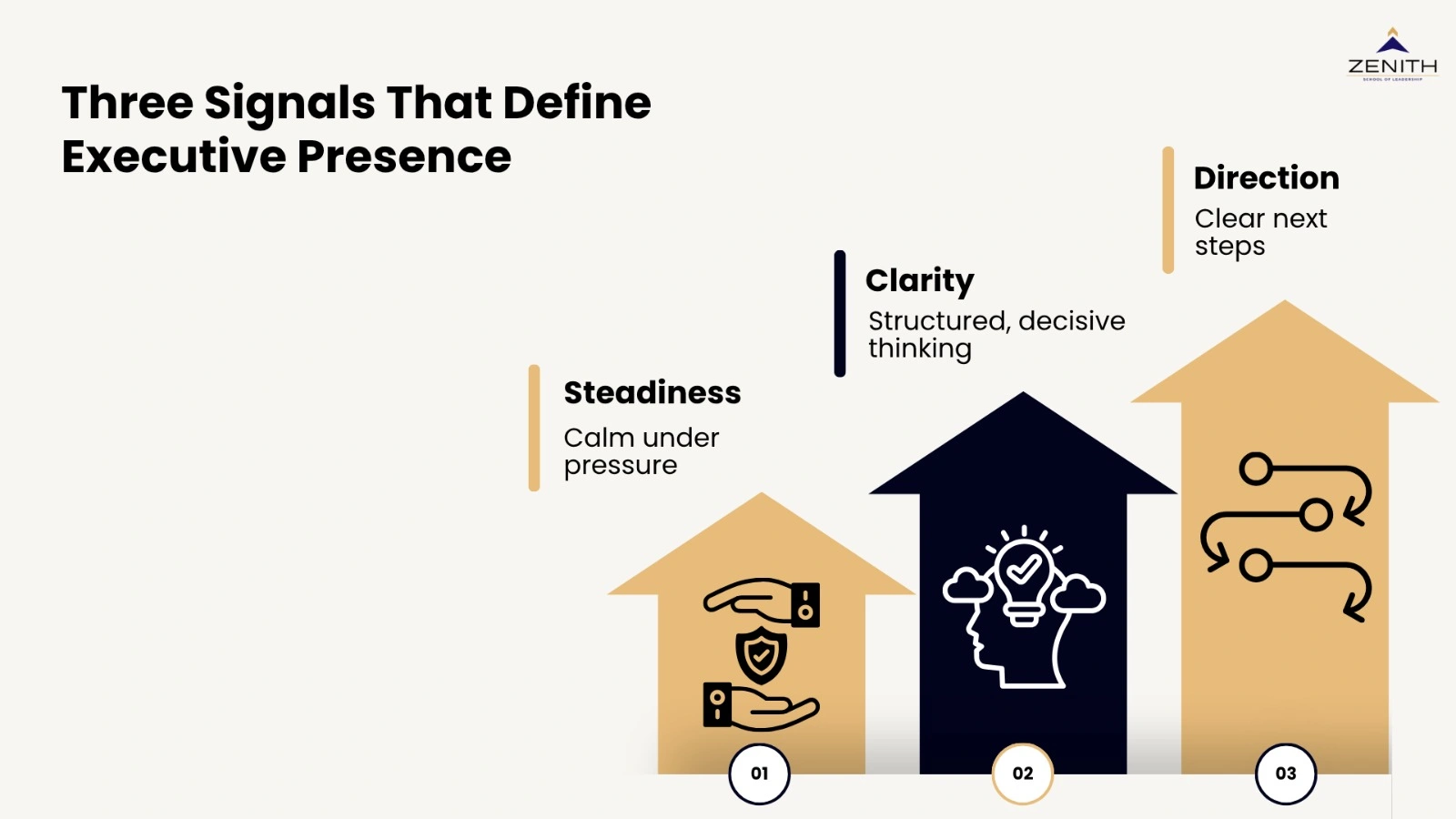
Instead of treating executive presence as a vague trait, it helps to understand it as three authority signals that people read through behavior.
1. Steadiness Under Pressure
This is the emotional signal.
People notice whether pressure changes your quality of presence. They observe whether challenge makes you reactive, defensive, scattered, or sharp in the wrong way. They also notice when someone remains composed without becoming cold.
This reflects strong executive presence qualities.
2. Clarity in Thought and Communication
This is the cognitive signal.
People do not experience authority only because you know a lot. They experience authority when your thinking helps them understand what matters, what the recommendation is, and why it deserves confidence.
This is a core part of executive presence communication.
3. Direction That Moves People Forward
This is the leadership signal.
Real authority helps people feel that there is a path forward.
This is where executive presence leadership skills become visible.
What Strengthens Executive Presence in Leadership Practice
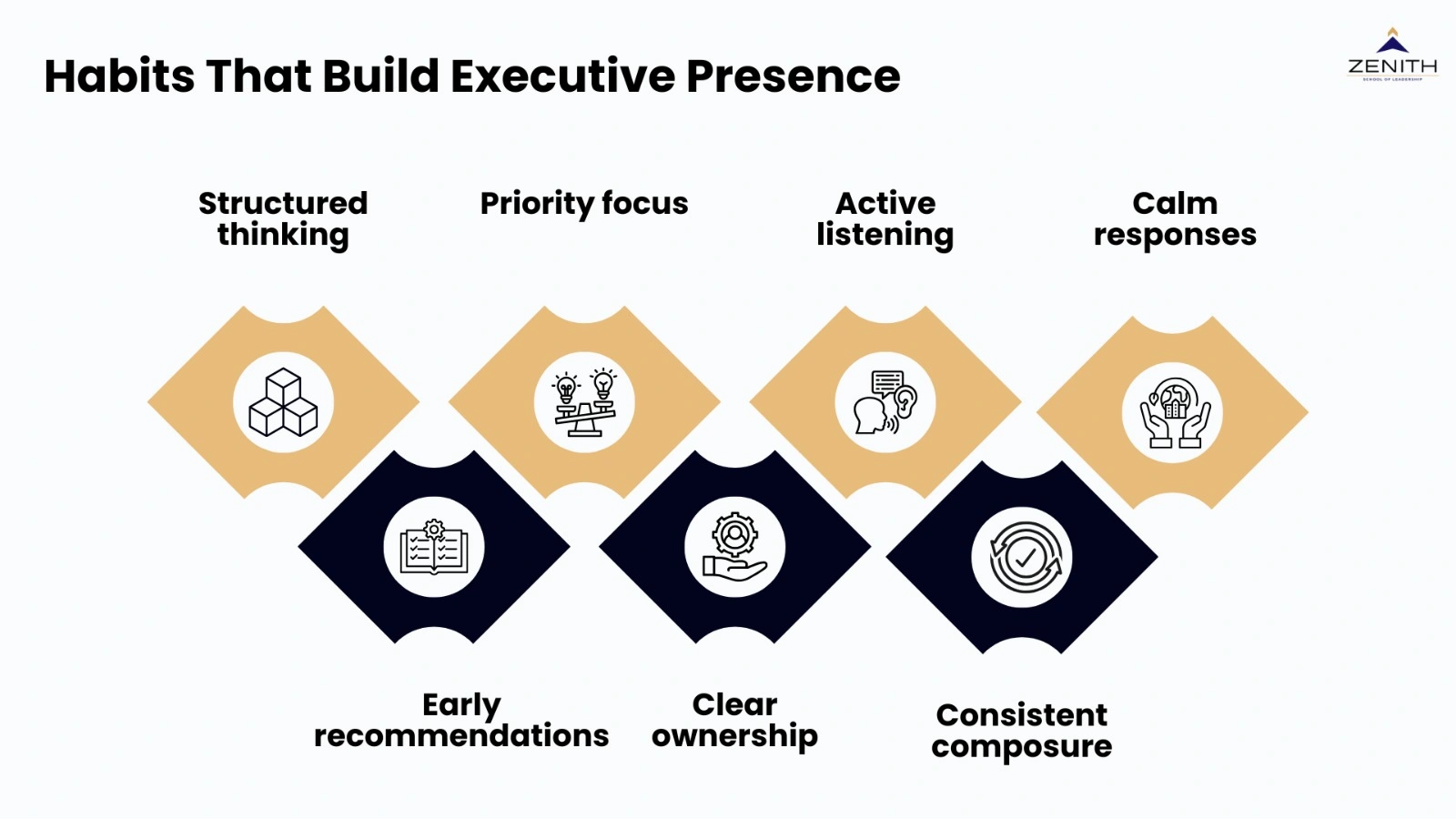
Executive presence is not built through image management. It is built through repeated leadership behaviors that make people experience you as credible.
What strengthens it most:
- Entering important discussions with your thinking already structured
- Stating the recommendation before getting lost in background detail
- Listening without becoming passive
- Responding to challenge without sounding threatened
- Bringing conversations back to priorities when they begin to drift
- Naming decisions, ownership, and next steps clearly
- Staying aligned in tone, message, and judgment even when pressure rises
These behaviors directly support how to improve executive presence at work.
What Weakens Authority More Than Leaders Realize
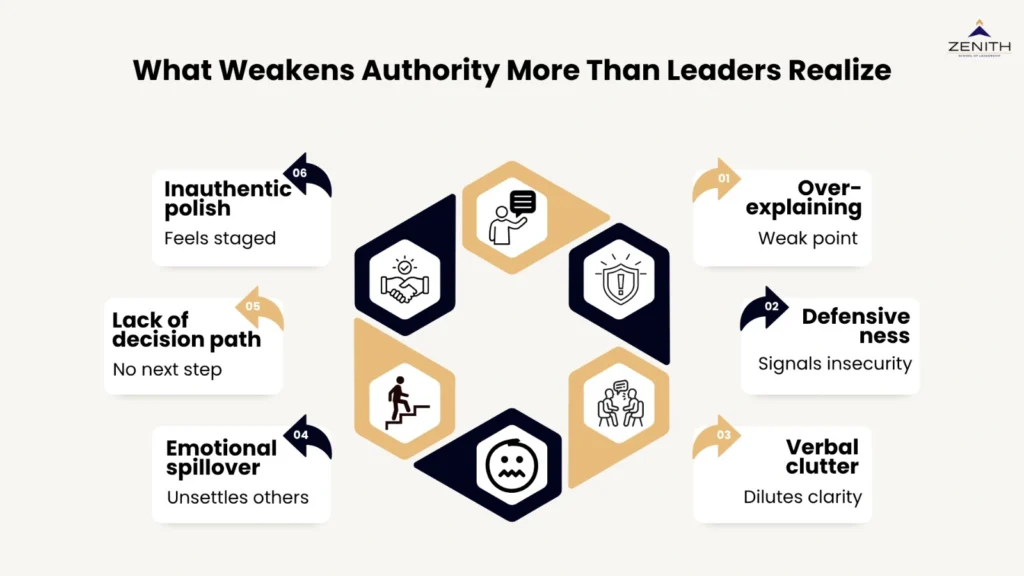
Executive presence is not only built by what you do well. It is also weakened by small patterns that quietly reduce how people experience you.
Watch out for these authority leaks:
- Over Explaining
When you give too much before giving the point, strong thinking can sound uncertain. - Defensiveness
When disagreement feels personal, expertise starts looking fragile. - Verbal Clutter
Too many qualifiers, too much softening, and too much justification weaken perceived decisiveness. - Emotional Spillover
Irritation, visible anxiety, impatience, or tension in tone can disturb people more than leaders realize. - Lack of Decision Path
Even a smart contribution loses strength when people still do not know what must happen next. - Inauthentic Polish
When communication sounds overly curated or disconnected from the leader’s real stance, people may admire it briefly but not trust it deeply.
These leaks do not always come from incompetence. Often they come from pressure, sincerity, perfectionism, or the desire to be thorough. But unless they are corrected, they slowly erode authority.
A Practical Discipline to Strengthen Executive Presence
Before any important leadership conversation, prepare these three points:
- What is the decision or direction that matters most here
- Why should people trust this thinking
- What needs to happen next
This is one of the simplest ways to develop executive presence.
Because it sharpens internal clarity before external scrutiny begins. It reduces rambling. It lowers unnecessary emotion. It helps you listen without losing your center. It makes your communication more intentional, more grounded, and more useful to others.
That is how leadership skills in management become visible as authority.
What Executive Presence Ultimately Signals
The outcome is not just that people think you speak well.
The real outcome is that people trust your judgment faster.
They feel clearer after hearing you.
They feel less scattered in difficult moments.
They understand what matters.
They know where to focus.
That is the real importance of executive presence.
What Separates Polish from Authority
Executive presence in leadership is not a performance layer added on top of leadership.
It is what people experience when leadership skills in management are fully embodied through steadiness, clarity, authenticity, and direction.
That is what strengthens authority at work.
Not just being heard.
Being trusted when it matters most.
Frequently Asked Questions About Executive Presence
Executive presence refers to a leader’s ability to inspire confidence through clear communication, emotional stability, and decisive thinking during professional interactions.
In the workplace, executive presence refers to the visible behaviors that signal leadership credibility — composure under pressure, clarity of communication, and the ability to guide decisions.
Leadership skills provide the behaviors that create executive presence. Communication clarity, decision-making capability, and emotional intelligence allow leaders to guide discussions effectively.
Yes. Executive presence develops through leadership practice, structured communication, and consistent decision-making behaviors rather than personality traits. Structured executive presence training and executive presence coaching both accelerate this development.
Managers improve leadership capability through experience, feedback, executive presence training, leadership development programs, and deliberate communication practice.
In senior leadership roles, executive presence often influences credibility and trust, which can impact career progression and leadership opportunities significantly.
Emotional intelligence allows leaders to manage reactions, understand group dynamics, and respond to challenges with composure — all of which are core executive presence qualities.
Yes. Executive presence for introverts depends on clarity and confidence rather than personality style. Introverted leaders often demonstrate strong presence through thoughtful, structured communication.
The key components of executive presence are emotional composure, clarity of thought, and directional authority — the three signals that shape how others experience leadership.
Professionals can practice executive presence by structuring their communication, preparing decisions in advance, guiding conversations toward outcomes, and using an executive presence self-assessment to track progress.
Executive presence and leadership presence are closely related. Leadership presence refers broadly to the impact a leader has on others. Executive presence typically refers to that same quality in senior organizational or boardroom contexts, often with added emphasis on gravitas, communication, and strategic credibility.
The executive presence pillars most commonly referenced are gravitas, communication, and appearance — as identified in foundational research — with increasing emphasis now placed on authenticity and inclusiveness as essential additional dimensions.
Table of Content
Read summarized version with
Some professionals have intelligence, experience, and strong intent, yet people still do not fully experience them as leadership.
Others may speak less, but the moment they do, people feel steadier. Their communication creates clarity. Their response under pressure reduces noise. Their presence makes others trust that someone thoughtful and capable is guiding the situation.
That difference is often called executive presence.
But executive presence is not image. It is not performative confidence. It is not about sounding impressive for a few minutes. It is the visible expression of deeper leadership skills in management. It is how people experience your judgment, emotional steadiness, and communication when the stakes are real.
Harvard Business Review notes that executive presence has traditionally been understood through three visible dimensions: gravitas, communication, and appearance. More recent discussion also shows that expectations are shifting, with greater importance now placed on authenticity, inclusiveness, and genuine respect.
That shift matters.
Because people no longer trust leadership only because someone appears polished. They trust leadership when they feel that the person in front of them is real, composed, thoughtful, and able to create confidence without relying on force.
Executive presence is your clarity staying steady when your status feels threatened.” - Gurleen
Why Executive Presence Matters More Than Many Leaders Realize
Leadership is not judged only by decisions. It is judged by how people feel in your presence while those decisions are being shaped, challenged, and communicated.
A leader may be intelligent, sincere, and hardworking. But if people leave important conversations feeling uncertain, overloaded, unconvinced, or emotionally unsettled, authority weakens even when the leader is technically right.
This is why leadership skills in management matter so deeply. They shape whether people experience direction or drift. They influence whether pressure creates confidence or confusion. They affect whether authority is quietly strengthened over time or slowly diluted in front of others.
Executive presence at work becomes especially visible in pressured moments. Not when everything is smooth, but when a recommendation is questioned, when priorities conflict, when disagreement enters the conversation, or when people begin looking for signs of who still has clarity.
In those moments, leadership is being read in real time.
Why Authenticity Has Become Central to Executive Presence
For many years, executive presence in leadership was interpreted too narrowly. It often rewarded polish without examining whether the leader felt trustworthy, grounded, or genuinely connected to the people around them.
That is changing.
Harvard Business Review’s updated discussion on executive presence points to authenticity and inclusiveness as increasingly important signals of leadership credibility. That makes executive presence far more than surface polish. It becomes a test of whether your communication feels aligned with your values, your judgment, and your actual leadership stance.
Authenticity does not mean saying everything you feel. It does not mean becoming casual, overly exposed, or emotionally unchecked.
Authenticity means people do not feel that you are performing leadership. They feel that you are inhabiting it.
That is why authenticity strengthens executive presence skills. It makes gravitas more believable. It makes communication more trustworthy. It makes authority feel earned rather than staged.
Executive Presence in Action
A strong example comes from Starbucks CEO Kevin Johnson during the 2018 Philadelphia store incident. What made that moment relevant was not simply that he apologized. It was the way leadership connected accountability with visible action. Starbucks announced that it would close more than 8,000 company owned stores in the United States for racial bias education, affecting nearly 175,000 employees.
That is what makes the example relevant here.
His authority did not come from sounding forceful or defensive. It came from acknowledging the issue directly, showing that leadership was listening, and backing words with a decision that signaled seriousness. People were not only hearing regret. They were seeing communication, responsibility, and follow through working together. That is executive presence in practice.
The Three Authority Signals People Read Immediately
Instead of treating executive presence as a vague trait, it helps to understand it as three authority signals that people read through behavior.
1. Steadiness Under Pressure
This is the emotional signal.
People notice whether pressure changes your quality of presence. They observe whether challenge makes you reactive, defensive, scattered, or sharp in the wrong way. They also notice when someone remains composed without becoming cold.
This reflects strong executive presence qualities.
2. Clarity in Thought and Communication
This is the cognitive signal.
People do not experience authority only because you know a lot. They experience authority when your thinking helps them understand what matters, what the recommendation is, and why it deserves confidence.
This is a core part of executive presence communication.
3. Direction That Moves People Forward
This is the leadership signal.
Real authority helps people feel that there is a path forward.
This is where executive presence leadership skills become visible.
What Strengthens Executive Presence in Leadership Practice
Executive presence is not built through image management. It is built through repeated leadership behaviors that make people experience you as credible.
What strengthens it most:
- Entering important discussions with your thinking already structured
• Stating the recommendation before getting lost in background detail
• Listening without becoming passive
• Responding to challenge without sounding threatened
• Bringing conversations back to priorities when they begin to drift
• Naming decisions, ownership, and next steps clearly
• Staying aligned in tone, message, and judgment even when pressure rises
These behaviors directly support how to improve executive presence at work.
What Weakens Authority More Than Leaders Realize
Executive presence is not only built by what you do well. It is also weakened by small patterns that quietly reduce how people experience you.
Watch out for these authority leaks:
- Over Explaining
When you give too much before giving the point, strong thinking can sound uncertain. - Defensiveness
When disagreement feels personal, expertise starts looking fragile. - Verbal Clutter
Too many qualifiers, too much softening, and too much justification weaken perceived decisiveness. - Emotional Spillover
Irritation, visible anxiety, impatience, or tension in tone can disturb people more than leaders realize. - Lack of Decision Path
Even a smart contribution loses strength when people still do not know what must happen next. - Inauthentic Polish
When communication sounds overly curated or disconnected from the leader’s real stance, people may admire it briefly but not trust it deeply.
These leaks do not always come from incompetence. Often they come from pressure, sincerity, perfectionism, or the desire to be thorough. But unless they are corrected, they slowly erode authority.
- Over Explaining
A Practical Discipline to Strengthen Executive Presence
Before any important leadership conversation, prepare these three points:
- What is the decision or direction that matters most here
• Why should people trust this thinking
• What needs to happen next
This is one of the simplest ways to develop executive presence.
Because it sharpens internal clarity before external scrutiny begins. It reduces rambling. It lowers unnecessary emotion. It helps you listen without losing your center. It makes your communication more intentional, more grounded, and more useful to others.
That is how leadership skills in management become visible as authority.
What Executive Presence Ultimately Signals
The outcome is not just that people think you speak well.
The real outcome is that people trust your judgment faster.
They feel clearer after hearing you.
They feel less scattered in difficult moments.
They understand what matters.
They know where to focus.
That is the real importance of executive presence.
What Separates Polish from Authority
Executive presence in leadership is not a performance layer added on top of leadership.
It is what people experience when leadership skills in management are fully embodied through steadiness, clarity, authenticity, and direction.
That is what strengthens authority at work.
Not just being heard.
Being trusted when it matters most.
Frequently Asked Questions About Executive Presence
Executive presence refers to a leader’s ability to inspire confidence through clear communication, emotional stability, and decisive thinking during professional interactions.
In the workplace, executive presence refers to the visible behaviors that signal leadership credibility — composure under pressure, clarity of communication, and the ability to guide decisions.
Leadership skills provide the behaviors that create executive presence. Communication clarity, decision-making capability, and emotional intelligence allow leaders to guide discussions effectively.
Yes. Executive presence develops through leadership practice, structured communication, and consistent decision-making behaviors rather than personality traits. Structured executive presence training and executive presence coaching both accelerate this development.
Managers improve leadership capability through experience, feedback, executive presence training, leadership development programs, and deliberate communication practice.
In senior leadership roles, executive presence often influences credibility and trust, which can impact career progression and leadership opportunities significantly.
Emotional intelligence allows leaders to manage reactions, understand group dynamics, and respond to challenges with composure — all of which are core executive presence qualities.
Yes. Executive presence for introverts depends on clarity and confidence rather than personality style. Introverted leaders often demonstrate strong presence through thoughtful, structured communication.
The key components of executive presence are emotional composure, clarity of thought, and directional authority — the three signals that shape how others experience leadership.
Professionals can practice executive presence by structuring their communication, preparing decisions in advance, guiding conversations toward outcomes, and using an executive presence self-assessment to track progress.
Executive presence and leadership presence are closely related. Leadership presence refers broadly to the impact a leader has on others. Executive presence typically refers to that same quality in senior organizational or boardroom contexts, often with added emphasis on gravitas, communication, and strategic credibility.
The executive presence pillars most commonly referenced are gravitas, communication, and appearance — as identified in foundational research — with increasing emphasis now placed on authenticity and inclusiveness as essential additional dimensions.