
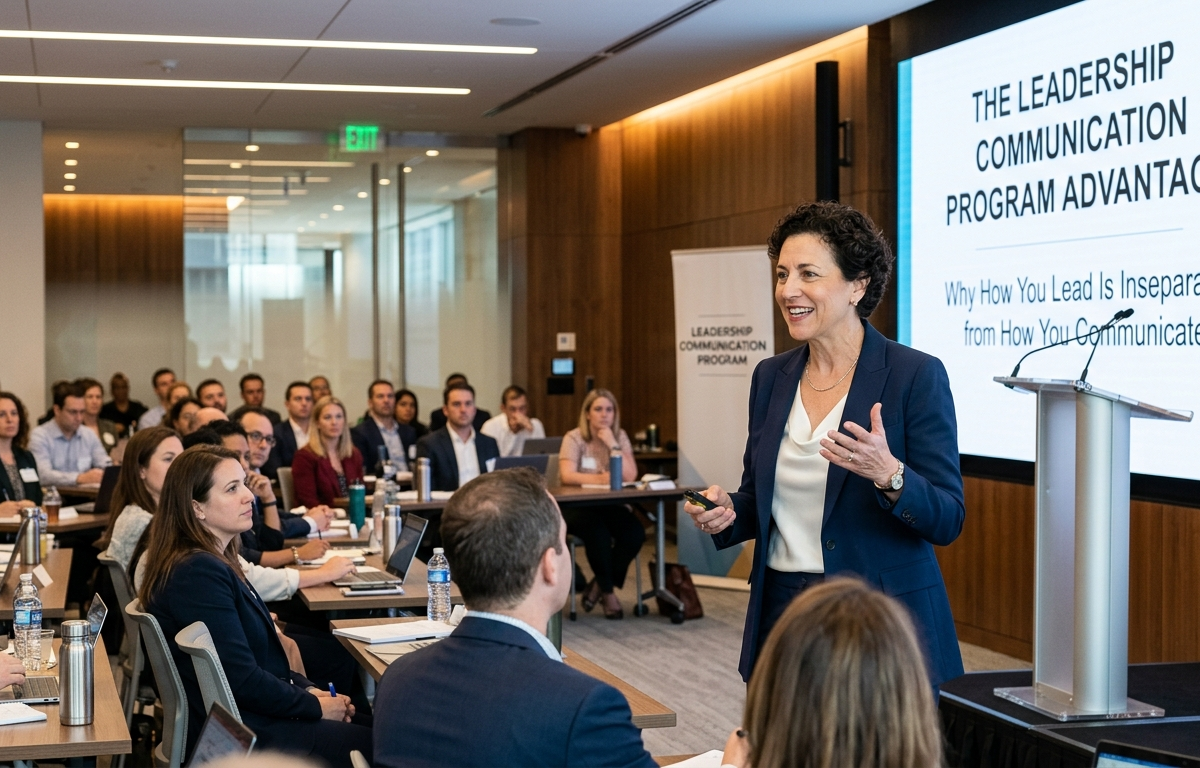
The Leadership Communication Program Advantage: Why How You Lead Is Inseparable from How You Communicate
If you have ever observed two leaders in similar roles-similar experience, similar technical knowledge, similar mandates-and wondered why one inspires extraordinary commitment while the other produces compliance at best, you have already intuited the central insight of leadership communication.
Leadership and communication are not separate disciplines. Leadership is expressed through communication. Every decision communicated, every vision articulated, every difficult truth delivered, every piece of recognition given, every conflict navigated-all of it is leadership happening through communication. And the quality of that communication determines the quality of the leadership.
This is why a leadership communication program is not supplementary to leadership development. It is leadership development, applied to its most fundamental and consequential dimension.
The Communication Demands of Modern Leadership
Leadership communication has always been important, but the demands have intensified significantly in the modern organizational context. Leaders today communicate across more channels, to more diverse audiences, under more scrutiny, with less tolerance for ambiguity or inauthenticity than at any point in organizational history.
They communicate strategy in formats that range from all-hands presentations to social media posts. They navigate stakeholder relationships across cultures, generations, and organizational levels. They deliver vision in moments of uncertainty, clarity in moments of complexity, and empathy in moments of organizational pain.
And they do all of this while managing their own pressures, their own uncertainty, and their own visibility in an environment where their communication is observable, archivable, and quotable in ways that previous generations of leaders never experienced.
The leaders who thrive in this environment are those who have developed a sophisticated, adaptive communication repertoire-not a single style, but a range of capabilities that can be deployed in service of whatever the leadership moment requires.
The Seven Communication Capabilities of Exceptional Leaders
In our work with senior professionals at Zenith School of Leadership, we have identified seven communication capabilities that consistently differentiate exceptional leaders from competent ones.
The first is Vision Communication-the ability to make the future vivid, specific, and emotionally resonant for people who are living in the present. Vision communication that works does not describe a destination; it makes people feel what it will be like to arrive there. It converts intellectual understanding into emotional commitment.
The second is Directional Clarity-the ability to translate complex strategy into clear, actionable guidance that enables independent decision-making throughout the organization. Leaders who communicate with directional clarity create organizations that can move without being managed at every step.
The third is Compassionate Directness-the ability to deliver difficult truths with honesty and care simultaneously. This is not about choosing between kindness and clarity. It is about developing the language and the emotional intelligence to hold both at once-to give people the information they need without the damage that unnecessary harshness creates.
The fourth is Inquiry Intelligence-the ability to ask questions that catalyze thinking rather than simply gather information. Great leadership questions open possibilities. They surface assumptions. They invite the kind of reflection that changes how people understand their own situations. This is one of the most undervalued communication skills in leadership.
The fifth is Narrative Fluency-the ability to move fluidly between data and story. Leaders who communicate through story and metaphor create meaning. Leaders who communicate through data alone create information. The most effective leaders do both-using data to ground the story in reality and story to make the data matter.
The sixth is Adaptive Communication-the ability to read a communication context and adjust style, tone, level of detail, and pace to serve the audience and the moment. This is not about being inauthentic; it is about having enough range that you can meet people where they are rather than requiring them to meet you where you are.
The seventh is Crisis Communication-the ability to lead through disruption with a communication posture that is calm, clear, and anchoring. In moments of organizational crisis or significant change, communication is not one tool among many. It is the primary leadership act. The leaders who handle crisis communication well often emerge with more trust than they had before.
Building a Leadership Communication Program
A genuine leadership communication program is not a series of communication workshops with leadership themes. It is a structured, immersive, feedback-intensive development experience that treats communication as the central expression of leadership and builds it with the same rigor that would be applied to strategy or financial acumen.
It requires honest assessment of current communication patterns and their organizational impact. It requires exposure to the full range of leadership communication challenges-not just the comfortable ones. It requires real-time feedback from skilled coaches who can see what the leader cannot see about their own communication. And it requires repeated practice under realistic pressure, so that new capabilities are built into default behavior rather than remaining conscious techniques that dissolve under stress.
At Zenith School of Leadership, our leadership communication programs are designed around these principles. We work with leaders who are already good and want to be exceptional-because we believe that at the level where leadership communication happens, the margin between good and exceptional is where extraordinary organizations are built.
The most important meeting you will ever lead, the most critical conversation you will ever have, the most pivotal message you will ever deliver-they all live in the domain of communication. Investing in that domain at the level it deserves is not a luxury. It is leadership.
