
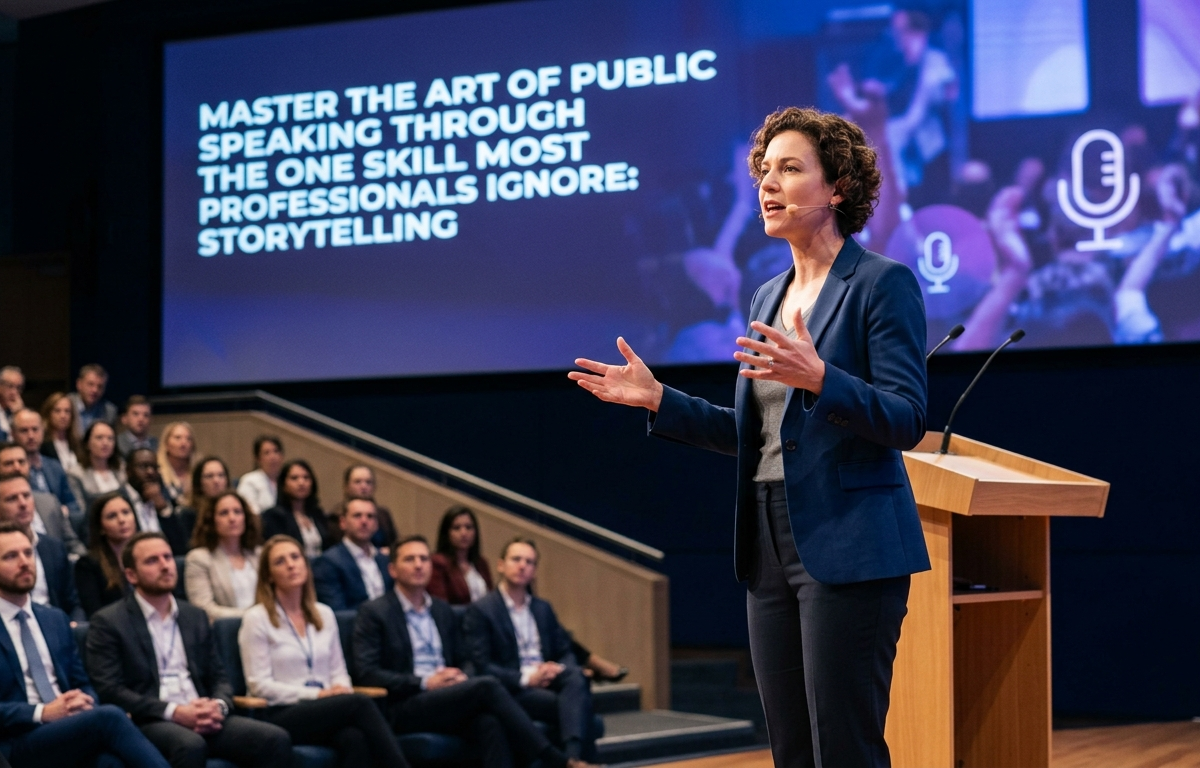
Master the Art of Public Speaking Through the One Skill Most Professionals Ignore: Storytelling
There is a presentation style that most professionals have perfected without realising it.
It sounds like this: “In Q3, we saw a 14% decline in engagement, driven primarily by a 22% increase in churn across the enterprise segment, compounded by a slowdown in new acquisition…”
The slide is full of numbers. The logic is airtight. The research is thorough.
And everyone in the room is secretly checking their phone.
This is not a content problem. The content is excellent. This is a communication problem – specifically, it is a story problem. And fixing it is the fastest, most reliable way for any professional to master the art of public speaking at a level that actually changes outcomes.
Why Storytelling Is the Most Underused Executive Skill
Most professionals think of storytelling as something for keynote speakers, marketers, and novelists. They associate it with entertainment – with performance – and they keep it at a careful distance from their “serious” professional communication.
This instinct is understandable. And it is costing them enormously.
Because here is what decades of research in cognitive science, communication psychology, and leadership effectiveness consistently confirm: the human brain is wired for story, not data. When we hear a story, our neural activity synchronises with the speaker’s. Our brains release oxytocin – a neurochemical associated with trust, connection, and motivation. We become more engaged, more receptive, and more likely to act on what we hear.
When we hear data alone, our analytical brain activates – sceptical, evaluative, and fundamentally passive. We process. We do not connect. And we do not act.
To truly master the art of public speaking – to move people, not just inform them – you must learn to lead with story.
What Storytelling in a Professional Context Actually Means
Let’s be precise about what storytelling in professional communication is not.
It is not anecdote-dropping to appear warm. It is not self-aggrandising narrative that buries the point. It is not distracting your audience with interesting tangents that have no connection to the decision you need them to make.
Professional storytelling is strategic narrative – the deliberate use of story structure to make your ideas more memorable, your data more emotionally resonant, and your ask more compelling. It is the difference between a presentation that informs and a presentation that moves.
Here is what it looks like in practice:
- Instead of: “Our customer satisfaction scores have dropped 18%.”
- You say: “I spoke to a customer last week who has been with us for seven years. She said something that stopped me cold: ‘I used to tell everyone about you. Now I tell people to look around before they commit.’ That 18% decline in our satisfaction scores is her voice, multiplied by thousands.”)
Same data. Radically different impact. The first informs. The second compels action.
The Architecture of a Powerful Story
Every story that moves people – whether it is a two-minute anecdote in a boardroom or a thirty-minute keynote – shares the same underlying structure. Understanding this structure is the core of any rigorous powerful storytelling workshop.
The Tension Point
Every powerful story begins with something at stake. Not context – stakes. What could be gained or lost? What problem is real and urgent? The tension is what makes the audience lean in.
The Human Element
Data represents populations. Stories represent people. The moment you attach a human face – a specific person, a real experience, a moment with emotional weight – to your point, your audience’s brain shifts from analytical to empathetic. That shift is where influence happens.
The Insight
A great professional story is not just compelling – it illuminates. It takes your audience from where they are to where you need them to be by helping them see something they had not seen before. The story is the vehicle. The insight is the destination.
The Call to Significance
The most powerful closing move in professional storytelling is not a call to action – it is a call to significance. Help your audience understand that the decision they are being asked to make matters beyond the spreadsheet. That it affects real people, real outcomes, real futures. This is where conviction converts.
Why a Powerful Storytelling Workshop Transforms Speakers
Reading about storytelling helps. Watching examples helps. But neither of these produces the transformation that a rigorously designed powerful storytelling workshop delivers.
The reason is simple: storytelling is a performance skill, not an intellectual one. You cannot think your way to being a powerful storyteller. You have to practise – repeatedly, in environments that push you beyond the comfortable version of your communication and give you specific, actionable feedback on what is working and what is not.
A great workshop creates the space for exactly this kind of practice. Participants find their own stories – from their professional experience, their personal history, their observations of the world – and learn to shape them into vehicles for the ideas they most need to communicate. They practise in front of peers and coaches. They receive structured feedback. They refine. They practise again. And they leave not just knowing how to tell stories, but having actually told them – having felt the difference it makes to a room when a story lands.
How Storytelling Helps You Master Public Speaking at Every Level
Storytelling is not just a presentation technique. When you integrate story into your public speaking, it changes your entire relationship with the audience and the material.
- It reduces performance anxiety: because you are no longer performing a script – you are sharing something you know deeply and personally, which is far less frightening than trying to remember data points
- It creates genuine connection: audiences respond to authenticity, and a personal story is the most authentic communication any professional can offer
- It makes you memorable: people forget statistics within minutes; they remember the story about the seven-year customer for weeks
- It makes your ideas actionable: because the emotional resonance of a story motivates behaviour in ways that data alone cannot
All of this is why storytelling sits at the heart of how to truly master the art of public speaking – not as an add-on, but as the core of the craft.
Developing Your Story Voice at Zenith School of Leadership
At Zenith School of Leadership, storytelling is not a module we teach. It is a language we develop. Across our programs – from Communication Intelligence to Executive Presence coaching – we help professionals discover, shape, and deliver the stories that are uniquely theirs.
Our approach recognises that every professional already has a rich inventory of stories – experiences that have shaped their thinking, challenges that have revealed their character, observations that illuminate the ideas they most want to share. The work is not inventing stories. It is learning to surface them, shape them, and deploy them with precision and confidence.
If you are ready to master the art of public speaking through the transformative power of story, Zenith School of Leadership is where that journey begins.
